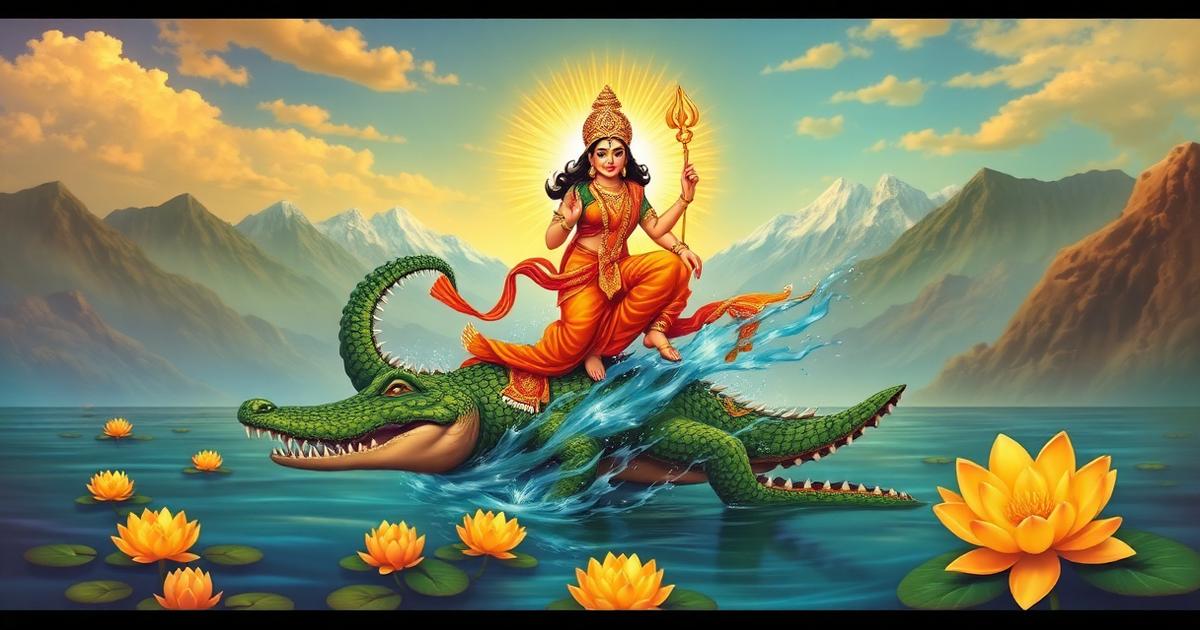
Who Chhathi Maiya Is
Chhathi Maiya is the goddess to whom the Chhath vrat is dedicated, worshipped mainly across Bihar, Jharkhand, eastern Uttar Pradesh and the Nepal Terai, and now wherever families from those regions have settled.
Two identities are held together in her devotion, and devotees rarely feel a need to separate them:
- Devi Shashthi, the goddess of the sixth day, invoked in the Puranas as the protector of newborn children and the deity honoured on the sixth night after a birth. The word chhath itself means sixth, and the Chhath vrat falls on the sixth tithi of Kartik Shukla Paksha.
- The sister of Surya Dev, as folk songs describe her. This is why the vrat is offered to the sun while the songs address her, and why the two are never worshipped separately during Chhath.
In most Hindu traditions a goddess is approached through a murti in a garbhagriha. Chhathi Maiya is approached at a riverbank, at sunrise and sunset, with arghya raised to the sky. She is one of the very few major deities in India worshipped almost entirely outdoors.
The Kathas Told About Her
Several kathas circulate together in the Chhath belt, and different families keep different ones.
The Shashthi katha. In the Puranic account, Devi Shashthi is a form of the divine mother who presides over childbirth and infancy. A king who lost his children is said to have been advised to worship her, and the child born after that vrat survived, which is why she is invoked for santan and for the health of children.
The Karna katha. Karna, son of Surya, is remembered as a devotee who stood in water offering arghya to his father every morning. Anga desh, his kingdom, corresponds to the Bhagalpur and Munger region, and local memory ties the Chhath practice to him.
The Draupadi katha. During the Pandavas' exile, Draupadi is said to have kept a sun vrat on the advice of a rishi for the return of the kingdom and the wellbeing of her family. Many Chhath songs still mention her.
The Sita katha. In Munger, tradition holds that Sita kept Chhath after returning from Lanka, and the Sita Charan temple there is linked to it.
The kathas differ, but the request in all of them is the same: protection of children, health of the family and the restoration of what was lost.
How She Is Worshipped: Four Days, No Priest
Chhath is kept over four days, and every step belongs to the vrati rather than to a temple.
- Nahay Khay - the vrati bathes, cleans the kitchen completely and eats one satvik meal, usually arwa rice, chana dal and lauki, cooked without onion or garlic
- Kharna - a day long fast broken after sunset with kheer made of gud and rice, roti and fruit, shared as prasad with the whole neighbourhood
- Sandhya Arghya - the vrati stands in the river or pond at sunset and offers arghya to the setting sun, holding a soop filled with thekua, sugarcane, coconut, banana and seasonal fruit
- Usha Arghya - the same offering at sunrise the next morning, after which the fast is broken with ginger and water
Between Kharna and Usha Arghya the vrati keeps a nirjala fast for roughly thirty six hours. There is no mantra to be learnt from a book. The songs carry the ritual, sung by women in Bhojpuri, Magahi and Maithili, addressing Chhathi Maiya directly and often teasingly, as one would address a member of the family.
What Is Offered and Why It Matters

The Chhath offering list is unusually strict, and every item has a reason behind it.
- Thekua - wheat flour, gud and ghee, deep fried. It keeps for days without spoiling, which mattered when families walked long distances to the ghat.
- Daura and soop - bamboo baskets and winnowing fans, made by hand. Using bamboo rather than metal keeps the offering close to the earth and to the artisan who made it.
- Sugarcane, thekua, coconut, banana, sweet lime, radish and turmeric with leaves - all seasonal and locally grown, nothing imported and nothing out of season.
- Kosi bharai - lit earthen lamps arranged under a canopy of sugarcane stalks, kept by families who have made a vow, usually after the birth of a child or a marriage.
A quiet feature of Chhath is that purity here is about cleanliness and intention rather than about who does the work. The vrati cooks the prasad themselves, on a fresh mud stove using mango wood, and the ghat belongs to everyone who reaches it. Chhath is widely observed as a festival where families of every background stand in the same water at the same hour.
Where She Is Worshipped and the Rare Temples
Because Chhathi Maiya is worshipped at water, her sacred geography is made of ghats rather than temples.
- Patna's Ganga ghats - the largest concentration of Chhath vratis anywhere, with Deegha, Collectorate and Gandhi Ghat filling from before dawn
- Deo Surya Mandir, Aurangabad - one of the oldest sun temples in the region and the site of a huge Chhath mela
- Baragaon, Nalanda and Ulaar, Patna district - old Surya shrines where Chhath crowds gather
- Munger's Sita Charan - tied to the Sita katha of Chhath
- Chhathi Maiya than - small platforms under a tree in villages, where the family's Chhath vow is registered and repeated year after year
The festival now travels with people. Delhi's Yamuna ghats, artificial ponds in Mumbai and Surat, and community ghats in Kolkata, Dubai and Mauritius all see arghya offered on the same two mornings. A vrati far from home will still face the same sun at the same moment as one standing in the Ganga.
Keeping Her Worship If You Are Away From a River
Families outside the Chhath belt often ask whether the vrat can be kept without a river. Tradition is practical about this.
- A clean artificial pond, society tank or large tub is accepted in cities. What matters is standing in water and facing the sun directly.
- The arghya timings follow local sunset and sunrise, not Patna's. Check your own city's timings for the two days.
- Prasad must be cooked at home by the vrati or by a family member keeping the same discipline, in a kitchen cleaned beforehand, without onion, garlic or tasting while cooking.
- If someone in the family cannot fast for health reasons, they can still participate by helping with the daura, cleaning the ghat area, or singing the Chhath geet. The vrat allows only one vrati per household to carry the fast.
- Those who cannot keep the full nirjala fast may keep a Chhathi Maiya vow of service instead, such as feeding children or offering fruit at a ghat, which the tradition treats as sincere rather than second best.
The underlying instruction of Chhath is simple. Stand where the light reaches you, offer what your own hands prepared, and ask for the wellbeing of the household rather than for yourself.
Frequently Asked Questions
Who exactly is Chhathi Maiya?+
She is worshipped as Devi Shashthi, the goddess of the sixth day who protects newborn children, and in folk devotion as the sister of Surya Dev. Both identities are held together during Chhath, when arghya is offered to the sun while the songs address her.
Why does Chhath have no priest or temple ritual?+
The vrat is kept directly by the devotee. The vrati cooks the prasad, carries the daura, stands in the water and offers arghya without an intermediary, which is why Chhath is often described as the most personal of the large Hindu festivals.
Can men keep the Chhath vrat for Chhathi Maiya?+
Yes. Although the vrat is most often kept by women, men keep it too, and in many families the vrat passes to a son or husband when needed. The rules of fasting and purity are the same for both.
What is offered to Chhathi Maiya in the soop?+
Thekua, sugarcane, coconut, banana, sweet lime, radish, turmeric with leaves and other seasonal produce, arranged in a bamboo soop and daura. Everything is local, seasonal and prepared at home by the vrati.
How many times a year is Chhathi Maiya worshipped?+
Twice. Kartik Chhath, a few days after Diwali, is the larger observance, and Chaiti Chhath in the spring month of Chaitra is kept by a smaller number of families with the same four day structure.
Can Chhath be kept in a city without a river?+
Yes. Clean artificial ponds, society tanks or even a large tub at home are accepted, since the essential act is standing in water and offering arghya to the sun at local sunset and sunrise timings.
About the author
Pandit Mahesh Trivedi · Festival Traditions & Panchang
Pandit Mahesh leads the festival-date and Panchang content on Vandnaa. He cross-references multiple regional panchangs (Drik, Vaishnava, Bengali, Marathi) for every festival date published on the site.
Meet the Vandnaa editorial team →