
The Presiding Devi of Cuttack
Cuttack Chandi, worshipped as Maa Katak Chandi, is the presiding deity of Cuttack, Odisha's old capital and its second city.
What is there:
- The Devi in the sanctum, worshipped in a four armed form, with the temple located near the Mahanadi
- A temple complex that has been rebuilt and extended over time
- Subsidiary shrines within the compound
- A position in the heart of the old city, with the lanes around it given over to flower and prasad sellers
The Devi is understood as the Ishta Devi of the city, the deity to whom Cuttack belongs. That relationship is not abstract. Businesses open with her name, families bring newborns for first darshan, students come before examinations, and the city's biggest annual event is her Durga Puja.
Odisha's religious life is dominated nationally by Jagannath at Puri, and Cuttack Chandi is comparatively unknown outside the state. Within Odisha, and particularly in Cuttack, she is central.
The Sixteen Day Durga Puja
What sets Cuttack Chandi apart is the length of its Durga Puja.
- Where most Durga Pujas run through Shashthi to Dashami, roughly five days, the observance here runs for sixteen days
- It begins on Mulashtami, in the dark fortnight preceding Navratri, and continues through Navratri to Vijayadashami
- Each day has its own rites, and the Devi is presented in a different form through the sequence
- The final days follow the standard Durga Puja pattern with Ashtami, Sandhi Puja, Navami and Dashami
The city's whole calendar bends around it. Cuttack's Durga Puja is among the largest in eastern India outside Kolkata, with the pandals of the city's puja committees running alongside the temple observance.
What distinguishes Cuttack's pandals is the silver and gold filigree medha, the backdrop behind the deity, made by the city's own craftsmen.
Cuttack has been a centre of tarakasi, silver filigree work, for centuries, and the puja committees commission enormous filigree backdrops that take months to make and represent a substantial part of the city's craft economy. Some of these medhas are decades old and are brought out each year.
Daily Worship
Outside the puja season, the temple runs as the city's principal working shrine.
- Daily aarti and worship at fixed times, with the morning and evening drawing the largest attendance
- Offerings of flowers, sindoor, chunari, coconut and sweets
- Bhog prepared and distributed
- Tuesdays and Fridays as the days of heaviest local footfall
- Families bringing newborns for first darshan, and children for mundan
- Students, businesspeople and officials coming before examinations, ventures and postings
The temple also has a role in the civic life of Cuttack that goes beyond worship. Public occasions in the city are frequently marked at the temple, and the Devi's name appears in the naming of institutions, businesses and events across the district.
During Navratri and the sixteen day puja, the temple is at its busiest, with queues extending well beyond the compound and the city administration managing crowds and traffic through the period.
For a visitor, an ordinary morning gives you a working Odia temple: the ritual, the flower sellers, the queue of families and the aarti, without the scale of the festival.
Cuttack and Its Crafts
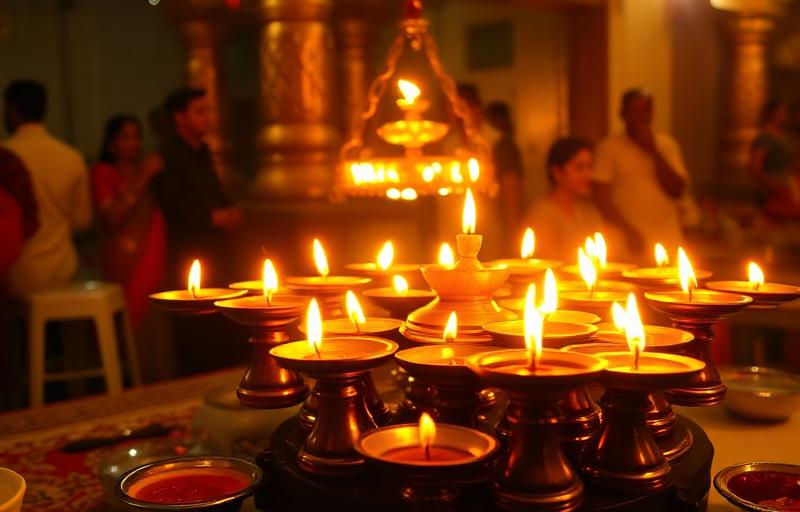
Understanding the temple means understanding the city, since the two are closely tied.
What Cuttack is:
- Odisha's old capital, founded in the medieval period at the junction of the Mahanadi and Kathajodi
- The state's commercial and legal centre, with the High Court and the older institutions
- A city of craft, particularly tarakasi, the silver filigree work for which it is known across India
- The site of Barabati fort, the medieval fortification of the Ganga and Gajapati periods
The filigree connection matters to the temple directly. The medhas of the Durga Puja are the largest expression of the craft, and the trade sustains a substantial number of families in the old city.
Other sites in and around Cuttack:
- Dhabaleswar, the island Shiva temple in the Mahanadi
- Barabati fort and the Cuttack ghats
- Netaji birthplace museum, in the house where Subhas Chandra Bose was born
- Bhubaneswar, about 30 km, with the great temple city of Lingaraj, Mukteswar and Rajarani
- Ratnagiri, Udayagiri and Lalitgiri, the Buddhist sites of the Assia hills, within a day trip
Cuttack works well as a base for the whole cluster, and the temple is a natural first stop.
The Devi Shrines of Odisha
Odisha's Shakta tradition is substantial and often overlooked because of the scale of Jagannath.
The principal Devi sites:
- Cuttack Chandi, the presiding Devi of Cuttack
- Biraja at Jajpur, an ancient and highly significant shrine
- Sarala Devi at Jhankad, associated with the poet Sarala Das
- Tara Tarini near Berhampur, on the Rushikulya, a major hill shrine
- Maa Tarini at Ghatgaon, whose name is on trucks and buses across the state
- Samaleswari at Sambalpur, the presiding Devi of western Odisha
- Bhattarika on the Mahanadi at Baramba
- Chausathi Jogini at Hirapur, the sixty four yogini temple
- Kichakeswari at Khiching in Mayurbhanj
What runs through them is a pattern seen across eastern India. Each region has its presiding Devi, each is treated as the owner of her territory, and the relationship is protective and local rather than doctrinal.
It is also worth noting the relationship with Jagannath. In Odia tradition the Devi shrines and the Jagannath tradition are not in competition. Vimala, within the Puri temple itself, is a Shakta shrine of great significance, and the mahaprasad of Jagannath is offered to her before it is distributed.
Visiting the Temple
Practical notes.
Getting there
- The temple is in the old city of Cuttack, near the Mahanadi
- Cuttack Junction is a major railway station on the Howrah to Chennai line
- Bhubaneswar airport is about 30 km away
- Autos run throughout the city and the temple is known to every driver
When to go
- The sixteen day Durga Puja, from Mulashtami through Vijayadashami, the city's greatest occasion
- Chaitra Navratri, the spring observance
- Tuesdays and Fridays through the year for the weekly rhythm
- Ordinary mornings for a calm darshan
At the temple
- Offerings are flowers, sindoor, chunari, coconut and sweets, sold in the lanes outside
- Dress modestly and remove footwear at the designated place
- Follow the queue arrangements during Durga Puja, which are strictly managed
- Photography restrictions may apply in the sanctum
During Durga Puja
- The city is extremely crowded, with pandal hopping running through the nights
- See the silver filigree medhas, which are what makes Cuttack's puja distinctive
- Book accommodation well ahead, since the city fills
- Expect traffic restrictions and plan to walk
A closing suggestion. If you can time a visit for the Durga Puja, do. Cuttack's silver medhas are unlike anything at any other puja in India, and they exist because a temple and a craft grew up in the same city and have been working together for a very long time.
What People Ask Most
Who is Maa Katak Chandi?+
The presiding Devi of Cuttack, Odisha's old capital, worshipped in a four armed form in a temple near the Mahanadi. She is understood as the Ishta Devi of the city, and businesses, families and institutions across the district are associated with her name.
Why does the Durga Puja here last sixteen days?+
The observance at Cuttack Chandi begins on Mulashtami in the dark fortnight preceding Navratri and continues through Navratri to Vijayadashami, with each day having its own rites and the Devi presented in a different form through the sequence.
What are Cuttack's silver medhas?+
The silver and gold filigree backdrops placed behind the deity in the city's Durga Puja pandals, made by Cuttack's own tarakasi craftsmen. They take months to make, represent a substantial part of the city's craft economy, and some are decades old and brought out each year.
When is the temple busiest?+
Through the sixteen day Durga Puja from Mulashtami to Vijayadashami, and during Chaitra Navratri. Tuesdays and Fridays draw the heaviest weekly footfall, while ordinary mornings are calm.
How do you reach the temple?+
It is in the old city of Cuttack near the Mahanadi. Cuttack Junction on the Howrah to Chennai line serves the city, Bhubaneswar airport is about 30 km away, and autos run throughout the city.
What else is worth seeing around Cuttack?+
Dhabaleswar the island Shiva temple in the Mahanadi, Barabati fort and the Cuttack ghats, the Netaji birthplace museum, Bhubaneswar about 30 km away with Lingaraj and Mukteswar, and the Buddhist sites of Ratnagiri, Udayagiri and Lalitgiri within a day trip.
About the author
Pandit Mahesh Trivedi · Festival Traditions & Panchang
Pandit Mahesh leads the festival-date and Panchang content on Vandnaa. He cross-references multiple regional panchangs (Drik, Vaishnava, Bengali, Marathi) for every festival date published on the site.
Meet the Vandnaa editorial team →Explore on Vandnaa
Related Articles

Dhabaleswar: The Shiva on an Island in the Mahanadi
7 min read
Budhi Thakurani: The Goddess Berhampur Sends Home to Her Father Every Two Years
8 min read
Maa Tarini of Ghatgaon: The Goddess Whose Name Is Painted on Odisha's Trucks
8 min read
Chausathi Jogini at Hirapur: A Roofless Circle of Sixty Four Goddesses
8 min read