The Goddess on Every Windscreen
Maa Tarini is worshipped at Ghatgaon, in Keonjhar district of Odisha, in a temple set in forest country on the road between Keonjhar and Panikoili.
Her name means the one who ferries across, the same root as tarini elsewhere in India, and she is approached as the goddess who takes a devotee through what they cannot cross alone.
What makes her devotion immediately visible in Odisha is where her name appears. It is painted on the back of trucks, buses, autorickshaws and taxis across the state, on shop shutters, on tools and on the walls of workshops. In a state with many important shrines, hers is the name that travels on the road.
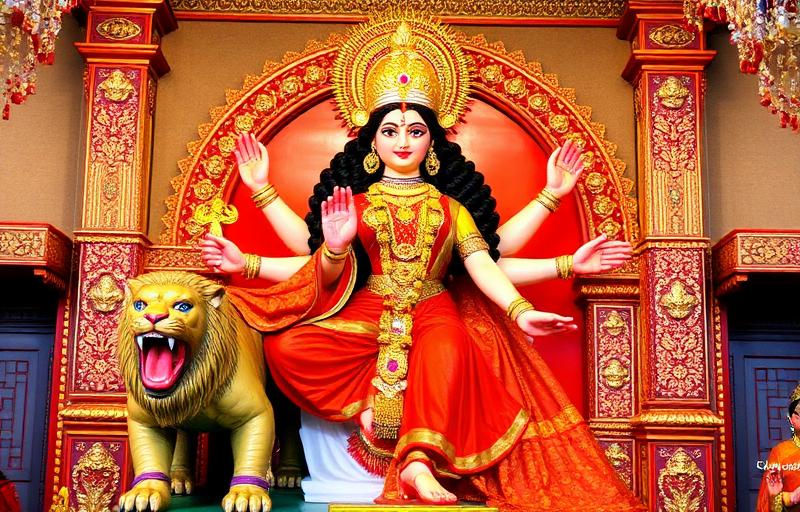
Her form in the sanctum is unusual as well. She is worshipped not as a full figure but as a face, covered in vermilion, with large eyes, and the deep red of the sindoor is what devotees describe when they talk about her darshan.
Her following cuts across the state:
- Drivers and transport workers, for whom she is the deity of the road
- Families across Keonjhar, Jajpur, Bhadrak and beyond, who bring newborn children and complete mundan here
- Devotees who make vows for employment, health, marriage and matters that have stalled
- Odias settled outside the state, who carry her name and images with them
The Katha of the Devotee Who Looked Back
The katha of how the goddess came to Ghatgaon is one of the best known stories in Odisha, and it explains why the temple stands where it does, in forest country rather than in a town.
In the telling, a devotee, described in different versions as a craftsman or a temple servant, had worshipped the goddess for years and asked her to come with him to his own place.
She agreed, on one condition. She would follow behind him, and he must not look back until they arrived. As long as he heard the sound of her anklets, he would know she was with him.
He set out, and the sound followed. Then, at Ghatgaon, in the middle of forest, the sound stopped, or he thought it had. He turned around.
And she stayed there.
The temple stands at exactly that point. What devotees take from the katha:
- The goddess chose to be reached rather than possessed. She could have gone anywhere, and where she stopped is where people must come.
- The failure was doubt, not disobedience. He looked back because he stopped hearing her, which is the most human thing in the story.
- Her presence is conditional on trust, which is exactly what devotees invoke when they set out on a road with her name on the vehicle
Similar stories are told across India about deities who agreed to follow and stopped when looked at. Odisha's version is unusually specific in what it produced: a temple in the forest, on a road, worshipped above all by people who travel.
The Coconut Offering
The offering that defines Ghatgaon is the coconut, and the scale of it is difficult to convey without seeing it.
Devotees offer coconuts in enormous numbers, and the temple receives them continuously. Several practices have grown around this:
- Devotees who cannot travel send coconuts with relatives, neighbours or drivers heading that way, and the offering is made on their behalf
- Drivers passing on the road stop to offer, and vehicles carrying coconuts for other devotees are common
- Devotees offer from a distance where the crowd does not allow reaching the shrine, throwing the coconut toward the temple in the direction of the deity
- Coconuts offered are afterwards handled by the temple, and the sheer quantity has made the offering itself part of Ghatgaon's identity
The practice of sending an offering with a traveller is worth noting. It creates a chain of trust that fits the goddess exactly. A devotee in Bhubaneswar hands a coconut to a driver they may not know, and it reaches the shrine because that is understood as the driver's own devotion as much as theirs.
Alongside coconuts, devotees offer chunri, sindoor, sweets, incense and cash, and mundan for children is performed here in large numbers. The Tuesday is the main day of the week, and the temple is busiest through Chaitra and during the Navratri periods.
Why Drivers Carry Her Name
The association between Maa Tarini and Odisha's drivers is the most visible feature of her devotion, and it makes sense on several levels.
- Her name means the one who ferries across. For someone whose work is moving people and goods safely from one place to another, that is not a metaphor.
- The temple is on the road, in forest country, where drivers actually pass rather than in a town they would have to detour into
- The offering suits the work. A coconut can be bought at a roadside stall, offered in a few minutes and does not require the driver to leave the vehicle for long.
- The trade is dangerous. Long distance driving in India carries real risk, and a deity of safe passage answers a daily concern rather than an occasional one.
- It is collective. Transport unions, fleet owners and workshops keep her image, and a new vehicle in Odisha is very often taken for darshan or blessed with her name before it goes into service.
This pattern is not unique to Odisha. Across India, transport workers keep specific deities, and vehicle shrines are one of the most widespread and least documented forms of contemporary Hindu practice.
What is distinctive at Ghatgaon is the completeness of it. In Odisha, Maa Tarini is not one of several deities drivers might name. She is the one, to the point that the two words on the back of a truck are read as a statement of where the vehicle comes from as much as of what the driver believes.
The Temple in the Forest
Ghatgaon is a small place, and the temple's setting is a large part of its character.
- The shrine stands in Keonjhar district, in a forested belt, on the road linking Keonjhar with Panikoili and the coastal districts
- The temple itself is modest in scale compared to Odisha's great temples, and the crowds are far larger than the structure suggests
- Facilities have expanded over the years to handle the volume of devotees, with queue arrangements during peak periods
- The area around the temple has the character of a highway shrine town, with stalls selling coconuts, sindoor, chunri and prasad
The forest setting is not incidental to how devotees understand her. She stopped in the forest rather than continuing to a town, and Odisha's Devi traditions are full of goddesses associated with forests, hills and the edges of settlement rather than with urban centres.
Keonjhar district itself is mining and forest country, and the devotion at Ghatgaon draws heavily on the working population of that landscape: miners, transporters, forest workers and farmers. That is a different congregation from the one at a major coastal temple, and the atmosphere at Ghatgaon reflects it.
The main occasions are Tuesdays through the year, the Chaitra period, and Navratri in both Chaitra and Ashwin, when the temple sees its largest gatherings.
Visiting Ghatgaon
Ghatgaon is straightforward to reach and is usually visited on the way to or from Keonjhar.
- Location - Ghatgaon, Keonjhar district, Odisha, on the Keonjhar to Panikoili road
- Nearest hubs - Keonjhar town, with Bhubaneswar around four hours away by road and Cuttack and Jajpur closer
- Best time - October to March. Tuesdays and the Chaitra and Navratri periods are the busiest.
- What to carry - coconuts, which are sold in quantity at the stalls outside, along with chunri, sindoor and sweets
- With children - mundan is performed here in large numbers and arrangements exist at the temple
- Etiquette - remove footwear, follow the queue system on busy days, and do not photograph inside the sanctum
Odisha's wider Devi circuit can be built around this visit. Biraja at Jajpur, the Shakti Peeth of the state, is on the way toward the coast. Maa Mangala at Kakatpur and Sarala at Jhankad lie further south. Samaleswari at Sambalpur is a separate trip into western Odisha, and Tara Tarini in Ganjam is in the far south of the state.
One practical note that fits this particular deity. If you are driving in Odisha and someone at a stall or a dhaba asks you to carry a coconut to Ghatgaon, that is the tradition described in this article. It is a normal request, it is made in good faith, and taking it is considered an act of devotion in itself.
Reader Questions Answered
Who is Maa Tarini?+
Maa Tarini is the goddess worshipped at Ghatgaon in Keonjhar district, Odisha. Her name means the one who ferries across, and she is worshipped in the form of a face covered in vermilion rather than as a full figure.
Why do drivers in Odisha write Maa Tarini on their vehicles?+
Because her name means the one who ferries across, which matches the work of moving people and goods safely. Her temple stands on the road in forest country, the coconut offering suits a short stop, and transport workers across the state keep her as the deity of safe passage.
What is the katha of Ghatgaon?+
A devotee asked the goddess to come with him, and she agreed on the condition that he not look back until they arrived, following him by the sound of her anklets. At Ghatgaon the sound seemed to stop, he turned around, and she remained there. The temple stands at that spot.
Why are coconuts offered at Ghatgaon?+
The coconut is the characteristic offering here and arrives in enormous numbers. Devotees who cannot travel send coconuts with relatives or with drivers heading that way, and the offering is made on their behalf.
Which day is best for darshan at Ghatgaon?+
Tuesday is the main day of the week, and the Chaitra period along with Navratri in both Chaitra and Ashwin brings the largest crowds. October to March is the most comfortable season for travel.
Is Maa Tarini of Ghatgaon the same as Tara Tarini in Ganjam?+
No, they are different shrines. Tara Tarini is the twin goddess shrine on the Kumari hills above the Rushikulya in Ganjam district, while Maa Tarini is worshipped at Ghatgaon in Keonjhar district in the north of the state.
About the author
Anjali Mehta · Editor, M.A. Religious Studies
Anjali is the managing editor for Vandnaa and oversees the festival and vrat coverage. She holds an M.A. in Religious Studies and reviews every published article for accuracy, accessibility, and tradition-fidelity.
Meet the Vandnaa editorial team →