The Temple of Ma Bhavatarini
The Dakshineswar Kali Temple stands on the eastern bank of the Ganga (Hooghly) just north of Kolkata, in West Bengal. It is dedicated to Goddess Kali in her form as Ma Bhavatarini - 'the Mother who carries her devotees across the ocean of worldly existence (bhava)'.
The temple was built in 1855 by Rani Rashmoni, a great devotee and philanthropist, who is said to have been inspired by a vision of the Divine Mother. The grand temple complex, in traditional Bengal architecture, houses the main shrine of Ma Bhavatarini along with a row of Shiva temples and a Radha-Krishna temple. Beyond its beauty and history, Dakshineswar is world-renowned as the place where the great saint Sri Ramakrishna Paramahamsa served as a priest and experienced his profound realisations of the Divine Mother, making it one of the most spiritually charged shrines in India.
Sri Ramakrishna & the Divine Mother
Dakshineswar is inseparable from the life of Sri Ramakrishna Paramahamsa (1836-1886), one of the greatest saints of modern India:
- Priest of the Mother: As a young priest at Dakshineswar, Ramakrishna worshipped Ma Kali not as a mere idol but as the living Divine Mother, longing for her direct vision with a child's intensity.
- Vision of the Mother: After deep, tearful longing, he is said to have received the direct, overwhelming vision of Ma Kali, and thereafter lived in constant communion with her.
- Universal realisation: From Dakshineswar, Ramakrishna practised the paths of many traditions and taught that all sincere paths lead to the one God - a message of harmony that inspired millions.
- A spiritual fountainhead: His disciple Swami Vivekananda and the Ramakrishna Movement carried this message across the world, and Dakshineswar remains a living centre of that devotion.
To visit Dakshineswar is thus to walk where a great God-realised soul lived and loved the Mother, and countless devotees feel that sacred presence there still.
Significance & Darshan
For those wishing to visit Dakshineswar:
- Location: On the bank of the Ganga at Dakshineswar, just north of Kolkata, easily reached by road, rail and even ferry, and close to the Belur Math (headquarters of the Ramakrishna Mission) across the river.
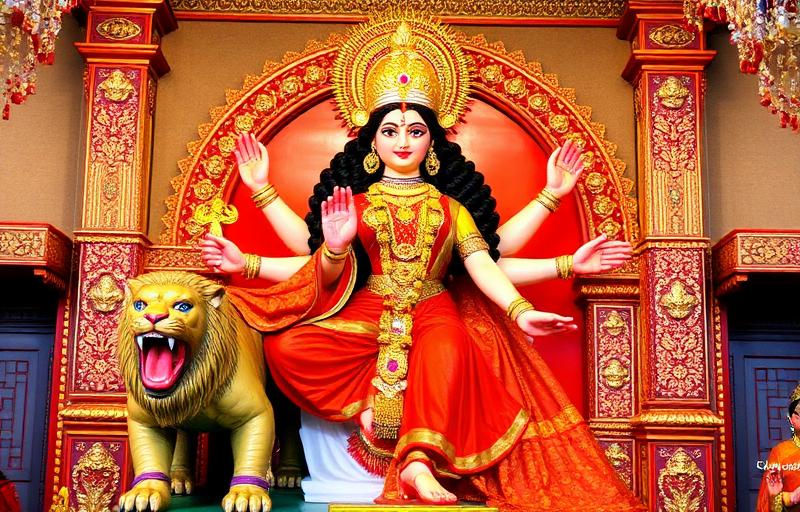
- Main darshan: Devotees behold Ma Bhavatarini, standing upon Lord Shiva, adorned and radiant, and offer their prayers for the Mother's grace, protection and liberation from worldly bondage.
- The wider complex: Pilgrims also visit the twelve Shiva temples along the riverfront, the Radha-Krishna temple, and Sri Ramakrishna's room, preserved as it was.
- Festivals: Kali Puja (around Diwali), Navratri and Snana Yatra draw great crowds; Bengalis especially throng here to worship the Mother.
- Reverence: Dress modestly, maintain cleanliness and silence, follow the temple customs, and take a moment in Sri Ramakrishna's room to feel the saintly presence.
A visit combines darshan of the Divine Mother with the deeply moving memory of a great saint's love for her. Confirm timings and arrangements locally before travelling.
What People Ask Most
Which goddess is worshipped at Dakshineswar Kali Temple?+
The temple is dedicated to Goddess Kali in her form as Ma Bhavatarini, 'the Mother who carries her devotees across the ocean of worldly existence'. She is worshipped standing upon Lord Shiva, and devotees seek her grace, protection and liberation from bondage.
What is the connection between Dakshineswar and Sri Ramakrishna?+
Sri Ramakrishna Paramahamsa served as a priest at Dakshineswar and worshipped Ma Kali as the living Divine Mother, receiving his profound direct vision of her there. From this temple he taught that all sincere paths lead to one God, a message his disciple Swami Vivekananda carried across the world.
Who built the Dakshineswar Kali Temple?+
The temple was built in 1855 by Rani Rashmoni, a great devotee and philanthropist, who is said to have been inspired by a vision of the Divine Mother. The grand complex includes the main shrine of Ma Bhavatarini, a row of Shiva temples and a Radha-Krishna temple on the bank of the Ganga.
About the author
Pandit Ravindra Sharma · Vedic Rituals & Bhakti, 22+ years
Pandit Ravindra is the Vandnaa editorial team's resident specialist on aarti, chalisa, and daily devotion. He has performed home and temple pujas across Varanasi and Delhi for over two decades and contributes the bhakti-focused articles on this site.
Meet the Vandnaa editorial team →