What Devi Mahatmya Is, and How It Is Organized
Devi Mahatmya, also called Durga Saptashati ("seven hundred verses to Durga") or Chandi Path, is a roughly 700-verse Sanskrit text embedded within the Markandeya Purana, traditionally dated to somewhere between the fifth and sixth centuries CE, and stands as one of the foundational texts of Shakta tradition, the strand of Hinduism centered on worship of the Divine Feminine. It is the source text recited during Navratri and Durga Puja across much of India, and its verses are also the origin point for the nine forms of Durga celebrated during those festivals.
The text is structured into 13 chapters, but tradition groups these 13 chapters into three larger sections called charitas (episodes or acts), each dedicated to a different, escalating demonstration of the Goddess's power, and traditionally associated with a different aspect of Devi: Mahakali, Mahalakshmi and Mahasaraswati respectively.
- Prathama Charita ("First Episode"): Chapter 1 alone, associated with Mahakali.
- Madhyama Charita ("Middle Episode"): Chapters 2 through 4, associated with Mahalakshmi.
- Uttama Charita ("Final Episode"): Chapters 5 through 13, the longest by far, associated with Mahasaraswati.
This guide exists for a specific, common situation: a reader who wants to understand what actually happens across these 13 chapters, the story, the sequence, the major turning points, before or alongside taking up formal Sanskrit recitation (path) as a spiritual practice. Reading a translated summary first, this guide's premise holds, makes the eventual Sanskrit recitation considerably more meaningful, because the reciter already knows what each chapter is describing rather than moving through unfamiliar verses on faith alone.
Prathama Charita: Chapter 1, Madhu-Kaitabha
The First Charita is contained entirely within Chapter 1 and sets up the text's frame story before telling its own self-contained episode.
The frame story, recurring throughout the text, involves King Suratha, who has lost his kingdom, and a merchant named Samadhi, who has been cast out by his own family, meeting in a forest hermitage and both grieving their losses despite having, by worldly standards, everything to feel secure about; Suratha still feels attachment to a kingdom no longer his, and Samadhi still feels love for a family that rejected him. A sage named Medhas explains this as the power of Mahamaya, the Goddess's power of illusion, which binds even the wise to attachment, and to illustrate this power, he narrates the following episodes of the Devi Mahatmya to them, which occupy the rest of the text.
Chapter 1's own story is set at the very beginning of creation. Vishnu lies in yogic sleep on the cosmic serpent Shesha, floating on the primordial ocean, while Brahma sits on the lotus emerging from Vishnu's navel. Two demons, Madhu and Kaitabha, emerge from Vishnu's ear-wax (a striking, deliberately strange detail found in the original text) and threaten to kill Brahma. Unable to wake Vishnu himself, Brahma prays to Yoganidra, the Goddess as the very power of Vishnu's sleep, asking her to release Vishnu from her hold so he can rise and fight. She agrees, withdraws from Vishnu, and he wakes and, after a long battle, defeats Madhu and Kaitabha by a clever trick, having them ask for a boon and then requesting to slay them in a place with no water, before killing them on his own thighs when the ocean has receded.
The chapter's key teaching, established right at the outset, is significant: even Vishnu's power to act depends entirely on the Goddess first releasing him from her own illusive hold, establishing Devi's primacy over even the major male deities before the text's more famous battles even begin.
Madhyama Charita: Chapters 2-4, Mahishasura Mardini
The Middle Charita tells the story most devotees already associate with Durga Puja and Navratri, the origin and slaying of the buffalo-demon Mahishasura, spread across three chapters.
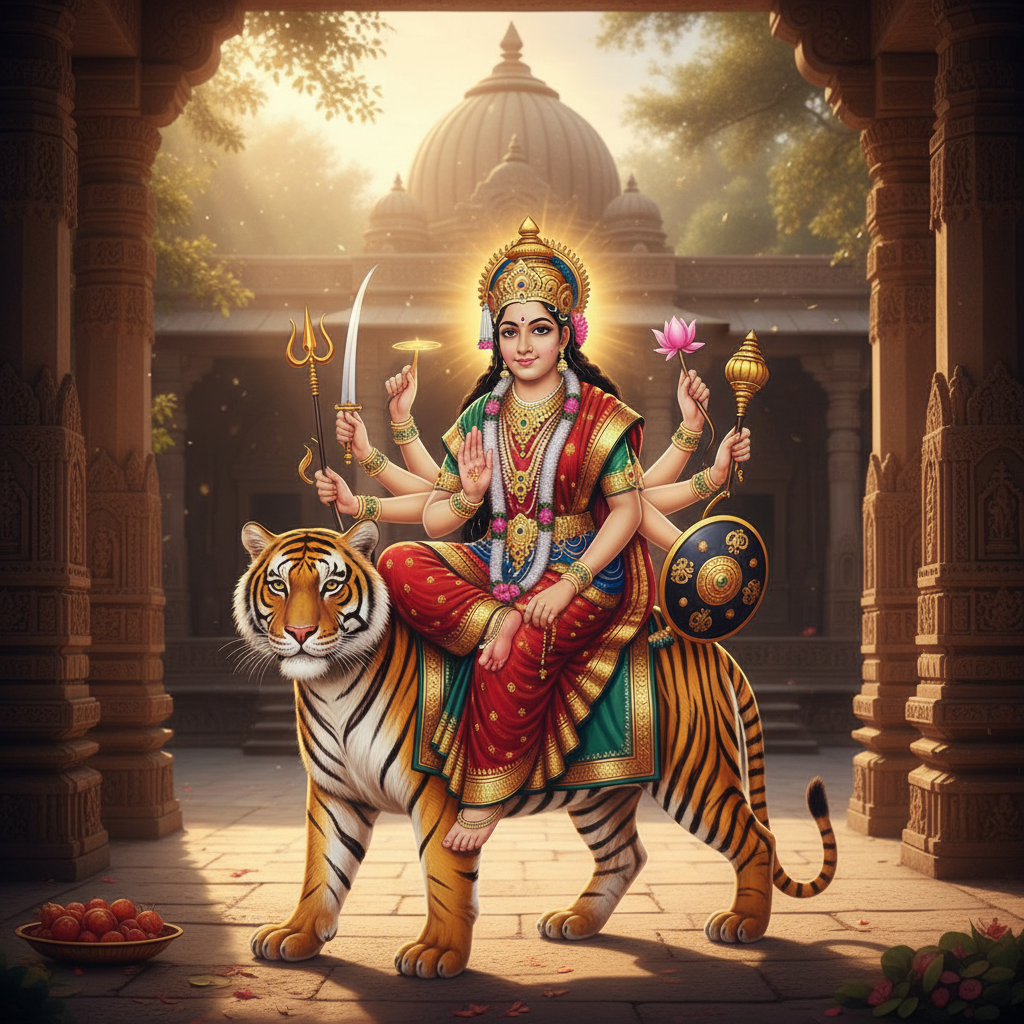
Chapter 2 opens with Mahishasura having defeated the gods and seized control of the heavens, having earned a boon that no man or god could kill him. Facing this crisis, the assembled gods, led by Vishnu and Shiva's fury combining with the anger of all the other deities, release a tremendous, combined light and energy that coalesces into a single female form, the Goddess Durga. Each god contributes both a portion of their own power and their signature weapon, Shiva his trishul, Vishnu his chakra, Indra his vajra and bell, Himavan a lion as her vahana, together assembling both her form and her arsenal in one striking scene.
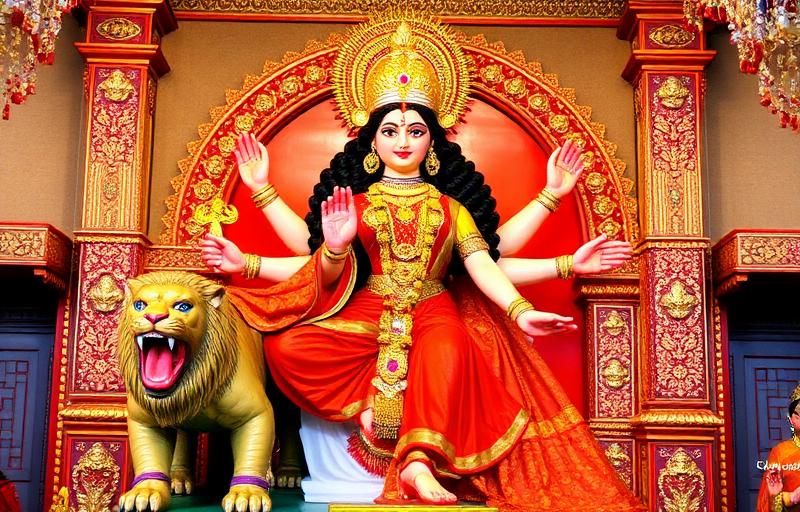
Chapter 3 is the chapter of battle itself, an escalating series of confrontations as Mahishasura's generals and finally the buffalo-demon himself, repeatedly shifting shape, lion, elephant, man, buffalo again, in an attempt to survive, are defeated one after another, culminating in Durga's decisive slaying of Mahishasura as he half-emerges from the buffalo form in his true shape, the moment most commonly depicted in Durga idols worldwide, her trishul or foot pressing down as she delivers the final blow.
Chapter 4 shifts tone entirely from battle to praise. Indra and the assembled gods offer an extended hymn of gratitude and reverence to the victorious Goddess, the Shakradi Stuti, celebrating her as the supreme refuge and power underlying the universe. This chapter is frequently recited on its own by devotees specifically for its devotional, hymn-like beauty, distinct from the narrative chapters surrounding it.
This three-chapter arc, crisis, manifestation and arming, battle, praise, is the emotional and narrative heart of the text for most devotees, and the episode most commonly retold in simplified form during Navratri storytelling.
Uttama Charita: Chapters 5-13, Shumbha-Nishumbha
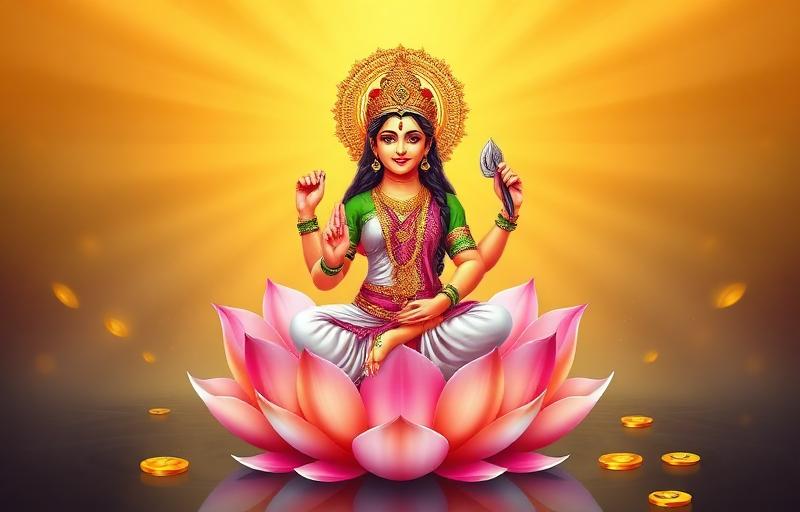
The Final Charita is by far the longest, spanning nine chapters, and tells a more elaborate, multi-stage story centered on two demon brothers, Shumbha and Nishumbha, who have similarly conquered the heavens.
Chapter 5 opens with the famous Devi Suktam, containing the widely recited verses beginning "Ya Devi Sarvabhuteshu," describing the Goddess as present in all beings in the form of consciousness, power, hunger, sleep, shadow and more, among the most quoted passages in the entire text. The narrative then introduces the demons' envoy, who approaches the beautiful Devi (in this episode appearing as Ambika/Parvati) to demand she marry Shumbha; she refuses, provoking the coming conflict.
Chapters 6-7 cover the first waves of battle. When the demon general Chanda and Munda attack, the Goddess produces Kali from her own furious brow to destroy them, earning Kali the name Chamunda. When the demon Raktabija enters the fight, a genuinely formidable foe since every drop of his blood that touches the ground spawns a new clone of him, the Goddess enlists Kali again, this time to drink his blood before it falls, finally ending his multiplying threat.
Chapters 8-10 bring the climactic confrontation with Nishumbha and then Shumbha himself, with the Goddess ultimately revealing, in a philosophically significant moment, that all the other goddess forms who assisted her in battle, including Kali, were never separate beings but her own emanations, reabsorbed back into her as Shumbha is finally slain.
Chapter 11 contains the Narayani Stuti, another major hymn of praise, in which the gods thank the Goddess and she prophesies her future incarnations across future ages, including forms like Shakambhari and Bhramari.
Chapters 12-13 close the text, with the Goddess herself describing the benefits (phalashruti) of her Mahatmya being read and remembered, before the frame story concludes: Suratha and Samadhi, having heard all this from Medhas, undertake tapasya and each receive a boon, Suratha to regain and later transcend his kingdom, reborn as a future Manu, and Samadhi to attain true spiritual knowledge.
How to Approach the 13 Chapters as a First-Time Reader
A first-time reader does not need to approach all 13 chapters as a single uniform block read start to finish in one sitting; understanding the text's own internal structure makes it considerably easier to navigate.
A practical entry sequence for a first read:
1. Start with the frame story context in Chapter 1, just enough to understand Suratha, Samadhi and Medhas, the narrative device holding the whole text together. 2. Move to Chapters 2-4, the Mahishasura episode, likely the most familiar story already, given its central place in Navratri and Durga Puja imagery. 3. Read Chapter 4's Shakradi Stuti slowly, as a hymn rather than narrative, since its beauty is more devotional than plot-driven. 4. Read Chapter 5's opening Devi Suktam carefully, this is among the most important passages in the entire text theologically, and worth sitting with independent of the surrounding narrative. 5. Read Chapters 6-10 as a connected unit, the Shumbha-Nishumbha war, since these chapters build on each other closely and are best read together rather than split across widely separated sittings. 6. Close with Chapter 11's Narayani Stuti and Chapters 12-13's phalashruti and resolution, understanding why the text describes its own recitation as beneficial before ever attempting a formal path.
For devotees planning to eventually take up the traditional full Sanskrit path (recitation), this summary-first approach is not a shortcut around that practice, but a preparation for it. Knowing what Chapter 3's battle is actually describing, or why Chapter 5 opens with the Devi Suktam specifically, transforms the Sanskrit recitation from an act of faith in unfamiliar syllables into a recitation grounded in real, if translated, comprehension, which many devotees report meaningfully deepens the devotional experience of the formal path itself.
Why Reading the Story Deepens the Recitation Practice
There is a real and common gap between reciting Devi Mahatmya in Sanskrit, whether during Navratri, a formal Durga Puja, or personal path practice, and actually knowing what each chapter is describing as it passes. Both practices, recitation and comprehension, have genuine value, but they serve different purposes, and combining them, this section argues, serves a devotee better than either alone.
Sanskrit recitation of a sacred text carries its own traditionally recognized power, the sound (shabda) itself, correctly pronounced, is understood in Hindu tradition to carry spiritual effect independent of moment-to-moment conscious translation. This is precisely why generations of devotees have recited Chandi Path faithfully without necessarily having formally studied a translation alongside it, and their practice is not considered lesser for it.
But reading a summary or translation first, even once, changes the texture of subsequent recitation in a way many devotees describe as genuinely transformative. Knowing that Chapter 3's rapid verses are describing a shape-shifting demon's desperate final stand, rather than an undifferentiated stream of Sanskrit syllables, gives the reciter's attention somewhere real to land. Knowing Chapter 5 opens with the Devi Suktam's celebrated vision of the Goddess present within all beings turns that passage from unfamiliar sound into a genuinely moving theological statement the reciter is consciously affirming.
For a practical next step: read this summary once, ideally alongside a full translation for a first pass through the actual verses, before or during your next Navratri, and note whether the recitation itself, whether attempted in full Sanskrit path or through a sibling post's more detailed vidhi guidance, feels different afterward. Most devotees who make this comparison report that it does, that the text stops being 700 verses to get through and starts being a story, three of them in fact, that they now recognize as it unfolds.
🪔 The Vandnaa app's daily reading reminders can help you pace a full first read of Devi Mahatmya across Navratri's nine days, one charita section at a time.
What People Ask Most
How many chapters does Devi Mahatmya have, and how are they grouped?+
Devi Mahatmya has 13 chapters, traditionally grouped into three charitas: the Prathama Charita (Chapter 1), the Madhyama Charita (Chapters 2-4), and the Uttama Charita (Chapters 5-13), associated respectively with Mahakali, Mahalakshmi and Mahasaraswati.
Is Devi Mahatmya the same as Durga Saptashati?+
Yes, Devi Mahatmya is also known as Durga Saptashati (seven hundred verses) or Chandi Path, and is the source text found within the Markandeya Purana that is recited during Navratri and Durga Puja.
Which chapter of Devi Mahatmya describes the slaying of Mahishasura?+
The Mahishasura episode spans Chapters 2 through 4: Chapter 2 covers the Goddess's manifestation and arming, Chapter 3 the battle and his slaying, and Chapter 4 the gods' hymn of praise following the victory.
What is the Devi Suktam and where does it appear?+
The Devi Suktam, containing the widely recited "Ya Devi Sarvabhuteshu" verses describing the Goddess's presence within all beings, appears at the opening of Chapter 5, the beginning of the Uttama Charita.
Should I read a translation of Devi Mahatmya before doing formal Sanskrit path?+
It is not required, since Sanskrit recitation carries its own traditional value regardless of translation study, but reading a summary or translation first is widely considered to deepen the experience, since the reciter then understands what each chapter is actually describing.
About the author
Anjali Mehta · Editor, M.A. Religious Studies
Anjali is the managing editor for Vandnaa and oversees the festival and vrat coverage. She holds an M.A. in Religious Studies and reviews every published article for accuracy, accessibility, and tradition-fidelity.
Meet the Vandnaa editorial team →