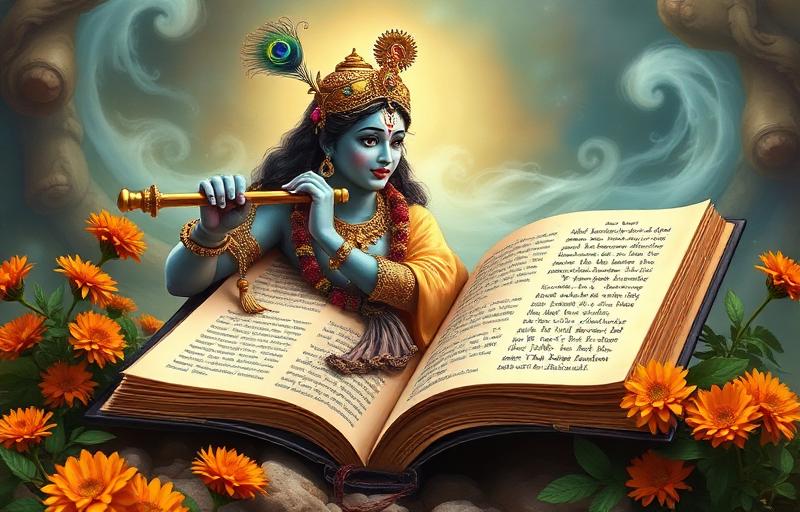
Turned Away From His Father's Lap
Dhruva was the son of King Uttanapada and his first queen Suniti, though the king's clear favouritism lay with his second queen Suruchi and her own son Uttama. One day, as a young child of about five, Dhruva climbed onto his father's lap while Uttama sat there, and Suruchi, seeing this, angrily pulled Dhruva off and told him plainly that he had no right to that seat or to his father's throne, since he was not born of her, the favoured queen, and that if he wanted such a privileged position he would need to be reborn from her own womb instead.
A child's response that surprised the adults around him
Rather than simply cry and accept the humiliation as a five-year-old might be expected to, Dhruva went to his mother Suniti in distress, and Suniti, herself long suffering under the household's unequal treatment, could offer comfort but no real solution, telling him only that the true refuge from such humiliation lay in devotion to Vishnu rather than in any position his father's court could grant.
Leaving for the forest
Dhruva took this not as a comforting platitude but as literal instruction, and resolved, at five years old and without any adult's permission or company, to walk into the forest and undertake tapasya severe enough to secure a position no one, not Suruchi and not circumstance, could ever take from him again.
Narada's Attempt to Talk Him Out of It
The sage Narada, encountering the child alone in the forest and learning of his resolve, tried to dissuade him, pointing out gently that a task this severe was ordinarily undertaken by seasoned ascetics after long preparation, not attempted by a five-year-old acting on a moment's hurt and a mother's offhand remark. Dhruva, unmoved, held to his resolve, and Narada, recognising the sincerity behind it, relented and instead gave him instruction: a specific mantra dedicated to Vishnu, along with guidance on posture and discipline suited to sustaining tapasya at this intensity.
The escalating austerity
Dhruva's penance progressed through stages of increasing severity, moving from a diet of forest fruit to leaves, to water alone, to air alone, and finally to standing on one leg without any sustenance at all, his concentration so total and so undisturbed by hunger, thirst, or fatigue that his body is described as radiating a fire intense enough to alarm the gods, who felt the heat of his austerity even from the heavens and grew concerned it might destabilise the cosmos if it continued unchecked.
Vishnu appears
Moved by the sincerity and intensity of the child's devotion, and to prevent the disruption his tapasya was beginning to cause, Vishnu himself appeared before Dhruva, physically manifest, and Dhruva, in the presence of the very deity he had sought, found himself for a moment unable to articulate the elaborate praise he had composed and prepared for this exact encounter, offering instead a simpler, more spontaneous expression of devotion that the text treats as more valuable than the composed hymn would have been.
Becoming the Pole Star
Vishnu granted Dhruva a boon beyond what the child had originally sought - not merely a secure position in his father's household, which is what his mother's remark had originally pointed him toward, but a place in the heavens itself, fixed and unmoving while every other star and celestial body circled around it: Dhruva was granted the position of Dhruva Tara, the Pole Star, remaining eternally in place at the sky's own axis, a status the text presents as vastly exceeding the more modest, purely earthly security he had initially set out to secure.
Why the pole star specifically
The astronomical fact underlying the myth, that Earth's axis points toward a star that consequently appears fixed while the rest of the night sky appears to rotate around it, is here given a devotional origin story rather than left as a bare observation - the star's fixedness becomes, in the myth's own logic, a physical manifestation of the unwavering steadiness Dhruva demonstrated in his penance, the cosmos itself organised around a five-year-old's refusal to be moved.
Where the story is still invoked
Dhruva's name has become a standing term in several Indian languages for steadfastness and fixed resolve itself, used well outside any explicitly religious context to describe unwavering determination, and the story is one of the most commonly told to children specifically, both for its child protagonist and for its clear, uncomplicated message that sincere devotion and resolve, even from someone very young and with no worldly standing to draw on, can accomplish what adult status and privilege could not.
Common Questions From Devotees
Why did Dhruva go to the forest alone at five years old?+
After his stepmother Suruchi humiliated him and denied him a place on his father's lap, telling him he would need to be reborn from her own womb to claim such privilege, his mother Suniti told him that true refuge from such treatment lay in devotion to Vishnu. Dhruva took this as literal instruction and resolved to undertake tapasya severe enough to secure a position no one could take from him.
What boon did Vishnu grant Dhruva?+
Rather than the modest earthly security Dhruva had originally sought within his father's household, Vishnu granted him a fixed, unmoving place in the heavens itself - the position of Dhruva Tara, the Pole Star, remaining eternally at the sky's own axis while other celestial bodies appear to circle around it.
Why is the pole star called Dhruva Tara?+
The tradition names it directly after the boy Dhruva, whose intense, unwavering penance is presented as the origin of the star's own fixed position in the sky - the astronomical fact that this particular star appears stationary while others rotate around it is given a devotional explanation rooted in Dhruva's steadfastness.
About the author
Anjali Mehta · Editor, M.A. Religious Studies
Anjali is the managing editor for Vandnaa and oversees the festival and vrat coverage. She holds an M.A. in Religious Studies and reviews every published article for accuracy, accessibility, and tradition-fidelity.
Meet the Vandnaa editorial team →