What Durga Saptashati Actually Is
Durga Saptashati, also called Devi Mahatmyam or Chandi Path, is a text of exactly 700 verses (the name literally means "seven hundred to Durga") embedded within the Markandeya Purana. It is one of the oldest and most structured devotional texts dedicated to the Goddess in her many forms, composed in Sanskrit and organized with remarkable precision into thirteen chapters, called adhyayas.
Unlike a single continuous story, Durga Saptashati narrates three distinct episodes in which the Goddess confronts and destroys different demons threatening cosmic order, each episode revealing a different aspect of her power. Sage Markandeya narrates the text to a king who has lost his kingdom and a merchant who has been betrayed by his own family, both of whom seek refuge in the forest and meet a sage who recounts these stories to explain the nature of Devi's power and how it can be accessed by ordinary devotees, not only in mythic battles but in the everyday battles of the mind and circumstance.
This framing matters for how the text is traditionally approached. It is not read simply as ancient history or entertainment, but as a sadhana, a spiritual practice believed to actively invoke the Goddess's protective and transformative energy through the disciplined act of recitation itself. Many devotees describe the effect of the Sanskrit verses, chanted correctly, as carrying a distinct resonance and power independent of whether the listener understands every word, similar to how the Gayatri Mantra or Vedic chanting is approached. This guide focuses specifically on the practical side: how a devotee wanting to read it at home, particularly a beginner, can actually approach the text without feeling overwhelmed by its length or complexity.
Understanding the 13 Chapters and 3 Charitas
The text's structure is more approachable once broken into its three sections, called charitas, each attributed a different presiding form of the Goddess:
- Prathama Charita (Chapter 1 alone) - the shortest section, centered on Mahakali, describing Vishnu's yoga-nidra and the goddess's role in the Madhu-Kaitabha episode. Often read on its own as a quick daily option.
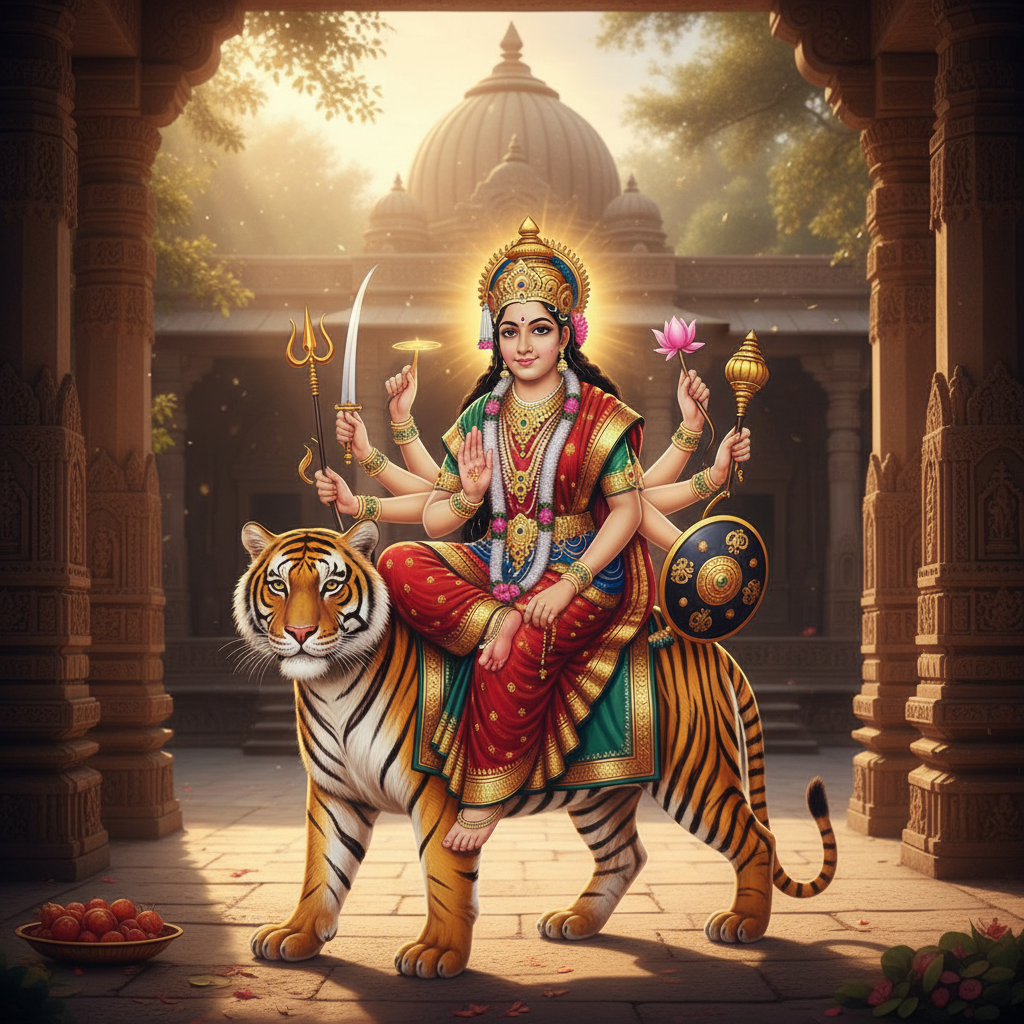
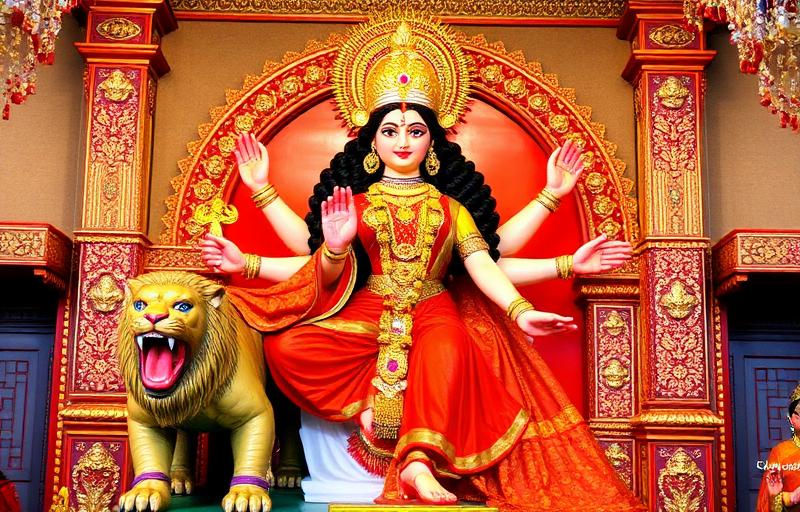
- Madhyama Charita (Chapters 2-4) - centered on Mahalakshmi, this is the section describing the Goddess's battle with the buffalo demon Mahishasura, likely the most well-known story from the text and the one most often depicted in Durga Puja imagery.
- Uttama Charita (Chapters 5-13) - the longest section by far, centered on Mahasaraswati, covering the battle with the demons Shumbha and Nishumbha, and including the famous Devi describing herself as the source of all creation.
Beyond the charitas, a complete traditional path also includes several supplementary texts recited alongside the main 700 verses: the Devi Kavach (a protective armor recited before beginning), Argala Stotram and Kilaka Stotram (recited between chapters one and two), and closing hymns like the Devi Suktam and phalashruti (the chapter describing the benefits of recitation) at the end.
For a beginner, simply knowing this structure changes how intimidating the text feels. Instead of "700 verses," it becomes: a short opening chapter, a well-known middle section most people already have some familiarity with through Navratri and Durga Puja celebrations, and a longer closing section that can be approached gradually. Many printed editions clearly mark these divisions, making it easy to plan a reading schedule around them rather than trying to absorb the text as one undifferentiated block.
Rules of Purity, Timing and Discipline
Certain traditional rules govern how Durga Saptashati is meant to be approached, more strictly than many other devotional texts, given its status as a powerful sadhana:
- Physical purity - bathing before beginning the path is considered essential, along with wearing clean clothes, ideally not recently worn for other activities.
- Facing east or north while seated, on a clean asana (mat) rather than directly on the floor.
- Best timing - Navratri is considered the single most powerful and traditional period for a complete reading, with many devotees completing the full text once during the nine days. Outside Navratri, Tuesdays, Fridays, and Ashtami or Navami tithis are considered favourable.
- Once begun on a given day, avoid leaving it incomplete if possible - tradition holds that starting a chapter and abandoning it partway is less favourable than reading a shorter, complete portion. Planning the day's reading in advance, based on the chapter divisions, helps avoid this.
- Menstruating women - many traditional households advise against active recitation during this time as a matter of long-standing custom, though practices vary meaningfully by family and region, and increasing numbers of women and priests today consider sincere devotion the more important factor; this is worth deciding according to your own family's guidance rather than a single fixed rule.
- A lit diya (traditionally of ghee) kept burning through the reading session, and a small altar with an image of Durga, is customary though not strictly mandatory for a beginner just starting out.
None of these rules are meant to create anxiety about "doing it wrong." They function as a container of respect around a text considered especially potent, and most households treat the spirit of sincerity and consistency as more important than perfect adherence to every rule, particularly for someone in their first year of practice.
Realistic Pacing for Beginners
An experienced reader, fluent in Sanskrit pronunciation, can complete the full Durga Saptashati including the supplementary stotras in roughly two and a half to three hours in one sitting. For a genuine beginner, that number is both unrealistic and, frankly, the wrong goal to chase in the first attempt.
A far more sustainable approach spreads the text across the nine days of Navratri, using the chapter structure covered earlier as a natural map:
- Day 1: Devi Kavach, Argala and Kilaka Stotram, plus Chapter 1 (Prathama Charita)
- Days 2-4: One chapter each from the Madhyama Charita (Chapters 2, 3, 4)
- Days 5-9: Roughly one to two chapters each from the Uttama Charita (Chapters 5 through 13), with the longer Chapter 5 given its own day
This pacing keeps each day's reading to a manageable twenty to forty minutes, sustainable even alongside work, family responsibilities and the general busyness of Navratri itself. A beginner following this schedule finishes the entire text once by Vijayadashami, which is itself considered a meaningful accomplishment.
For someone reading outside Navratri or wanting a lighter daily habit the rest of the year, an even gentler pace, one chapter every few days without a fixed deadline, is entirely acceptable. Tradition does not impose a race. What matters more than speed is pronunciation improving gradually through repeated exposure, and the reading gradually feeling less like decoding unfamiliar syllables and more like a familiar, settled practice, the same shift that eventually happens with any memorized or frequently repeated Sanskrit text.
✨ The Vandnaa app includes the full Durga Saptashati text with Hindi meaning, making it easier to follow along at whatever pace suits your first year of practice.
Shorter Versions for When Time Is Genuinely Limited
Tradition itself recognises that a full reading is not always possible, and offers sanctioned shorter alternatives rather than treating anything less than all 700 verses as incomplete or insufficient.
- Chapter 1, 4, 5 and 11 together are sometimes recommended as a condensed version touching each of the three charitas, when time allows for only a fraction of the full text.
- The Devi Kavach alone, a much shorter protective hymn, is commonly recited daily by those who cannot commit to the fuller text but want a consistent connection to it.
- Chapters 12 and 13, the phalashruti section describing the benefits of the path, are sometimes read alone as a way of connecting with the text's closing intention even without reading the narrative portions.
- The Navarna Mantra - "Om Aim Hreem Kleem Chamundaye Vichche" - is considered a seed-mantra distillation of the entire text's energy, and repeating it as japa (traditionally 108 times using a mala) is a widely accepted substitute during weeks when even a single chapter feels unmanageable.
The underlying principle across all of these shorter options is that sincere, consistent engagement with even a small portion of the text is considered more valuable than an inconsistent attempt at the full version that ends up abandoned halfway through the first week. Many experienced devotees actually began their own relationship with Durga Saptashati this way, with the Navarna Mantra or a single chapter recited regularly for months or years before working up to attempting the complete text during a Navratri. There is no expectation that a beginner's first attempt needs to be the full, unabridged version, and easing into it gradually is considered a perfectly legitimate way to build the practice.
Benefits Tradition Describes
The text's own closing chapters, the phalashruti, describe the benefits believed to come from sincere recitation, and it is worth presenting these as tradition describes them, in devotional rather than literal or promissory terms.
Durga Saptashati is traditionally associated with protection from obstacles and negative influences, courage in the face of genuine adversity, and the removal of fear, framed through the Goddess's own role as the destroyer of forces that threaten order and wellbeing. Devotees going through a difficult period, a serious illness in the family, a legal battle, a period of sustained hardship, often turn to this specific text over gentler devotional options precisely because of this association with facing down real difficulty rather than offering only comfort.
Beyond the specific outcomes described in the phalashruti, many devotees describe a subtler, more consistent benefit: a sense of inner steadiness that builds through the discipline of the practice itself, the same kind of grounding that comes from any committed, repeated spiritual discipline. Sitting with a difficult Sanskrit text daily or across nine focused days, working through pronunciation, returning to it despite a busy schedule, builds a kind of resolve that devotees often describe as valuable independent of whatever external outcome they were originally praying for.
At the close of a reading, tradition includes a samarpan, a dedication of the effort made, typically a short prayer offering the merit of the recitation to the Goddess and to the wellbeing of one's family. This closing gesture matters: it reframes the entire practice not as a transaction seeking a specific reward, but as an offering, which is closer to how Durga Saptashati has been approached by devotees for centuries.
What People Ask Most
How long does it take to read the full Durga Saptashati?+
An experienced reader can complete it in roughly two and a half to three hours in one sitting. Beginners are better served spreading it across the nine days of Navratri, reading twenty to forty minutes daily following the chapter structure.
Can women read Durga Saptashati during menstruation?+
Practices vary by family and region. Many traditional households advise pausing active recitation during this time as a matter of long-standing custom, while many priests and devotees today consider sincere devotion the more important factor. It is best decided according to your own family's guidance.
Is it necessary to read all 700 verses in a single sitting?+
No. Spreading the text across the nine days of Navratri, or across shorter regular sessions outside Navratri, is a widely accepted and traditional approach, particularly for beginners still building familiarity with the Sanskrit.
What is the difference between Durga Saptashati and Chandi Path?+
They refer to the same text. Durga Saptashati is the name based on its 700 verses, while Chandi Path and Devi Mahatmyam are alternate names for the same composition within the Markandeya Purana, used somewhat interchangeably across different regions.
Should beginners learn Sanskrit pronunciation before starting?+
It helps but is not a prerequisite. Many beginners start with a transliterated text and improve pronunciation gradually through repeated reading. Sincerity in the attempt is traditionally considered more important than starting only once pronunciation is perfect.
What if the path gets interrupted midway through a chapter?+
Try to complete at least the chapter you are on rather than stopping mid-way, and plan the next day's portion in advance to avoid this. If an interruption is unavoidable, resuming calmly at the next opportunity, without guilt, is considered entirely acceptable.
About the author
Dr. Suresh Iyer · Vastu Shastra & Jyotish, 18+ years
Dr. Suresh has practiced traditional Vastu and basic Vedic Jyotish for over 18 years across South India. He contributes the Vastu, direction, and home-puja layout guides on Vandnaa.
Meet the Vandnaa editorial team →