One Part of Shiva, Given a Separate Life
Different Puranas frame Durvasa's parentage slightly differently, but a common thread runs through most versions: he is counted as a partial or wrathful incarnation of Shiva, born to the sage Atri and his wife Anasuya, the same household that in another story is visited by the Trimurti disguised as infants to test Anasuya's chastity.
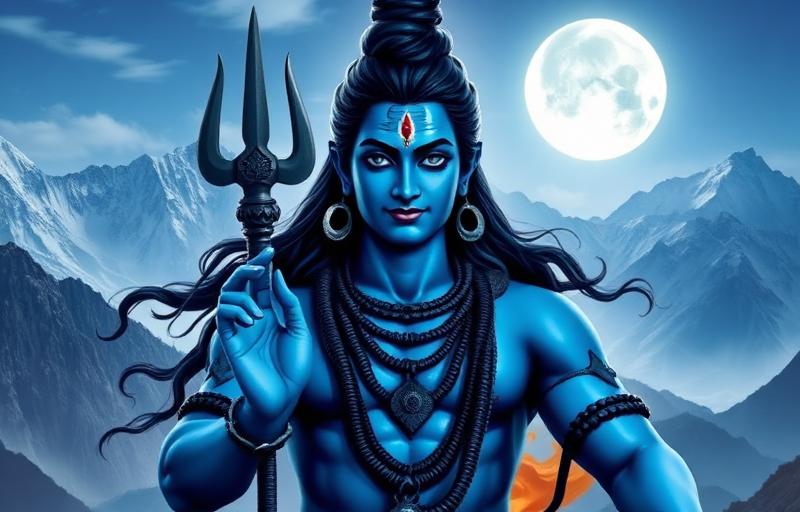
One well-known account holds that Anasuya's extraordinary devotion once moved the three great gods, Brahma, Vishnu and Shiva, to each grant her a son born partly of themselves: Soma from Brahma's portion, Dattatreya from Vishnu's, and Durvasa from Shiva's, specifically the krodha, the anger, within Shiva's nature.
This detail matters more than it might first appear. Durvasa is not written as a sage who happens to have a temper the way an ordinary person might. He is written as a being whose fundamental substance is that particular quality, which means every outburst attached to his name across the epics and Puranas is, within the tradition's own logic, not a character flaw layered onto an otherwise wise man but the literal expression of what he was made from.
Anasuya's household, in other words, produced three sons who each carried forward one distinct divine quality: Soma's gentleness, Dattatreya's all-encompassing wisdom, and Durvasa's capacity for immediate, overwhelming wrath.
A Curse That Explains Half the Epics
Once this origin is established, Durvasa's recurring role across Hindu narrative literature reads differently. He is the sage whose brief, easily provoked anger sets major plots in motion with almost mechanical regularity: cursing Shakuntala to be forgotten by Dushyanta when her mind wandered during his visit, testing Ambarisha and nearly destroying himself against the Sudarshana Chakra in the process, giving Kunti the mantra that would let her summon any god, appearing at Krishna and Rukmini's household to test their hospitality with characteristically unreasonable demands.
A reader who has met several of these stories elsewhere in this series will notice the pattern: Durvasa rarely appears to advance a plot through wisdom the way other sages do. He appears as a test, a hazard, a force of nature dressed as a guest, whose favour is worth having precisely because his displeasure is so easy to earn and so difficult to survive.
And crucially, the tradition does not read this as villainy. Durvasa's curses are almost always eventually softened, redirected, or shown to serve a larger purpose he himself could not see in the moment of his fury, which is consistent with treating him as a fragment of Shiva rather than an ordinary bad-tempered man: Shiva's anger in the fuller tradition is destructive and purifying at once, never simply cruel for its own sake.
How the Tradition Wants This Read
Taking Durvasa's origin seriously changes how his stories should be told. He is not a cautionary tale about controlling one's temper in the way a folk story about an angry neighbour might be. He is closer to a personification, a way for the epics to introduce sudden, disproportionate, world-altering consequence into an otherwise steady narrative, the way a sudden storm alters a calm sea.
This is also why so many of his victims are ultimately protected or restored: Shakuntala's curse is later lifted by the sight of the ring, Ambarisha survives the Chakra's pursuit through his own unwavering devotion, and Krishna finds a way to satisfy even Durvasa's most extreme demands. The wrath is real and its effects are real, but the tradition consistently arranges for it not to be the final word.
Anasuya's household therefore gave the world three distinct lessons in one family: that wisdom, gentleness and anger can all be forms a devotee's life takes, and that the last of these, however uncomfortable, is not automatically outside the bounds of what a great sage's life can look like.
Frequently Asked Questions
Why is Durvasa known for his temper?+
Tradition holds that Durvasa was born as a partial incarnation of Shiva, specifically embodying Shiva's krodha or wrath, to the sage Atri and Anasuya. His frequent, sudden curses across the epics are read as the direct expression of that origin.
Are Durvasa's curses usually undone?+
Very often, yes. Shakuntala's curse is later lifted by the recognition of a ring, Ambarisha is protected by his own devotion, and other stories show his displeasure eventually serving a larger purpose rather than remaining purely destructive.
Who are Durvasa's brothers?+
In this account, Soma (the moon, born of Brahma's portion) and Dattatreya (born of Vishnu's portion) are his brothers, all three born to Atri and Anasuya as expressions of one divine quality each.
About the author
Anjali Mehta · Editor, M.A. Religious Studies
Anjali is the managing editor for Vandnaa and oversees the festival and vrat coverage. She holds an M.A. in Religious Studies and reviews every published article for accuracy, accessibility, and tradition-fidelity.
Meet the Vandnaa editorial team →