What Ekadashi Is, and Why There Are 24 (or 26) a Year
Ekadashi is the eleventh tithi (lunar day) counted from both the new moon and the full moon, which means it recurs twice in every lunar month, once during the waxing fortnight (Shukla Paksha) and once during the waning fortnight (Krishna Paksha). With twelve lunar months in a standard year, that produces twenty-four Ekadashis, each dedicated to Lord Vishnu and each carrying its own name, legend and specific merit.
Every Ekadashi is traditionally observed with a fast, ranging from a single meal to a completely water-free (nirjala) fast depending on the individual's capacity and the specific Ekadashi's tradition, along with reading or listening to that Ekadashi's katha, and worship of Vishnu, often through the Vishnu Sahasranama or a simple offering of tulsi leaves, which are considered especially dear to him.
In years with an Adhik Maas, an intercalary leap month added roughly every 32-33 months to keep the lunar and solar calendars aligned, two additional Ekadashis appear: Padmini Ekadashi and Parama Ekadashi, bringing the total for that year to twenty-six. These extra Ekadashis are considered especially meritorious precisely because they are rare.
This guide lists all twenty-four names in the order they occur through the Hindu lunar year, from Chaitra to Phalguna, grouped in blocks of six so the full list is easy to scan and remember. Exact Gregorian dates shift every year, so always confirm the specific date closer to the month using a panchang or a reliable app rather than relying on last year's calendar.
- 24 Ekadashis in a standard year, 26 in an Adhik Maas year
- Each falls on the 11th day of both lunar fortnights
- All are dedicated to Lord Vishnu
- Fasting intensity and specific rules vary by individual Ekadashi and by family tradition
Chaitra to Jyeshtha: The First Six Ekadashis
The Hindu lunar year traditionally begins with Chaitra, and the first block of Ekadashis carries the year from early spring into the onset of summer.
- Papmochani Ekadashi (Chaitra, Krishna Paksha) - observed to free the devotee from past sins and negative karma before the new year begins
- Kamada Ekadashi (Chaitra, Shukla Paksha) - believed to fulfil sincere desires and free one from the effects of past wrongdoing
- Varuthini Ekadashi (Vaishakh, Krishna Paksha) - associated with protection from hardship and is said to grant merit equal to great acts of charity
- Mohini Ekadashi (Vaishakh, Shukla Paksha) - commemorates Vishnu's Mohini avatar, who charmed the demons to protect the nectar of immortality for the gods
- Apara Ekadashi (Jyeshtha, Krishna Paksha) - also called Achala Ekadashi, observed for freedom from sin and for fame and prosperity
- Nirjala Ekadashi (Jyeshtha, Shukla Paksha) - the most rigorous of all twenty-four, a completely water-free fast said to carry the combined merit of every other Ekadashi in the year, and widely observed even by those who skip the rest
Of this block, Nirjala Ekadashi in particular draws devotees who cannot observe all twenty-four fasts individually, since tradition holds that sincerely completing this one fast alone confers the benefit of the full year's cycle. It typically falls in late May or June, ahead of the peak summer heat, which makes its water-free discipline especially demanding and especially respected among observers.
Each of these six marks a transition in the agricultural and seasonal calendar of North India as well, moving from the freshness of spring into the building heat that precedes the monsoon, and several of their associated legends reflect themes of endurance and purification that mirror that seasonal shift.
Ashadha to Bhadrapada: The Monsoon Ekadashis
This block covers the monsoon months, which also bring the start of Chaturmas, the four-month period when Vishnu is traditionally believed to enter cosmic sleep, a theme directly reflected in two of these Ekadashi names.
- Yogini Ekadashi (Ashadha, Krishna Paksha) - observed for relief from illness and past-life afflictions, said to grant merit equal to feeding thousands of Brahmins
- Devshayani Ekadashi (Ashadha, Shukla Paksha) - also called Padma or Hari Shayani Ekadashi, marking the day Vishnu begins his four-month cosmic sleep and the start of Chaturmas, after which auspicious ceremonies like weddings typically pause
- Kamika Ekadashi (Shravan, Krishna Paksha) - observed in the sacred month of Shravan, believed to remove sins equivalent to killing a cow, one of the gravest transgressions in tradition, when accidental
- Putrada Ekadashi (Shravan, Shukla Paksha) - also called Pavitra Ekadashi, observed by couples desiring a child and blessed with virtue
- Aja Ekadashi (Bhadrapada, Krishna Paksha) - also called Annada Ekadashi, linked to King Harishchandra's legendary trials and observed for liberation from sin
- Parivartini Ekadashi (Bhadrapada, Shukla Paksha) - also called Parsva Ekadashi, marks the point in his cosmic sleep when Vishnu is believed to turn from one side to the other
This stretch of the calendar is considered especially significant because it opens Chaturmas, a period devotees traditionally use to intensify their spiritual practice, taking up additional vows, avoiding certain foods, and increasing their focus on scripture and satsang, since Vishnu himself is understood to be in repose during these months.
📿 Vandnaa's app sends a gentle reminder ahead of each Ekadashi with that day's specific katha and fasting rules, so you never have to cross-check a paper calendar mid-month.
Ashwin to Margashirsha: The Festive-Season Ekadashis
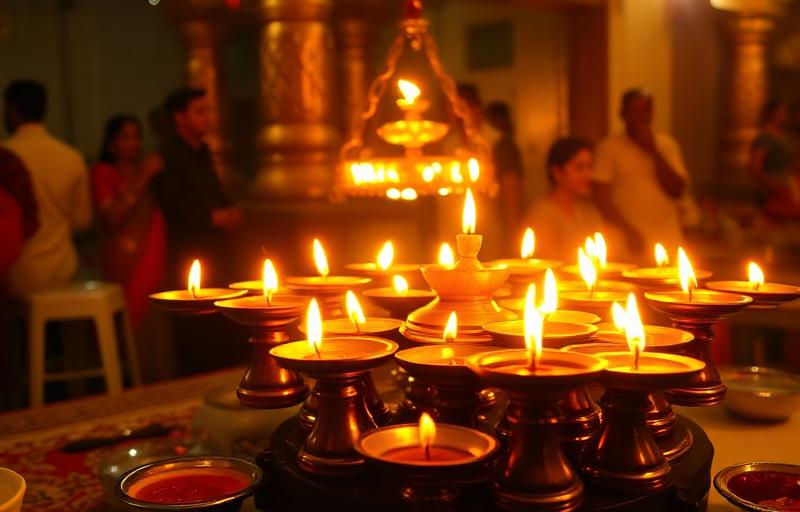
This block runs through the busiest festival stretch of the year, from Navratri through Diwali, and includes the Ekadashi that ends Chaturmas.
- Indira Ekadashi (Ashwin, Krishna Paksha) - observed for the liberation of one's ancestors, often falling during Pitru Paksha
- Papankusha Ekadashi (Ashwin, Shukla Paksha) - said to destroy sins as an ankusha (goad) controls an elephant, observed during the Navratri period
- Rama Ekadashi (Kartik, Krishna Paksha) - falls just before Diwali, observed for prosperity and freedom from difficulty
- Devutthana Ekadashi (Kartik, Shukla Paksha) - also called Prabodhini Ekadashi, marks Vishnu's awakening from his four-month cosmic sleep, ending Chaturmas and reopening the season for weddings; also closely linked with Tulsi Vivah, celebrated shortly after
- Utpanna Ekadashi (Margashirsha, Krishna Paksha) - commemorates the origin of the goddess Ekadashi herself, born from Vishnu to defeat the demon Mura
- Mokshada Ekadashi (Margashirsha, Shukla Paksha) - observed for liberation of ancestors and coincides with Gita Jayanti, the day the Bhagavad Gita was spoken on the battlefield of Kurukshetra
Devutthana Ekadashi is one of the most eagerly awaited dates on this list for a practical reason: it lifts the informal pause on weddings and other auspicious ceremonies that began with Devshayani Ekadashi four months earlier, which is why the wedding season across much of North India visibly picks up in the weeks immediately following it.
- Indira and Mokshada Ekadashi both carry a strong ancestor-liberation theme
- Devutthana Ekadashi doubles as the start of the post-Chaturmas wedding season
- Mokshada Ekadashi shares its date with Gita Jayanti in most years
Pausha to Phalguna: The Final Six Ekadashis
The year's cycle closes with this block, carrying the calendar through the peak of winter and into the approach of Holi and the spring that begins the cycle anew.
- Saphala Ekadashi (Pausha, Krishna Paksha) - observed for success (saphalta) in one's endeavours
- Putrada Ekadashi (Pausha, Shukla Paksha) - also known as Vaikuntha Ekadashi in South Indian tradition, when temple doors symbolising the gateway to Vishnu's abode are ceremonially opened
- Shattila Ekadashi (Magha, Krishna Paksha) - involves the use of sesame (til) in six different ways during worship and bathing, for purification
- Jaya Ekadashi (Magha, Shukla Paksha) - also called Bhaimi Ekadashi, observed for freedom from the fear of becoming a preta (restless spirit) after death
- Vijaya Ekadashi (Phalguna, Krishna Paksha) - associated with Lord Rama's crossing of the ocean to reach Lanka, observed for victory over obstacles
- Amalaki Ekadashi (Phalguna, Shukla Paksha) - also called Amla Ekadashi, centred on worship of the amla (Indian gooseberry) tree, believed to be dear to Vishnu and to emerge from a drop of his nectar
Vaikuntha Ekadashi deserves a special mention here, since it draws some of the largest single-day temple crowds of the year at major Vaishnava shrines in South India, particularly at Srirangam and Tirupati, where devotees queue for hours to pass through the Vaikuntha Dwaram, the symbolic doorway to Vishnu's heavenly abode, opened only on this date.
- Shattila and Amalaki Ekadashi both centre on a specific natural element, sesame and amla respectively
- Putrada Ekadashi in Pausha is distinct from the Shravan Putrada Ekadashi earlier in the year, despite sharing a name
- This block closes the annual Ekadashi cycle just before Holi and the return to Chaitra
The Extra Ekadashis of Adhik Maas, and General Rules to Remember
In any year that contains an Adhik Maas, the extra lunar month inserted to keep the lunar calendar aligned with the solar year, two more Ekadashis appear on the calendar: Padmini Ekadashi, falling in the Shukla Paksha of the extra month, and Parama Ekadashi, falling in its Krishna Paksha. These are collectively considered among the most meritorious Ekadashis precisely because Adhik Maas itself is regarded as a bonus month specially suited to spiritual practice, and because these two fasts appear only once every 32 to 33 months on average.
Across all twenty-four (or twenty-six) Ekadashis, a few rules apply broadly, though family and regional traditions can vary in their details:
- Rice and rice-based foods are traditionally avoided on Ekadashi, since Ekadashi is believed to reside within grains of rice
- Onion, garlic and certain lentils are also commonly avoided, in keeping with a broadly sattvic diet for the day
- The fast is usually broken the following morning, on Dwadashi, at a specific window called Parana time, rather than immediately after sunset
- Tulsi leaves are considered essential to Vishnu's worship on this day, though they are not offered on the day the leaves are plucked
- Many devotees choose one or two personally significant Ekadashis, such as Nirjala or Devutthana, to observe strictly, even if they do not fast on all twenty-four
Used as a reference through the year, this list is less about memorising every date in advance and more about recognising each name when it appears on a calendar or panchang, and understanding at a glance what that particular day is asking of you.
What People Ask Most
How many Ekadashis are there in a year?+
There are 24 Ekadashis in a standard lunar year, two in every month, one in the waxing fortnight and one in the waning fortnight. In a year with an Adhik Maas (leap month), two extra Ekadashis appear, bringing the total to 26.
Which is considered the most important Ekadashi of the year?+
Nirjala Ekadashi, falling in Jyeshtha month, is widely considered the most significant, since tradition holds that observing this single, completely water-free fast carries the combined merit of all 24 Ekadashis in the year.
Why is rice avoided on Ekadashi?+
Tradition holds that the sage Medha, in the form of the Ekadashi tithi, took refuge within grains of rice after a curse from sage Durvasa, so consuming rice on this day is considered equivalent to consuming flesh, and is avoided out of respect for that belief.
What is the difference between the two Putrada Ekadashis?+
There are two Ekadashis named Putrada in the year: one in Shravan (also called Pavitra Ekadashi) and one in Pausha (also called Vaikuntha Ekadashi in South India). Both are observed by couples desiring a child, but they fall in different months and carry slightly different regional customs.
What happens if I cannot fast on every Ekadashi?+
Most devotees do not observe all 24 fasts strictly. It is common and acceptable to choose a few personally meaningful Ekadashis, such as Nirjala or Devutthana, and observe those with full sincerity, or to simply avoid rice and offer prayers on the others.
About the author
Pandit Mahesh Trivedi · Festival Traditions & Panchang
Pandit Mahesh leads the festival-date and Panchang content on Vandnaa. He cross-references multiple regional panchangs (Drik, Vaishnava, Bengali, Marathi) for every festival date published on the site.
Meet the Vandnaa editorial team →Explore on Vandnaa
Related Articles

Ekadashi List 2026 - All 24 Dates, Names, Vrat Vidhi + Significance
11 min read
Nirjala Ekadashi 2026: Date, Vrat Vidhi & Why It Equals All 24 Ekadashis Combined
9 min read
Pradosh Vrat vs Masik Shivratri: Two Monthly Shiva Observances Compared
7 min read

Dincharya: Structuring a Hindu Daily Spiritual Routine From Sunrise to Sleep
7 min read