Two Texts, Two Very Different Registers
Devotees new to Ganesha worship often encounter both Ganesh Atharvashirsha and Ganesh Chalisa early on and assume they are interchangeable, two prayers that both praise Ganesha, so either will do. They are both legitimate, beloved and effective devotional texts, but they come from different traditions, different eras and different registers of Sanskrit and Hindi devotion, and recognizing that difference actually helps a devotee choose more intentionally rather than defaulting to whichever text they happened to learn first.
Ganesh Atharvashirsha belongs to the Upanishadic tradition, associated with the Atharva Veda, composed in a dense, philosophical Sanskrit that does not merely praise Ganesha but identifies him directly with Brahman, the ultimate, formless reality underlying all existence. Its tone is closer to meditation and metaphysical assertion than storytelling, more comparable to reciting a philosophical Upanishad than singing a devotional song.
Ganesh Chalisa, by contrast, belongs to the much more recent and far more accessible chalisa tradition, forty verses (chaupais) composed in simple, rhythmic Hindi or Avadhi, following the same popular structure as the Hanuman Chalisa and other beloved chalisas. It tells Ganesha's stories, lists his attributes and virtues in warm, direct language, and makes appeals for his blessing in a tone closer to a child speaking to a beloved parent than a philosopher describing the absolute.
Neither text is "better" or "more advanced" than the other in any way that matters devotionally, tradition does not rank sincere bhakti expressed in Hindi as lesser than sincere invocation expressed in Vedic Sanskrit. What differs is register and function, and the rest of this guide walks through exactly how to use that difference to choose intentionally rather than arbitrarily.
Ganesh Atharvashirsha: Origin and Character
Ganesh Atharvashirsha is counted among the minor Upanishads associated with the Atharva Veda tradition, giving it a formal Vedic pedigree distinct from most later devotional literature. Its content reflects this lineage directly: rather than narrating Ganesha's birth or exploits, it opens by asserting his identity with the fundamental principles of reality, famously declaring lines to the effect of "you are Brahma, you are Vishnu, you are Rudra, you are Indra," positioning Ganesha not as one deity among many but as the ground of all divinity, consistent with the Ganapatya tradition that holds Ganesha as the supreme Brahman.
The text also contains the well-known Ganesha Gayatri, "Om Tatpurushaya Vidmahe Vakratundaya Dhimahi Tanno Danti Prachodayat," embedding a formal Vedic-style meditation mantra within the larger hymn, and closes, like many such texts, with a phalashruti describing the benefits of its recitation.
Because of this Vedic, philosophical register, Ganesh Atharvashirsha is traditionally treated with a certain formality. It is commonly recited during structured puja, particularly during Ganesh Chaturthi and Sankashti Chaturthi, often by those with some familiarity with Sanskrit recitation, and some traditions recommend repeated recitation, such as 21 times, on specific significant occasions for particular intentions. It is less commonly the text a household teaches a very young child as their first Ganesha prayer, simply because its Sanskrit is denser and its content more abstract and philosophical than narrative.
For a devotee drawn to the more contemplative, philosophical dimension of Hindu practice, someone who enjoys sitting with an idea like "Ganesha as the substrate of all reality" and letting it settle during recitation, Atharvashirsha offers a depth that a narrative devotional poem, by its nature, does not attempt to provide.
Ganesh Chalisa: Origin and Character
Ganesh Chalisa belongs to the broad and much-loved chalisa genre, forty-verse devotional poems in simple, rhythmic Hindi or Avadhi, a form popularized enormously by the Hanuman Chalisa and adapted for many deities across subsequent centuries. Unlike Atharvashirsha's Vedic pedigree, Ganesh Chalisa is a comparatively recent composition within the devotional (bhakti) tradition, written in language designed to be immediately understood, memorized easily and sung together in groups, rather than studied as philosophy.
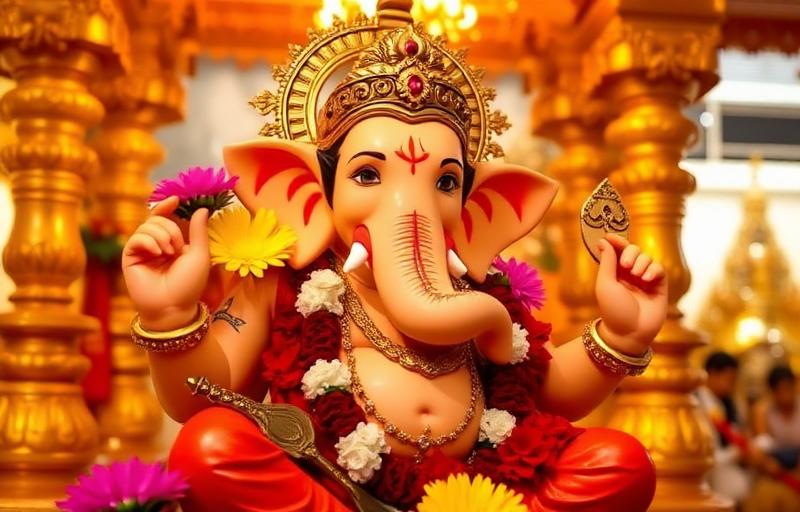
Where Atharvashirsha opens with metaphysical identity claims, Ganesh Chalisa opens more like a story and a heartfelt appeal, describing Ganesha's form, his parents Shiva and Parvati, his beloved modak, his mouse (mushak) vahana, and recounting episodes from his mythology in accessible language, before turning to direct requests for his blessing, protection from obstacles, and grace in the devotee's everyday concerns.
This accessibility is precisely the Chalisa's strength. Its rhythm and rhyme make it genuinely easy to sing, easy to teach a child, and easy to recite together as a family or in a group setting, such as during a Sankashti Chaturthi gathering or a simple evening aarti at home. Many devotees who find Sanskrit recitation intimidating find an immediate, comfortable entry point into daily Ganesha devotion through the Chalisa specifically because it asks nothing of them linguistically beyond fluent Hindi.
Its emotional register also tends to be warmer and more intimate than Atharvashirsha's, appropriate for moments when a devotee wants comfort, reassurance, or a direct, simple appeal rather than philosophical contemplation, the difference between talking to a beloved elder in your own language and reciting a formal, elevated invocation.
When Atharvashirsha Is the Better Fit

Certain occasions and moods lean naturally toward Atharvashirsha, given its formal, contemplative character:
- Structured, formal puja, particularly during Ganesh Chaturthi and Sankashti Chaturthi, when a devotee is following a more elaborate ritual sequence and wants the recitation to match that formality.
- Personal meditative practice, for a devotee who wants to sit with philosophical ideas about the nature of reality and Ganesha's identity as Brahman, using the recitation as a contemplative anchor rather than an emotional appeal.
- When you already have some comfort with Sanskrit and want to deepen your engagement with Vedic-register texts generally, Atharvashirsha is a comparatively accessible entry point into Upanishadic literature, being shorter than most major Upanishads.
- Occasions calling for repeated, structured recitation, some traditions specifically recommend 21 repetitions on significant days for focused intention-setting, a practice suited to Atharvashirsha's dense, formal structure.
- When you want to connect Ganesha worship to broader Vedantic philosophy, since the text explicitly bridges devotional worship and non-dual philosophical assertion in a way few other Ganesha texts attempt.
A useful gut check: if the moment calls for depth, formality and philosophical grounding, reach for Atharvashirsha. If you are newer to Sanskrit or want something you can recite quickly and confidently without a text in hand from the very first attempt, this may not be the natural starting point, the next section's text likely fits better.
It is worth adding that Atharvashirsha's shortness, typically reciting in under five minutes once familiar, means it fits comfortably even into a brief morning puja alongside other elements, contrary to the assumption that its philosophical density also means it takes long to complete.
When Ganesh Chalisa Is the Better Fit
Other occasions and moods lean naturally toward Ganesh Chalisa, given its accessible, warm and narrative character:
- Daily, quick recitation, especially on busy mornings or evenings when a devotee wants a meaningful few minutes of connection without the additional focus Sanskrit pronunciation might demand.
- With children, the Chalisa's story-driven content, simple language and singable rhythm make it a natural first Ganesha text to teach a child, building genuine engagement rather than rote, uncomprehended repetition.
- Group or family recitation, its rhyme and rhythm make it far easier to recite together aloud than a denser Sanskrit prose-and-verse hymn, especially in mixed-generation households.
- Moments needing comfort and reassurance rather than philosophical contemplation, times of stress, worry or a simple desire to feel close to Ganesha in an intimate, accessible way rather than an elevated, formal one.
- Tuesdays and Wednesdays, days commonly associated with Ganesha worship in many regional traditions, when a household wants a simple, repeatable addition to their existing routine rather than a new formal undertaking.
- When Sanskrit fluency is a genuine barrier, there is no spiritual shortfall in choosing the text you can recite with real understanding and feeling over one you can only mechanically sound out; sincerity in a language you actually understand consistently outweighs mechanical recitation of one you do not.
A useful gut check mirroring the previous section: if the moment calls for warmth, accessibility and something the whole family can join in on, Ganesh Chalisa is very likely the better fit, and there is no sense in which choosing it represents a lesser or incomplete devotional practice.
Reciting Both Together: A Combined Approach
There is no rule against reciting both texts, and many devoted households do exactly this, treating them as complementary rather than as alternatives to choose between permanently.
A common combined approach starts with Ganesh Chalisa, using its warm, accessible opening to settle the mind into a devotional mood, before moving into the shorter, denser Atharvashirsha for a few minutes of deeper, more contemplative focus, closing the practice on that elevated note. Others reverse the order, opening with the formal Atharvashirsha while attention is freshest, then closing with the Chalisa's warmth as a gentler transition back into the day.
For those with limited time on an ordinary day, alternating is a practical solution: Ganesh Chalisa on busier weekdays, Atharvashirsha on days with more available time, such as weekends, or specifically on Sankashti Chaturthi and Ganesh Chaturthi when a fuller, more formal practice feels appropriate.
A useful principle for a beginner deciding how to structure their own Ganesha devotion: start with whichever text you can approach with genuine understanding and comfort today, most often the Chalisa for someone without Sanskrit familiarity, and add the other over time as your practice and confidence grow, rather than feeling obligated to master both simultaneously from the outset. Tradition does not impose a required order or a minimum combined practice; it simply offers two well-loved paths to the same beloved deity, each suited to different moments in a devotee's day, mood and life stage.
✨ The Vandnaa app carries both texts with clear Hindi and English readings, so switching between them to match your mood takes seconds, not a search.
Common Questions From Devotees
Is Ganesh Atharvashirsha more powerful than Ganesh Chalisa?+
No, tradition does not rank one as more powerful than the other. They differ in register and occasion, Atharvashirsha being a formal Vedic hymn and Chalisa an accessible devotional poem, but sincerity of devotion matters more than which text is chosen.
Can beginners start directly with Ganesh Atharvashirsha?+
Yes, if comfortable with Sanskrit pronunciation, though many beginners find Ganesh Chalisa's simple Hindi an easier and more immediately understood starting point, adding Atharvashirsha once basic comfort with the Chalisa is established.
When is Ganesh Atharvashirsha traditionally recited?+
It is most commonly recited during structured puja, especially Ganesh Chaturthi and Sankashti Chaturthi, with some traditions recommending repeated recitation, such as 21 times, on significant occasions.
Why is Ganesh Chalisa easier to recite than Atharvashirsha?+
Ganesh Chalisa is composed in simple, rhythmic Hindi rather than dense Vedic Sanskrit, following the accessible chalisa format popularized by the Hanuman Chalisa, making it easier to understand, memorize and sing without prior Sanskrit familiarity.
Is it acceptable to recite both Ganesh Atharvashirsha and Ganesh Chalisa together?+
Yes, many devotees recite both, often opening with the Chalisa to settle into devotion and following with Atharvashirsha for deeper contemplation, or alternating between the two based on available time and occasion.
About the author
Acharya Vinaya Kapoor · M.A. Sanskrit, Mantra & Stotra Studies
Acharya Vinaya holds an M.A. in Sanskrit from Banaras Hindu University and writes the mantra and stotra commentary on Vandnaa. Her focus is on accurate pronunciation, traditional context, and helping modern readers connect with classical texts.
Meet the Vandnaa editorial team →