What Is the Ganapati Atharvashirsha?
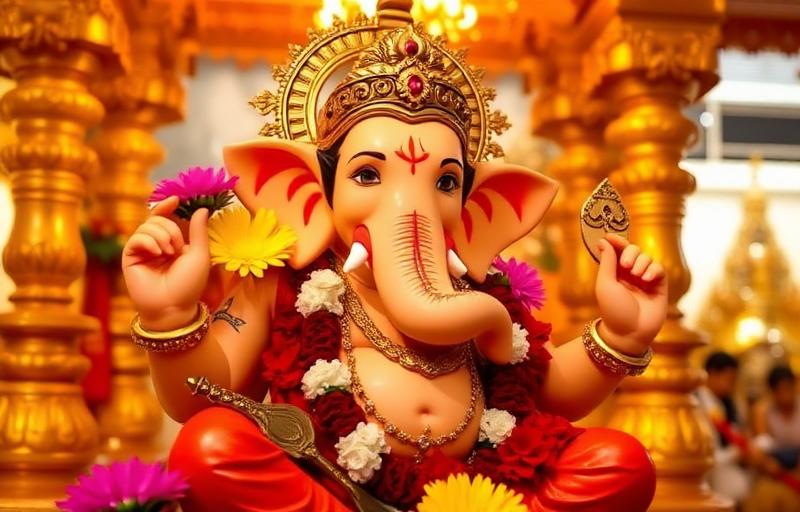
The Ganapati Atharvashirsha, also known as the Ganapati Upanishad, is a short but deeply revered Vedic text associated with the Atharva Veda tradition. It is one of the most important scriptures for devotees of Lord Ganesha.
Unlike a simple prayer of praise, this Upanishad makes a bold spiritual declaration: Ganesha is not merely one deity among many, but the very Brahman, the supreme reality from which all creation arises. The hymn addresses Ganapati as the source, the sustainer and the dissolver of the universe, identical with Om itself.
It is recited daily by many devotees, and especially during Ganesh Chaturthi, Sankashti and Vinayaka Chaturthi, often as part of an abhishekam on a Ganesha murti.
Key Verses & Their Meaning
The heart of the Atharvashirsha is the great identification of Ganapati with the absolute truth:
ॐ नमस्ते गणपतये। त्वमेव प्रत्यक्षं तत्त्वमसि। Om Namaste Ganapataye. Tvameva pratyaksham tattvamasi. (Om, salutations to you, O Ganapati. You alone are the visible manifestation of the Truth - Thou art That.)
त्वमेव केवलं कर्तासि। त्वमेव केवलं धर्तासि। त्वमेव केवलं हर्तासि। Tvameva kevalam kartasi. Tvameva kevalam dhartasi. Tvameva kevalam hartasi. (You alone are the creator. You alone are the sustainer. You alone are the destroyer.)
त्वमेव सर्वं खल्विदं ब्रह्मासि। त्वं साक्षादात्मासि नित्यम्। Tvameva sarvam khalvidam brahmasi. Tvam sakshad atmasi nityam. (You alone are truly all this Brahman. You are verily the eternal Self.)
The text also gives the Ganesha Gayatri and the seed mantra gam:
एकदन्ताय विद्महे वक्रतुण्डाय धीमहि। तन्नो दन्तिः प्रचोदयात्॥ Ekadantaya vidmahe, vakratundaya dhimahi, tanno dantih prachodayat. (We meditate on the single-tusked one, we contemplate the curved-trunk one; may that tusked Lord inspire us.)
Benefits of Reciting It
The Atharvashirsha itself, in its closing phalashruti, promises great fruit to one who recites it with faith:
- Removal of obstacles: As the Vighnaharta, Ganesha clears barriers from one's path and undertakings.
- Wisdom and clarity: It is said to sharpen the intellect (buddhi) and grant clear understanding, dear to students and seekers.
- Spiritual realisation: The text declares the reciter draws near to Brahman, the supreme truth.
- Protection and purification: Daily recitation is believed to purify the mind and protect from negativity.
- Prosperity and fulfilment: Reciting it before beginning new work invites auspicious beginnings.
The benefits are described as flowing from sincere, regular recitation with correct pronunciation, not from a single reading alone.
How to Chant the Atharvashirsha

1. Time and place: Recite after a bath in the morning, ideally before a Ganesha image or murti, facing east or north. 2. Begin with Ganesha: Light a ghee or oil lamp, offer durva grass, red flowers and modak or laddoo if available. 3. Pronunciation: This is a Vedic text, so clear and careful pronunciation is important. Learning from an audio recording or a teacher helps greatly. 4. Repetitions: Many recite it once daily. On special occasions devotees do an abhishekam with 21 recitations (ekavimshati), pouring water or panchamrit over the murti with each round. 5. Durva offering: Offering 21 blades of durva grass during recitation is a cherished tradition. 6. Close with gratitude: End with the Ganesha Gayatri and a short aarti, and distribute prasad.
Consistency and devotion matter more than speed - chant slowly, with the heart fixed on the meaning.
Common Questions From Devotees
What does 'Tvameva pratyaksham tattvamasi' mean?+
It means 'You alone are the visible manifestation of the Truth - Thou art That.' It declares that Lord Ganesha is the supreme Brahman, the very reality behind all creation, perceivable directly.
Is Ganapati Atharvashirsha part of the Vedas?+
It is an Upanishad associated with the Atharva Veda tradition, also called the Ganapati Upanishad. It is widely recited as a sacred Vedic hymn dedicated to Lord Ganesha.
How many times should it be recited for abhishekam?+
A traditional practice is to recite it 21 times (ekavimshati) while performing abhishekam on a Ganesha murti, offering water or panchamrit with each round. Daily reciters often read it once a day.
When is the best time to recite the Atharvashirsha?+
Morning after a bath is ideal, especially on Ganesh Chaturthi, Sankashti Chaturthi and Vinayaka Chaturthi, and on Wednesdays. It is also recited before starting new ventures for an auspicious beginning.
About the author
Acharya Vinaya Kapoor · M.A. Sanskrit, Mantra & Stotra Studies
Acharya Vinaya holds an M.A. in Sanskrit from Banaras Hindu University and writes the mantra and stotra commentary on Vandnaa. Her focus is on accurate pronunciation, traditional context, and helping modern readers connect with classical texts.
Meet the Vandnaa editorial team →