The Katha: A Race Around the World
Lord Shiva and Mata Parvati had two sons - Ganesha and Kartikeya (also called Murugan, Skanda or Subramanya). One day a question arose over which of the two should be honoured first, and in one telling there was a special fruit (in some versions the fruit of wisdom and immortality) to be won.
To settle it fairly, the divine parents announced a challenge: 'Whoever circles the entire world (the universe) and returns first will be the winner.'
Kartikeya, swift and eager, at once leapt upon his peacock and flew off to circumnavigate the whole earth, mountain by mountain, ocean by ocean. Ganesha, with his large form and his small mouse as a mount, knew he could never win such a race by speed. So he paused, thought deeply, and found a different way.
Ganesha's Wise Answer
Instead of rushing off, Ganesha quietly walked up to his parents, Lord Shiva and Mata Parvati, and slowly circled them - going around them seven times (a pradakshina) - and then folded his hands.
When they asked why he had not gone to circle the world, Ganesha answered with gentle wisdom: 'My mother and father contain the whole universe. For me, you are my world. Going around you is the same as going around all of creation.'
The scriptures say that for a child, the parents embody the divine, and that Mata and Pita together hold within them all the worlds, all the holy places and all the gods. By honouring his parents, Ganesha had circled the entire cosmos without taking a step beyond them. When Kartikeya finally returned, exhausted from his journey, he found that Ganesha had already won.
The Meaning of the Story
This beloved katha is not about cleverness winning over effort. Kartikeya's journey was sincere and brave; Ganesha's answer was the fruit of deeper insight. The story teaches several truths at once:
- Parents are the whole world: To a true child, mother and father embody all of creation and the divine itself. Serving and honouring them is the highest pilgrimage.
- Wisdom over speed: The shortest path to truth is sometimes not the fastest motion but the deepest understanding.
- The divine is near, not distant: We often search far and wide for God, when the sacred is present in those right before us, in love and duty close at hand.
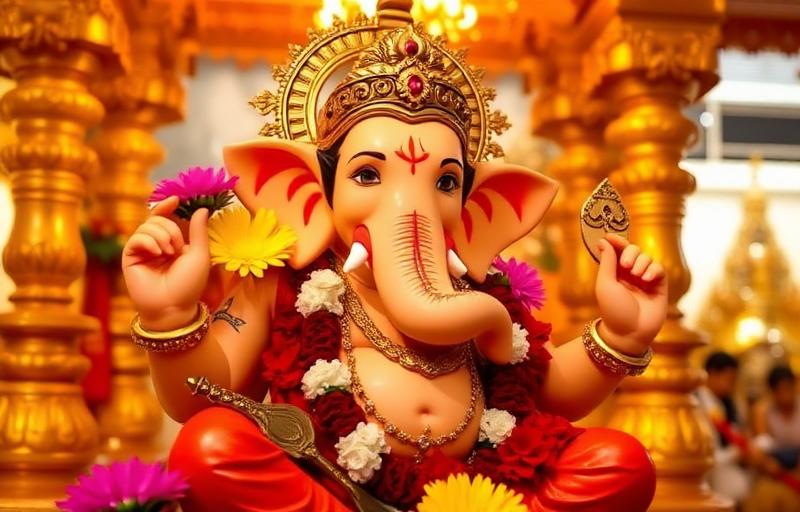
It is also said that this is why Ganesha is honoured first in every Hindu puja - his wisdom and devotion earned him the place of the first-worshipped (Pratham Pujya).
The Lesson for Devotees
The race of Ganesha and Kartikeya leaves us with a teaching as tender as it is profound: we do not have to travel far to find the divine - it lives in the love and care of those closest to us.
For the devotee, this means honouring one's parents and elders as living forms of the sacred, and understanding that true devotion is measured not by grand gestures but by depth of heart. Ganesha did not win by trickery; he won because he saw clearly what was truly worthy of worship. When we begin every prayer with 'Om Gan Ganapataye Namah', we invoke this same wisdom - the intelligence to see the holy where it really is, and the humility to bow before it.
Frequently Asked Questions
What was the race between Ganesha and Kartikeya?+
Shiva and Parvati challenged their sons that whoever circled the whole world first would win. Kartikeya flew off on his peacock to go around the earth, while Ganesha found a wiser way to complete the journey.
How did Ganesha win the race?+
Ganesha simply walked around his parents, Shiva and Parvati, seven times and said that since they contain the whole universe, circling them equals circling all of creation. He won while Kartikeya was still travelling the earth.
What is the moral of the Ganesha race story?+
The story teaches that parents embody the whole world and the divine, that wisdom is greater than speed, and that the sacred is found near us in love and duty, not only in distant journeys.
Is this why Ganesha is worshipped first?+
Yes, by tradition this wisdom and devotion are among the reasons Ganesha is honoured first in every Hindu puja as Pratham Pujya, the first-worshipped, invoked before any auspicious task.
About the author
Anjali Mehta · Editor, M.A. Religious Studies
Anjali is the managing editor for Vandnaa and oversees the festival and vrat coverage. She holds an M.A. in Religious Studies and reviews every published article for accuracy, accessibility, and tradition-fidelity.
Meet the Vandnaa editorial team →