What Is the Garbhagriha
The garbhagriha is the innermost chamber of a Hindu temple, the small, usually windowless room that holds the murti, the consecrated image of the deity. It sits at the exact centre of the temple's ground plan, directly beneath the rising shikhara or vimana tower, and is almost always the smallest, plainest and darkest space in the entire temple complex, in deliberate contrast to the ornate halls and gateways that lead up to it.
Despite, or because of, this simplicity, the garbhagriha is considered the most sacred point of the temple, the place where the deity is believed to be permanently present after the consecration rituals (prana pratishtha) are performed.
The Meaning of 'Womb Chamber'
The word garbhagriha comes from two Sanskrit words: garbha, meaning womb, and griha, meaning house or chamber. Together they mean 'womb chamber', a name that is deeply intentional. Just as a womb is the hidden, protected space where life takes form, the garbhagriha is understood as the sacred space where the divine presence takes concrete form for the devotee.
This womb symbolism connects the garbhagriha to a wider idea found across Hindu thought: that creation itself begins in stillness and darkness before manifesting into the visible world, and that approaching the divine means moving inward, from noise to silence, from light to a deeper light.
How Design Reinforces Meaning
Several design choices reinforce the garbhagriha's meaning.
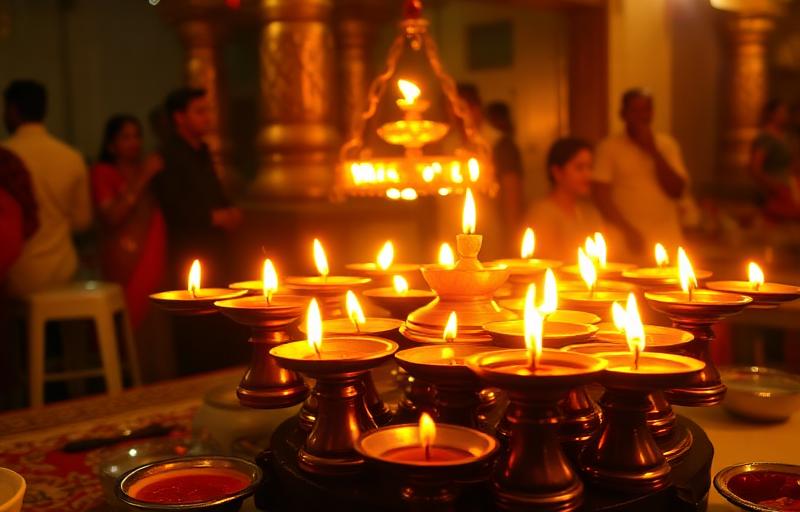
- Darkness: unlike the bright outer halls, the sanctum is kept dim, lit only by oil lamps, encouraging a devotee's focus to turn inward rather than outward.
- Single entrance: the garbhagriha typically has just one doorway and no windows, symbolising a single, focused path to the divine.
- Cube-shaped base: the chamber is traditionally built on a square or cubic plan, considered in shilpa shastra to be the most stable and auspicious of forms.
- Central position: it sits at the very centre of the temple, directly below the highest point of the tower, so that the entire structure is, in effect, built around this one small room.
The Moment of Darshan
For a devotee, walking from the bright, crowded outer mandap into the hushed, dim garbhagriha is often a deeply felt shift. The noise fades, the light lowers, and the eyes adjust to see the murti often illuminated only by a single lamp. This moment of standing before the deity is called darshan, and it is considered the emotional and spiritual peak of a temple visit, the reason the entire journey, from gopuram to mandap to sanctum, was undertaken in the first place.
Who May Enter the Sanctum
In many traditional temples, only the appointed priest, the archaka or pujari, is permitted to enter the garbhagriha itself, performing the daily rituals of abhishekam (ritual bathing), decoration and offering on behalf of all devotees. This is not meant to distance the devotee from the divine, but to preserve the sanctum's stillness and the unbroken discipline of its daily worship, so that when a devotee does approach for darshan, the space remains undisturbed and sacred.
Devotees typically pause at the threshold, sometimes touching it lightly, before receiving darshan from just outside or from within the permitted distance, hands folded, eyes fixed on the murti.
The Deepest Truths in the Smallest Space
The garbhagriha reminds devotees that the deepest truths are often held in the smallest, quietest spaces. Its darkness is not emptiness but concentration, its silence not absence but presence.
Standing before the garbhagriha, even for a few seconds of darshan, is traditionally regarded as a moment of grace. Worship is an act of faith and love, not a transaction, and the humble, dark chamber at the centre of every temple has held that faith steady for centuries.
Common Questions From Devotees
What does garbhagriha mean?+
Garbhagriha is a Sanskrit term meaning 'womb chamber', referring to the small, innermost sanctum of a Hindu temple where the deity's consecrated image is enshrined.
Why is the garbhagriha kept dark and small?+
The darkness and small size are traditionally meant to turn a devotee's attention inward, away from external distraction, and to concentrate the sense of sacredness around the deity at the temple's centre.
Can any devotee enter the garbhagriha?+
In most traditional temples, only the appointed priest enters the garbhagriha to perform daily rituals, while devotees receive darshan of the deity from just outside or from a permitted distance.
About the author
Dr. Suresh Iyer · Vastu Shastra & Jyotish, 18+ years
Dr. Suresh has practiced traditional Vastu and basic Vedic Jyotish for over 18 years across South India. He contributes the Vastu, direction, and home-puja layout guides on Vandnaa.
Meet the Vandnaa editorial team →