Two Different Occasions, One Beloved Deity
It is common for newer devotees to assume Hanuman Jayanti and the weekly Tuesday vrat are simply two names for the same practice, since both center on Hanuman and both are widely observed across North India. They are not the same thing, and understanding the difference actually makes both practices more meaningful, not less.
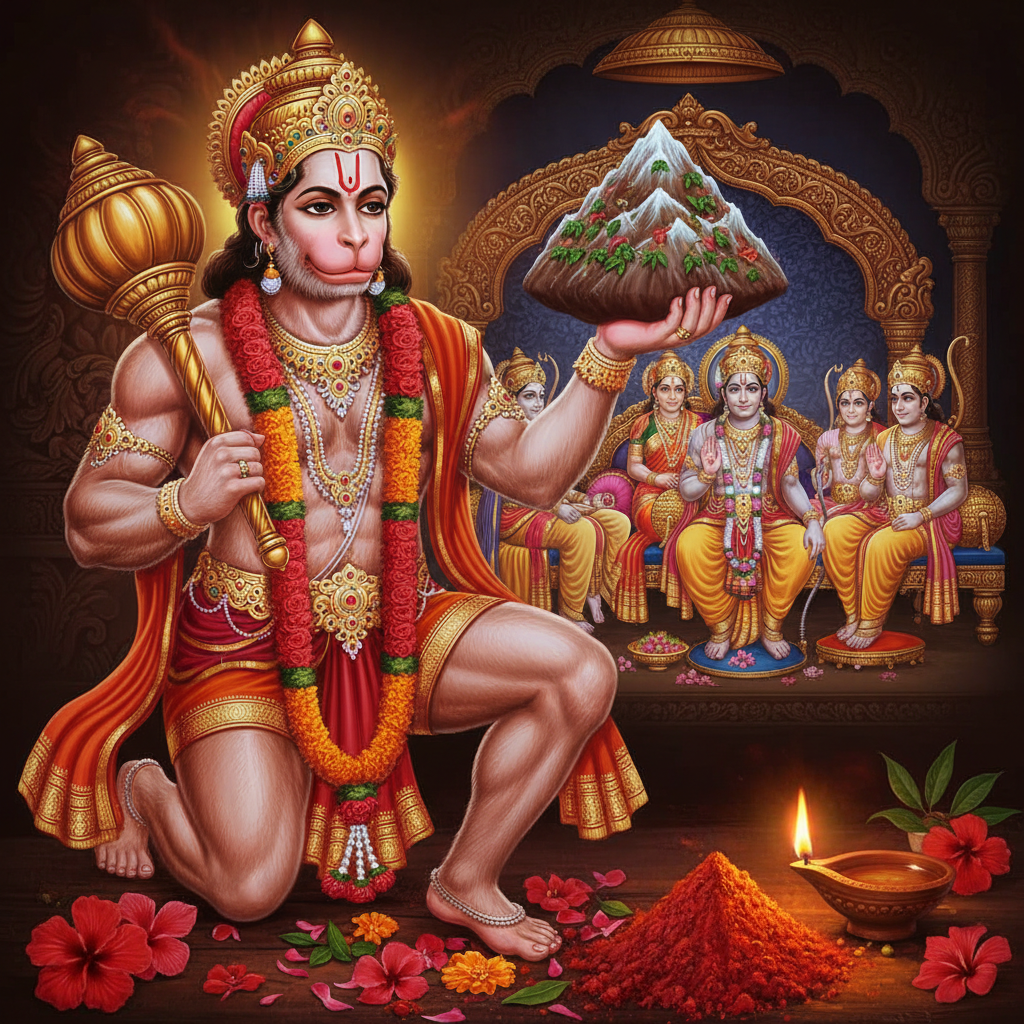
Hanuman Jayanti is an annual festival, a single fixed day each year marking Hanuman's birth, celebrated with the scale and structure of a major festival: temple processions, akhand path (continuous recitation) of the Hanuman Chalisa, large public gatherings and, in many communities, sindoor offerings echoing the katha of Hanuman covering himself in vermillion out of devotion to Sita and Ram. It is a celebration, comparable in spirit to a birthday observed with the whole community.
The Tuesday vrat, by contrast, is a weekly, recurring, largely personal or family-level practice. There is no single "Tuesday Jayanti", every Tuesday (Mangalvar) throughout the year is considered auspicious for Hanuman worship, and devotees who keep this vrat treat it as an ongoing discipline rather than a once-a-year event. It typically involves fasting for the day (in whatever form the individual's family tradition specifies), a visit to a Hanuman temple if possible, and recitation of the Hanuman Chalisa or Bajrang Baan at home.
The simplest way to hold the distinction: Hanuman Jayanti asks "how do we celebrate him, together, on his day," while the Tuesday vrat asks "how do I stay in steady relationship with him, week after week, on my own." Neither replaces the other, and as the sections below explain, most serious devotees of Hanuman end up observing some version of both.
Hanuman Jayanti: The Annual Celebration
Hanuman Jayanti marks the day Hanuman was born to Anjana and Kesari, empowered by Vayu, the wind god. Most of North India observes it on Chaitra Purnima, the full moon of the Chaitra month, typically falling in March or April, though devotees should note that some regional traditions, including parts of South India and certain Vaishnava lineages, mark his birth on a different date, such as Margashirsha Amavasya, reflecting a different but equally valid regional reading of his katha. The site's dedicated Hanuman Jayanti guide covers this year's exact date and full katha in detail.
What distinguishes Jayanti's vidhi from an ordinary day of worship is its scale and specific ritual emphasis:
- Akhand Path: Many temples and communities organize a continuous, unbroken recitation of the Hanuman Chalisa or Sundarkand, sometimes running for 24 hours with devotees taking turns.
- Sindoor offering: Directly tied to the katha where Hanuman applies sindoor to his entire body upon learning Sita does so for Ram's long life, wanting to offer the same devotion multiplied endlessly. Devotees offer sindoor to the murti and often receive a tilak of it in return.
- Public processions and bhandara: Community meals (bhandara) and processions are common, especially near major Hanuman temples, making this a visibly social, celebratory occasion rather than a private one.
- Special katha recitation: The specific story of Hanuman's birth, including the episode of young Hanuman leaping toward the sun mistaking it for a fruit, is retold in many households and temples on this day specifically.
Because it is a fixed annual date rather than a recurring weekly practice, Hanuman Jayanti carries a heightened, once-a-year intensity, similar to how Janmashtami or Ram Navami function for their respective deities, a peak moment rather than an ongoing rhythm.
The Tuesday Vrat: The Weekly Discipline
The weekly Tuesday vrat rests on a different logic entirely. Tuesday (Mangalvar) is associated with Mangal (Mars) and, by extension, with Hanuman's fierce, protective, obstacle-removing energy, making it the traditional day of the week set aside for his worship, much as Monday belongs to Shiva and Thursday to Vishnu and Brihaspati.
A typical Tuesday vrat includes:
- A fast for the day, the specifics varying by family and region, some observe a full fast taking only water, others eat once after sunset, and many follow a simpler falahar (fruit and milk-based) fast rather than a strict one, since tradition places sincerity above severity.
- Wearing red or orange, colours closely associated with Hanuman, and some devotees specifically avoid non-vegetarian food, alcohol and, in some traditions, even certain vegetables like garlic and onion for the day.
- Temple visit and offerings, particularly of boondi laddoo, chola (a dish of boiled gram), or a simple laddoo, along with sindoor and a red or saffron cloth (chola) for the murti in some regional customs.
- Recitation at home, most commonly the Hanuman Chalisa, though many devotees also read the Bajrang Baan or Sankat Mochan Ashtak, especially when the vrat is being kept for a specific difficulty or obstacle in life.
Unlike Jayanti, the Tuesday vrat is rarely a public, community-scale event. It functions primarily as personal or family sadhana, often undertaken for a specific period, sixteen or twenty-one consecutive Tuesdays being a common traditional commitment, similar in structure to the Solah Somvar vrat kept for Shiva, rather than as an unbroken lifetime commitment from day one.
Because it repeats weekly, this vrat builds a very different kind of relationship with Hanuman than Jayanti does: not a single peak of devotion, but a steady, accumulating discipline that shapes the devotee's week around a recurring point of humility and request for strength.
Side by Side: The Key Differences

A quick comparison, gathering the distinctions covered above into one place for easy reference:
- Frequency: Hanuman Jayanti occurs once a year on a fixed date; the Tuesday vrat occurs every week, all year round.
- Scale: Jayanti is typically a large, public, community-organized celebration; the Tuesday vrat is typically a private, personal or family-level practice.
- Core ritual: Jayanti centers on akhand path, sindoor offering and katha recitation of his birth story; the Tuesday vrat centers on fasting, a temple visit and regular Chalisa or Bajrang Baan recitation.
- Purpose: Jayanti primarily celebrates and commemorates Hanuman's birth and life; the Tuesday vrat is more commonly undertaken to seek his protection, remove a specific obstacle, or build ongoing strength and discipline.
- Commitment style: Jayanti asks for one day of focused participation each year; the Tuesday vrat asks for sustained, repeated commitment, often for a set number of weeks.
- Fasting requirement: Jayanti does not universally require a strict fast, participation and worship are the main focus; the Tuesday vrat typically does involve some form of fasting as its central discipline.
Neither occasion is "more important" than the other in any doctrinal sense, they simply serve different devotional functions. A devotee who only ever attends Jayanti celebrations gets a once-a-year jolt of collective devotion; a devotee who only keeps the Tuesday vrat builds a quieter, more continuous relationship. Tradition does not rank these against each other, it simply offers both as complementary ways of staying connected to the same deity.
Understanding this table also clarifies a common point of confusion for newer devotees: missing Hanuman Jayanti in a given year is not the same lapse as missing a Tuesday during an ongoing 16-week vrat commitment. The former is a missed celebration; the latter can actually break a specific vow's continuity, which is why many traditions allow restarting a broken Tuesday vrat sequence from day one, a flexibility Jayanti, being a single yearly date, does not need.
Can a Devotee Observe Both?
Yes, and in practice, most committed devotees of Hanuman do exactly this without seeing any conflict between the two. The two practices are not competing claims on the same devotion; they operate on different timescales and serve different purposes, which is precisely what allows them to coexist comfortably.
A devotee who keeps the weekly Tuesday vrat throughout the year naturally treats the Tuesday that falls closest to, or that year happens to be, Hanuman Jayanti with extra significance, folding the annual celebration into their existing weekly rhythm rather than treating it as a separate obligation. Conversely, someone who does not keep a weekly vrat at all can still participate fully and meaningfully in Hanuman Jayanti as a once-a-year act of devotion, with no requirement to "graduate" to a weekly practice.
A natural progression many devotees follow, without any formal rule requiring it: begin with occasional temple visits and full participation in Hanuman Jayanti each year, and once that annual celebration starts to feel personally meaningful rather than merely cultural, consider taking up the weekly Tuesday vrat for a defined period, such as sixteen weeks, as a deliberate deepening of the relationship. This mirrors how many devotional practices in Hindu tradition are structured, starting with the accessible, communal expression and moving, at one's own pace and readiness, toward the more sustained, personal one.
There is no scriptural or traditional objection to observing both simultaneously for years on end, and no requirement to choose one over the other permanently. Some devotees keep the Tuesday vrat for a defined sixteen or twenty-one week period as a specific vow, then pause it, then pick it back up in a future year, while continuing to observe Hanuman Jayanti every single year regardless. The two calendars simply run alongside each other.
Choosing What Fits Your Life Right Now
For a reader deciding where to start, the choice does not need to be complicated. A few honest questions help clarify it:
- Do you want a once-a-year, community-oriented experience, or an ongoing personal discipline? If the former, simply mark Hanuman Jayanti on your calendar, plan to visit a temple or join an akhand path if one is nearby, and let that be enough for now. If the latter, the Tuesday vrat is the more natural fit.
- Are you currently facing a specific obstacle, fear, or difficulty? Many devotees turn specifically to the Tuesday vrat during a hard season of life, a health worry, a job search, a legal matter, treating the sixteen-week commitment as a focused period of seeking Hanuman's protective strength, then returning to lighter, occasional worship once that season passes.
- Can you realistically sustain a weekly fast right now? Be honest about your health, work demands and family situation. A shorter, gentler falahar-based Tuesday practice, or simply reciting the Hanuman Chalisa every Tuesday without a strict fast, is a completely legitimate starting point; the vrat does not have to be all-or-nothing from week one.
- Do you already have a strong pull toward Hanuman specifically, as opposed to general devotional practice? If Hanuman already feels like your ishta devta (chosen personal deity), the deeper, weekly commitment of the Tuesday vrat tends to feel less like an obligation and more like a welcome anchor in the week.
Whatever you choose, both paths lead back to the same core relationship, sincere devotion to Hanuman as protector, remover of obstacles and model of unwavering service. The calendar structure around that devotion, annual or weekly, is simply a container; what tradition actually asks for is the sincerity inside it.
🕉️ The Vandnaa app can remind you every Tuesday and on Hanuman Jayanti itself, so neither practice depends on remembering the date yourself.
What People Ask Most
Is Hanuman Jayanti the same as the Tuesday vrat?+
No. Hanuman Jayanti is a single annual festival marking his birth, celebrated once a year on a fixed date, while the Tuesday vrat is a weekly, recurring personal or family fasting practice observed every Tuesday throughout the year.
Do I need to fast on Hanuman Jayanti?+
Not universally. Hanuman Jayanti's focus is celebration, temple participation, akhand path and katha recitation. Many devotees do not observe a strict fast on this day, unlike the Tuesday vrat, where fasting is typically the central practice.
Can I keep the Tuesday vrat and also celebrate Hanuman Jayanti every year?+
Yes, absolutely. The two practices are complementary, not competing. Most committed devotees observe both, treating the weekly vrat as ongoing discipline and Hanuman Jayanti as the year's peak celebration, with no traditional objection to combining them.
How many Tuesdays should a beginner commit to for the vrat?+
Sixteen or twenty-one consecutive Tuesdays is a common traditional commitment, similar in structure to the Solah Somvar vrat for Shiva. Beginners can also start more gently with weekly Chalisa recitation alone, without a strict fast, before committing to a fixed count.
Why is Tuesday specifically associated with Hanuman worship?+
Tuesday (Mangalvar) is associated with Mangal (Mars) and, by extension, with Hanuman's fierce, protective and obstacle-removing energy, making it the traditional weekday set aside for his worship, much as Monday belongs to Shiva.
About the author
Pandit Mahesh Trivedi · Festival Traditions & Panchang
Pandit Mahesh leads the festival-date and Panchang content on Vandnaa. He cross-references multiple regional panchangs (Drik, Vaishnava, Bengali, Marathi) for every festival date published on the site.
Meet the Vandnaa editorial team →Explore on Vandnaa
Related Articles
Hanuman Jayanti 2026: Date, Puja Vidhi, Sundarkand & 7 Most Powerful Hanuman Mantras
9 min read
Hanuman Ashtami 2026 - Significance, Legend and Puja Vidhi of Ujjain's Festival
9 min read
Best Time to Chant Hanuman Chalisa – Morning, Night, Tuesday & 7 Power Moments
12 min read

Ram Raksha Stotra as a Daily Protection Practice: How to Begin
7 min read