The Temple at Idagunji
The Shri Vinayaka temple at Idagunji stands in Honnavar taluk, Uttara Kannada district, Karnataka, a short distance inland from the coast near the Sharavati estuary.
What is there:
- A temple in the coastal Karnataka idiom, with a tiled roof and a compound
- The image of Ganapati in black stone, a little under a metre in height
- The unusual thing about it, which is the form itself
- Subsidiary shrines and a tank
- A very large volume of visitors for a village temple
The form. This is what brings people:
- Ganapati here is standing, in the sthanaka posture, not seated
- He has two arms, not four
- One hand holds a lotus, the other a modaka
- The face and body are treated as those of a child, and he is understood here as Bala Ganapati
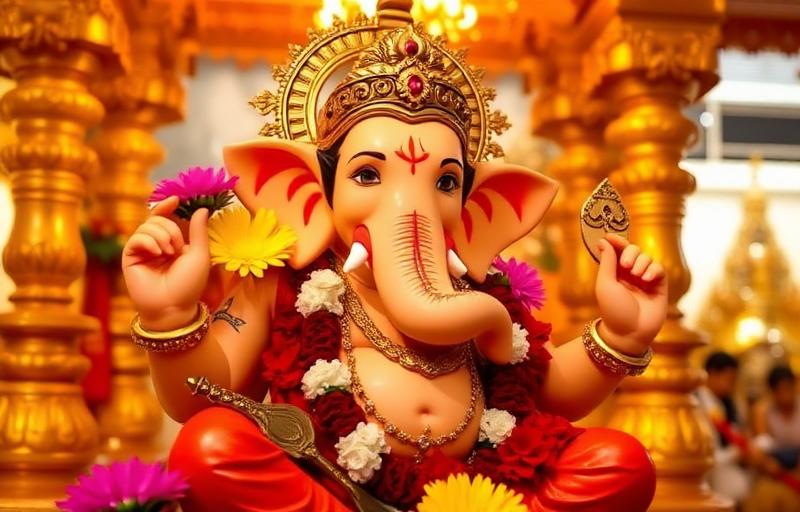
Why that is remarkable. Ganesha is among the most represented deities in the world and his iconography is highly standardised. He is normally shown seated, with four arms, holding a noose, a goad, a broken tusk and a bowl of modakas in the most common arrangement.
A standing, two armed, child form is a genuine departure, and it is old. Idagunji is one of the small number of places where an early and less standardised Ganesha survives in continuous worship, which makes it interesting to anyone who cares how a deity's image settled into the form we now take for granted.
The Katha of the Sages
The story attached to the shrine explains both why Ganapati is here and why he is a child.
As it is told:
- At the end of the Dvapara Yuga, with the Kali Yuga approaching, sages sought a place where they could continue their observances undisturbed
- A group led by the sage Valakhilya came to this region, near the Sharavati, and chose it
- Difficulties arose in completing their yajna
- Narada advised them to invoke Ganapati, the remover of obstacles, before proceeding
- Ganapati appeared to them in the form of a child
- The image installed here preserves that form, and the place became a shrine
The location's older name is given as Kunjaravana, and the deity is addressed in some usage as Devaganapati.
Why Ganapati is invoked first. This is the most widely observed rule in Hindu practice and is worth stating plainly for anyone who has wondered about it.
- Ganapati is Vighnaharta, the remover of obstacles, and also Vighneshvara, the lord of obstacles, which is the more precise title
- He both places and removes obstacles, and the point of invoking him first is to have him clear the path for whatever follows
- Every puja, every wedding, every new undertaking, the first page of a ledger and the start of a journey begin with him
- The rule is so general that it operates across sectarian lines. A Shaiva, a Vaishnava and a Shakta ritual will all begin the same way
The katha at Idagunji is that rule in narrative form. Sages doing serious work ran into obstruction, invoked the deity whose department that is, and were able to continue.
How Ganesha's Image Settled
The Idagunji image is a good occasion to look at how a deity's iconography develops, because it preserves a stage that mostly disappeared.
The standard modern Ganesha:
- Seated, often with one leg folded and one down
- Four arms, holding the pasha or noose, the ankusha or goad, the broken tusk, and a bowl of modakas
- A mouse as vahana
- Large belly, single tusk, snake around the waist
What varies, and there is a great deal of variation:
- Standing forms exist, though they are far less common
- Two armed forms are early and become rarer as the iconography standardises
- Dancing Ganeshas, Nritya Ganapati, are common in temple sculpture
- Forms with more arms, up to a great many, appear in tantric contexts
- Ucchishta Ganapati, Heramba, Bala and a long list of named forms each have their own prescriptions, and lists of thirty two forms are given in some traditions
What the two armed form indicates. Multiplication of arms in Indian iconography is generally a way of showing capacity, since each hand carries an attribute and each attribute is a function.
Early images of many deities have fewer arms, and the number increases as theology develops and more functions are attributed. A two armed Ganesha therefore usually points to an early conception or to a deliberate archaism.
Why Idagunji preserved it. Continuous worship is conservative. An image that has been the focus of an unbroken tradition does not get replaced when fashions change, because the image is the deity and not a representation of him.
That is why the oldest surviving forms of many deities are found not in museums but in small temples that never stopped, and Idagunji is a clear case.
What Is Offered
The offerings at Idagunji follow the deity's own preferences as the tradition understands them, and they are worth knowing before you go.
What devotees offer:
- Modaka, the steamed sweet dumpling that is Ganapati's own food
- Panchakajjaya, a mixture of ingredients including coconut, jaggery and sesame, characteristic of Karnataka
- Durva grass, the three bladed grass offered to Ganesha across India
- Coconut, flowers and lamps
- Vows are fulfilled here in various forms, including specified numbers of coconuts and prescribed offerings
On durva grass. It is worth a note because visitors often notice it and do not know what it is.
- Durva, Cynodon dactylon, is a common grass offered to Ganesha and to almost nobody else
- It is offered in bunches, generally in odd numbers of blades
- The katha usually given is that Ganesha, after consuming a demon who caused a burning within him, was relieved only when durva was offered
- The practical reading is that a deity whose offering is a weed anyone can pick has been made available to everyone, which fits Ganesha's character as the most domestic and least exclusive of the great deities
On animal sacrifice. Ganapati shrines do not receive it, and Idagunji's offerings are entirely vegetarian.
That is worth stating because in this same coastal region there are shrines where animal offering has traditionally been made, particularly in the spirit worship traditions of the districts further south. The two systems sit side by side in the same landscape, with entirely different rules, and devotees generally move between them without difficulty.
Understanding which kind of shrine you are in matters, and Idagunji is unambiguously the first kind.
The Uttara Kannada Coast
Idagunji sits in one of the more beautiful and less developed stretches of the Indian coast, and the surroundings deserve time.
The geography:
- Uttara Kannada runs from the Western Ghats down to the Arabian Sea in a short distance, so hills, rivers, estuaries and beaches are all within a few kilometres of each other
- The Sharavati reaches the sea at Honnavar, forming a wide estuary
- The district is heavily forested, with some of the best remaining forest cover in the Western Ghats
- Rainfall here is very high
Nearby:
- Honnavar, at the Sharavati estuary, with backwater boat trips
- Apsarakonda falls and beach
- Murudeshwar, with its very large modern Shiva statue and temple on a headland, about fifty kilometres away
- Gokarna, further north, a major Shiva shrine and a well known beach destination
- Jog Falls, upriver on the Sharavati, among the highest waterfalls in India and at their most dramatic in and just after the monsoon
- Yana, with its extraordinary black karst rock formations in the forest
Why the region is worth a slow trip. The Konkan and Karnataka coast north of Mangaluru is one of the last stretches of Indian coastline that has not been comprehensively developed.
What that gives you is a landscape where a village Ganapati temple, a working fishing harbour, a river estuary, a forest with hornbills and a beach with nobody on it can all occur within an afternoon's driving.
It is also under pressure, from port development, road widening and the general expansion of coastal tourism. Anyone travelling here should be conscious that the region's appeal depends on things that are actively being lost, and behave accordingly.
Visiting Idagunji
Getting there
- Idagunji, Honnavar taluk, Uttara Kannada district, Karnataka
- About 14 km from Honnavar, which is the nearest town
- Honnavar has a station on the Konkan Railway, which is the easiest way to reach this coast
- Roughly 130 km from Hubballi and about 470 km from Bengaluru by road
- Mangaluru and Goa are the nearest airports
Timings
- The temple opens in morning and evening sessions with a midday closure. Check locally
- Queues can be long on weekends and festival days despite the village setting
When to go
- October to February for the best weather on this coast
- Ganesh Chaturthi in Bhadrapada, the temple's principal occasion, when crowds are very heavy
- Sankashti Chaturthi each month, observed by regular devotees
- The monsoon, June to September, is spectacular in this district but travel is harder and the rain is serious
Practical notes
- Dress conservatively. Some temples in coastal Karnataka expect men to remove upper garments in the sanctum area, so check the local rule
- Leave footwear at the counters
- Offerings including modaka and panchakajjaya are available at the temple
- Carry cash. Facilities in the village are limited
- The temple provides prasad and there are arrangements for meals on festival days
Combining the visit
- Honnavar and the Sharavati estuary, with backwater boat trips
- Murudeshwar, fifty kilometres south, for the headland temple
- Jog Falls, upriver, best in and just after the monsoon
- Yana rock formations, inland in the forest
- Gokarna, north along the coast
If you are travelling the coast
- The Konkan Railway runs the length of this coastline and is one of the best rail journeys in India, particularly in the monsoon
- Distances between sites look short on a map and take longer in practice, because the road follows the coast and crosses estuaries
A closing thought. Ganesha is the most recognisable deity in the Hindu pantheon and, for most people, the most fixed in appearance. Idagunji quietly demonstrates that the fixity is recent, that the tradition experimented for a long time before settling, and that in at least one village nobody agreed to the final version.
What People Ask Most
What is unusual about the Idagunji Ganapati?+
He is standing rather than seated, has two arms rather than four, holds a lotus in one hand and a modaka in the other, and is treated as a child form, Bala Ganapati. Ganesha is normally shown seated with four arms, so this is a genuine and old departure preserved in continuous worship.
What is the katha of the temple?+
That at the end of the Dvapara Yuga, with Kali Yuga approaching, sages led by Valakhilya sought a place for their observances and chose this region near the Sharavati. Difficulties arose in completing their yajna, Narada advised invoking Ganapati, and he appeared to them as a child. The image preserves that form.
Why is Ganapati invoked first in every ritual?+
He is Vighnaharta, remover of obstacles, and Vighneshvara, lord of obstacles, the more precise title, since he both places and removes them. Invoking him first is to have the path cleared for whatever follows. The rule is so general that Shaiva, Vaishnava and Shakta rituals all begin the same way.
Why is durva grass offered to Ganesha?+
The katha usually given is that Ganesha, after consuming a demon who caused a burning within him, was relieved only when durva was offered. It is offered in bunches, generally in odd numbers of blades. A deity whose offering is a grass anyone can pick has been made available to everyone.
How do I reach Idagunji?+
It is about 14 km from Honnavar in Uttara Kannada district, Karnataka. Honnavar has a station on the Konkan Railway, which is the easiest way to reach this coast. By road it is roughly 130 km from Hubballi and about 470 km from Bengaluru, with Mangaluru and Goa the nearest airports.
What else is worth seeing nearby?+
Honnavar and the Sharavati estuary with its backwater boat trips, Apsarakonda falls and beach, Murudeshwar about fifty kilometres south, Jog Falls upriver on the Sharavati which are best in and just after the monsoon, the Yana rock formations inland in the forest, and Gokarna further north along the coast.
About the author
Pandit Ravindra Sharma · Vedic Rituals & Bhakti, 22+ years
Pandit Ravindra is the Vandnaa editorial team's resident specialist on aarti, chalisa, and daily devotion. He has performed home and temple pujas across Varanasi and Delhi for over two decades and contributes the bhakti-focused articles on this site.
Meet the Vandnaa editorial team →