A Temple on the Sand
The Kunkeshwar temple stands at Kunkeshwar village in Devgad taluka, Sindhudurg district, on the Konkan coast of Maharashtra, directly above the beach.
What is there:
- A stone temple with a shikhara, in a walled compound at the top of the beach
- A linga in the sanctum, the deity being Shiva as Kunkeshwar
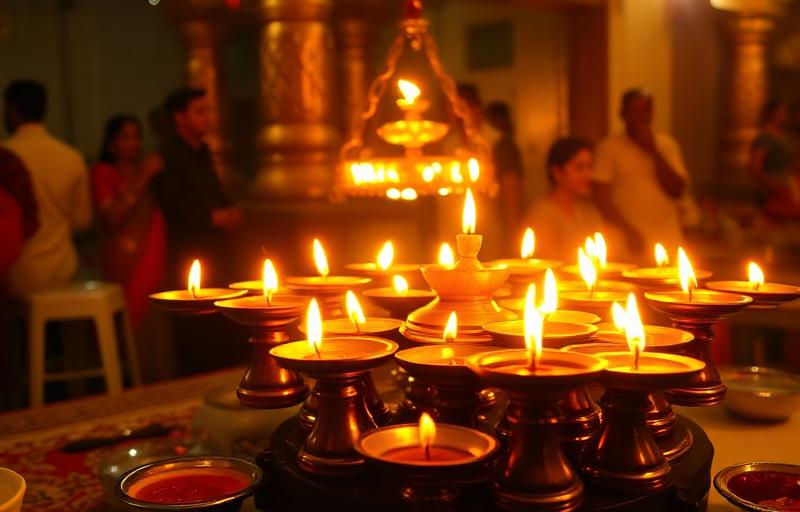
- A deepstambha, the lamp tower standing before the temple, which is a characteristic feature of Konkan and Goan temple building
- A courtyard, subsidiary shrines and a tank
- The Arabian Sea immediately outside, with the sand running up to the compound
What the setting does. Indian temples are usually approached through a settlement, along a street lined with shops, so that the shrine sits at the end of a built up sequence.
Here the sequence ends and then there is sand, and then the sea. There is nothing behind the temple, and nothing beyond it. The sound inside the compound, particularly in the monsoon and at high tide, is the sea, continuously.
Why that matters devotionally. A shrine placed at the edge of the land, facing an ocean, is making the same statement as a shrine at a river source or a mountain pass. It sits at a boundary, at the point where the known ends, and it is worth understanding that Indian sacred siting keeps returning to exactly those points.
The Katha of the Sailor
The story told at Kunkeshwar concerns someone at sea, which is exactly what a coastal shrine's story ought to be about.
The outline, as it is told locally:
- A ship was caught in a storm off this coast
- The person aboard, variously described in different tellings as a merchant, a trader or a foreign traveller, prayed for deliverance
- The vessel came safely to shore at this spot
- In gratitude, the temple was built or endowed
The tellings vary considerably in detail, including in who the person was and what became of them afterwards, and some versions carry endings that are not told the same way by everyone. The core of it, which is consistent, is a rescue at sea and a temple built as the return.
Why coastal shrines have stories like this. It is not a coincidence, and the pattern is worldwide.
- Going to sea in a wooden boat was genuinely dangerous, and everyone on this coast knew families who had lost people to it
- A community whose livelihood depends on returning from the water will make offerings about returning from the water
- A vow made in fear and fulfilled on land is the most common form of religious construction anywhere, and coastal temples are full of them
What this shrine records. Read this way, Kunkeshwar is a receipt. Somebody was in trouble at sea, made a promise, survived, and paid what they had promised.
That is a much more ordinary and much more human origin for a temple than a divine manifestation, and the Konkan coast is lined with shrines that began the same way. It is worth remembering when you are standing in the compound listening to the surf, that this is what the building is for.
How Konkan Temples Are Built
The Konkan has a temple style of its own, distinct from both the Deccan interior and from north India, and Kunkeshwar shows several of its features.
What to look for:
- The deepstambha, a free standing lamp tower before the temple, with projecting brackets on which oil lamps are placed. Lit for festivals, a full deepstambha is one of the most striking sights in Indian religious practice
- Tiled roofs on many Konkan temples, sloping steeply because the region receives extremely heavy monsoon rain, giving the buildings a domestic rather than monumental character
- Wooden structural elements and carved wooden pillars in older buildings, a response to timber being abundant and stone quarrying being harder in places
- Sabhamandapa, a large assembly hall, generally more prominent than in north Indian temples
- A tulsi vrindavan in the courtyard and the compound wall enclosing a defined precinct
Why the style is different:
- The rainfall is among the highest in India, and roofs had to shed water fast
- The region was under Shilahara, Vijayanagara, Bijapur, Portuguese, Maratha and British influence at different times, and the architecture absorbed from several directions
- Goan and Konkani temple building share a great deal, including the deepstambha and the layout, and the boundary between the two is a modern administrative line rather than a cultural one
What you also see across this coast:
- Guardian deities, Ravalnath, Betal, Santeri and others, in village shrines with their own distinct practice
- Sacred groves, the devrai, patches of forest protected on religious grounds, which are among the region's most important surviving habitats
- Naga shrines and stones under trees, often extremely old and entirely unmarked
The Konkan's religious landscape is denser and stranger than a visitor driving to a beach ever sees, and Kunkeshwar is the most accessible entry point into it.
Mahashivratri at Kunkeshwar

The temple's great occasion is Mahashivratri, in the month of Phalgun, and the fair here is one of the largest in the district.
What happens:
- A yatra is held over several days around Mahashivratri
- Devotees come from across Sindhudurg, Ratnagiri and Kolhapur, and from the Konkani diaspora in Mumbai
- Night long observance, with the temple open through the night
- Abhishek performed continuously, and long queues
- A market and folk entertainment along the beach and the approach road
On Mahashivratri generally. It is the one night of the year when Shiva temples across India stay open and awake, and the observance has a specific character:
- Jagaran, staying awake through the night, is the central practice
- The night is divided into four prahars, and abhishek is performed in each
- Offerings of bel patra, water, milk, and in many places bhang
- Fasting through the day and breaking it the next morning
Why the night. Shivratri means the night of Shiva, and the tradition gives several accounts, including that it marks the night of Shiva's marriage to Parvati, and that it is the night he performed the tandava.
The practical logic beneath it is that Shiva is a deity of what lies outside the settled and the daylight world. Cremation grounds, mountains, forests, intoxicants, ash and the night belong to him in a way they belong to no other major deity.
A night vigil for Shiva at a temple on an empty beach, with the sea audible in the dark and nothing beyond it, is about as complete a setting for that as India offers.
Devgad and the Sindhudurg Coast
Kunkeshwar sits in a district that is one of the most attractive and least visited parts of coastal India.
Devgad itself:
- A small port town with a fort on the headland, built in the Maratha period
- A lighthouse and a working fishing harbour
- A line of wind turbines along the ridge above the sea, which have become part of the view
- Devgad Alphonso, among the most highly regarded mangoes in India, grown in the orchards inland from the coast
Sindhudurg district:
- Named for the Sindhudurg sea fort at Malvan, built under Shivaji in the seventeenth century on an island offshore
- Malvan, with its beaches, its snorkelling and its distinctive cuisine
- Tarkarli beach and the Karli backwaters
- Amboli, in the ghats above, one of the wettest places in Maharashtra and rich in endemic species
- Sawantwadi, known for its lacquerware and wooden toys
- Vengurla and the coast down to the Goa border
The mango. Devgad and the surrounding coast produce Alphonso of a quality that commands a premium across India, and the season, roughly April to June, transforms the local economy each year. If you are here then, buy directly from an orchard rather than from a roadside stall, and expect to pay properly for the real thing.
Why the district is worth time. Sindhudurg has beaches without resorts, forts without ticket queues, temples that are entirely working shrines, and food that is one of the best regional cuisines in India.
It is also fragile. The coast is under pressure from development, and the difference between a Konkan village beach and a commercialised one is a decade of unmanaged tourism. Visit gently.
Visiting Kunkeshwar
Getting there
- Kunkeshwar, Devgad taluka, Sindhudurg district, Maharashtra
- Roughly 15 km from Devgad town and about 60 km from Kankavli
- Kankavli and Nandgaon Road are the nearest stations on the Konkan Railway, which is the best way to reach this coast
- Roughly 440 km from Mumbai and 380 km from Pune by road
- Buses and autos run from Devgad. A car or a two wheeler gives you the coast road, which is the point
Timings
- The temple keeps daily hours with aarti morning and evening. Check locally
- The compound is open through the day
When to go
- October to February for the best weather, calm sea and clear skies
- Mahashivratri in Phalgun for the yatra, the temple's largest occasion
- April to June if you want the mango season, accepting the heat
- The monsoon, June to September, is spectacular here and the sea is at its most dramatic, but swimming is out of the question and travel is harder
At the beach
- Do not swim carelessly. The Konkan coast has strong currents and this is an open beach with no lifeguard
- Swim only where local advice says it is safe, never alone, never after alcohol, and never in the monsoon
- If caught in a rip current, do not swim against it. Swim parallel to the shore until you are out of it
- Keep children within arm's reach at the water
Practical notes
- Dress and behave as at a working shrine. This is a village temple, not a beach attraction
- Remove footwear at the appropriate point
- Carry water in warm months. There is little shade
- Homestays in the village and around Devgad are the best accommodation, and the food is a large part of why
- Carry cash. Card facilities are limited
Combining the visit
- Devgad fort, lighthouse and harbour
- Malvan, Sindhudurg fort and Tarkarli, south along the coast
- Amboli in the ghats, especially in and just after the monsoon
- Sawantwadi for the lacquerware
A closing thought. India has an enormous coastline and remarkably few famous coastal temples, because the great pilgrimage centres grew up on rivers. Kunkeshwar is a reminder of the other tradition, the one belonging to people whose prayers were about getting home across water, and whose temple sits where they would have first seen land.
Frequently Asked Questions
Where is the Kunkeshwar temple?+
At Kunkeshwar village in Devgad taluka, Sindhudurg district, on the Konkan coast of Maharashtra, standing directly above the beach. It is roughly 15 km from Devgad town, with Kankavli and Nandgaon Road the nearest Konkan Railway stations.
What is the katha of the temple?+
That a ship was caught in a storm off this coast, the person aboard, described variously as a merchant, trader or foreign traveller, prayed for deliverance, the vessel came safely to shore here, and the temple was built or endowed in gratitude. Tellings vary in detail, but the core is a rescue at sea repaid with a temple.
What is a deepstambha?+
A free standing lamp tower placed before the temple, with projecting brackets on which oil lamps are set. It is a characteristic feature of Konkan and Goan temple building, and a fully lit deepstambha at a festival is one of the most striking sights in Indian religious practice.
When is the temple's main festival?+
Mahashivratri in the month of Phalgun, when a yatra is held over several days and the fair is among the largest in the district. Devotees come from across Sindhudurg, Ratnagiri and Kolhapur, the temple stays open through the night, and abhishek is performed continuously.
Is the beach safe for swimming?+
Treat it with caution. The Konkan coast has strong currents and this is an open beach with no lifeguard. Swim only where local advice says it is safe, never alone, never after alcohol and never in the monsoon. If caught in a rip current, swim parallel to the shore rather than against it, and keep children within arm's reach at the water.
What else is worth seeing in Sindhudurg?+
Devgad fort, lighthouse and fishing harbour; Malvan with the Sindhudurg sea fort built under Shivaji on an island offshore; Tarkarli beach and the Karli backwaters; Amboli in the ghats above, one of the wettest places in Maharashtra; and Sawantwadi for its lacquerware and wooden toys.
About the author
Pandit Ravindra Sharma · Vedic Rituals & Bhakti, 22+ years
Pandit Ravindra is the Vandnaa editorial team's resident specialist on aarti, chalisa, and daily devotion. He has performed home and temple pujas across Varanasi and Delhi for over two decades and contributes the bhakti-focused articles on this site.
Meet the Vandnaa editorial team →