The Temple at Bhuleshwar
The Mumbadevi temple stands at Bhuleshwar in south Mumbai, in the dense lanes behind the jewellery and cloth markets, a short walk from Zaveri Bazaar.
What is there:
- A compact temple with a courtyard, entirely surrounded by market buildings
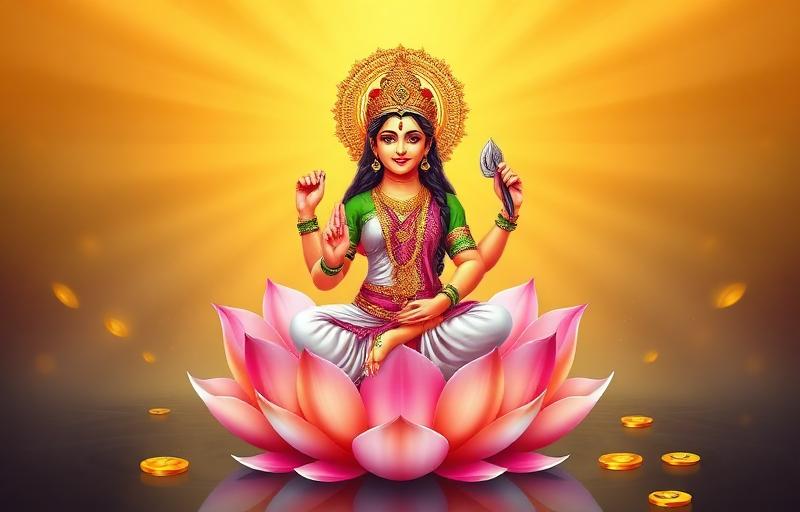
- The image of Mumbadevi, in black stone, wearing a silver crown, a nose stud and a gold necklace
- An image of Annapurna seated, and other shrines within the complex
- A tiger figure, the vahana associated with the Devi
- Shops immediately outside selling flowers, coconut, chunari and prasad
Why she matters beyond the neighbourhood:
- Mumbai is named after her. Mumba is the goddess and aai is mother in Marathi, and Mumba Aai gives Mumbai
- She is the kuldevi of the Koli community, the fishing people who were living on these islands long before the city existed
- Her temple was the shrine of the original settlement, not of the city that grew over it
What surprises most visitors is how small and how buried it is. There is no approach, no plaza and no view of it from a distance. You turn off a crowded lane and you are in it.
A city of this size might be expected to make more of the shrine it is named after. Mumbai has instead let the market grow up to its walls, which is arguably a more honest reflection of the city's priorities than any monument would be.
Mumba Aai and the City's Name
The name of the city has been argued over, and it is worth setting out the positions rather than asserting one.
The Marathi derivation:
- Mumba, the goddess, plus aai, the Marathi word for mother
- Mumba Aai, contracted to Mumbai
- This is the name the local population has used continuously, and it is attested in Marathi and Gujarati usage over a long period
The Portuguese derivation:
- A colonial era claim derived Bombay from the Portuguese bom bahia, meaning good bay
- The etymology is grammatically doubtful, since the Portuguese for good bay would take a different form
- Portuguese records use forms such as Bombaim, which several scholars regard as itself derived from the local name rather than the other way round
What happened officially. The city was renamed Mumbai in 1995, formalising a name that a very large part of its population had never stopped using. Marathi and Gujarati speakers had continued to say Mumbai throughout the period when English usage said Bombay.
Why this is more than a squabble about words. Place names record who was there first, and colonial renaming across the world tended to erase that record.
What makes Mumbai's case unusual is that the original name never actually went away. It survived in daily speech in two major languages for the entire colonial period, attached to a goddess in a small temple, maintained by a fishing community that had been overtaken by one of the largest cities in the world and had not moved.
The city was renamed after a shrine that had never stopped being visited.
The Temple That Was Moved
The temple standing at Bhuleshwar is not on its original site, and the story of the move is the story of the city being built.
What happened:
- The original shrine stood in the area of what is now the district around Bori Bunder, near where Chhatrapati Shivaji Maharaj Terminus stands
- As the East India Company developed the fort and the port through the early eighteenth century, that ground was required
- The temple was demolished in the course of this work, in the 1730s
- It was rebuilt at Bhuleshwar, where it stands now, in the same period
What this tells you about the city. Mumbai is built on reclaimed ground. The seven islands of Colaba, Old Woman's Island, Bombay, Mazagaon, Parel, Worli and Mahim were joined into a single landmass over the course of a very long engineering effort, and the coastline the Kolis knew is now under buildings.
The temple's move is one small instance of a general process:
- Ground was taken for forts, docks, causeways and reclamation
- Fishing settlements, called gaothans and koliwadas, were surrounded and squeezed
- Some shrines were destroyed. Some were moved. A number of koliwadas survive inside the modern city, still recognisable as villages
What is notable is that the goddess was not abandoned. A community with very little leverage against the Company nonetheless carried its kuldevi to another site and rebuilt.
That is what most of the surviving religious geography of old Bombay actually is. Not monuments that were protected, but shrines that people refused to let go of while the ground under them changed hands.
The Kolis
Mumbadevi's community is the reason the shrine exists, and they are still there.
Who the Kolis are:
- A fishing community long established on this coast, generally regarded as the original inhabitants of the seven islands
- Their settlements, the koliwadas, predate the city, and several survive within it, including at Worli, Mahim, Versova, Khar Danda and Cuffe Parade
- They have their own festivals, dress, cuisine and a distinctive relationship with the sea
- Mumbadevi is their kuldevi, and other Koli shrines are found across the coastline
What has happened to them:
- The city grew over their land, and reclamation removed the shoreline their villages depended on
- Fishing grounds have been affected by pollution, port traffic and coastal development
- Koliwadas now sit inside some of the most valuable real estate in India, with all the pressure that implies
- The community remains organised and vocal, and koliwada rights are a live issue in the city's politics
Why this belongs in an account of the temple. A kuldevi shrine is not an abstraction. It belongs to specific families, and its continuity depends on theirs.
Mumbadevi has survived the demolition of her original temple, the reclamation of the islands, and the growth of a megacity around her, because a community kept turning up. If the koliwadas go, the shrine becomes a monument rather than a temple.
The city's name will still be hers either way, which is a strange kind of permanence for a community that is running out of coastline.
Worship and the Calendar
The temple is busy, and the pattern of who comes and when says a good deal about the neighbourhood.
Daily practice:
- Darshan through the day, with the temple opening early and closing late by Mumbai standards
- Offerings of coconut, flowers, chunari, bangles and sindoor
- Aarti morning and evening
- A steady flow of traders from the surrounding markets, many of whom come at the start of the working day
The calendar:
- Navratri, both Chaitra and Ashwin, the temple's principal season, when Bhuleshwar is at its most crowded
- Tuesdays, the weekly day for Devi worship, which brings long queues
- Fridays, also observed
- The annual Mumbadevi jatra, the fair associated with the shrine
- Coconut Day, Narali Purnima, matters enormously to the Koli community, marking the reopening of the fishing season after the monsoon, though it is observed at the sea rather than here
Who comes. The mix is very Mumbai:
- Koli families, for whom this is the kuldevi shrine
- Marathi households from across the city
- Gujarati and Marwari trading families from the surrounding markets, for whom the Devi is a shrine of business and of the day's start
- People who work in Bhuleshwar and step in on the way past
That last category is worth noticing. In a city where nobody has time, a great deal of devotion happens in five minutes on the way to somewhere else. The temple's location in the middle of a working market is not a compromise. It is exactly where a working city's shrine belongs.
Visiting Mumbadevi
Getting there
- Bhuleshwar, south Mumbai, in the lanes near Zaveri Bazaar and Crawford Market
- Nearest suburban stations are Charni Road, Marine Lines and Masjid Bunder, all within walking distance
- The area is best reached on foot or by taxi. Do not attempt to drive in and park
- Metro and bus connections serve the general area
Timings
- Open through the day with a break. Check locally, since timings vary on festival days
- Early morning is by far the easiest time to visit
When to go
- November to February for tolerable weather in a very dense, humid neighbourhood
- Navratri for the temple at its fullest, accepting very heavy crowds and long queues
- Tuesdays for the weekly gathering
- Avoid the monsoon if you can, since Bhuleshwar's lanes flood and become extremely difficult
Practical notes
- Leave footwear at the stands outside
- Keep wallets and phones secured. This is a very crowded market district and the queue is close packed
- Offerings are bought from the shops immediately outside
- Photography inside is restricted. Ask rather than assume
- The lanes are narrow and busy with handcarts. Watch where you are walking
Combining the visit
- Bhuleshwar itself, one of the most atmospheric market districts in India, with lanes specialised by trade
- Zaveri Bazaar for jewellery and Crawford Market nearby
- The Bhuleshwar Mahadev temple and the several Jain temples of the district
- CSMT, the terminus built on the ground the original temple once occupied, is a twenty minute walk
That last pairing is worth doing deliberately. Walk from the goddess at Bhuleshwar to the railway terminus at Bori Bunder, and you have walked the distance the temple was moved, through the city that was built in the space between.
A closing thought. Mumbai presents itself as a city with no past, invented in the nineteenth century and reinvented since. The name it goes by is older than any of that, and belongs to a fishing community's mother goddess in a lane you would walk past without noticing.
Quick Answers
Is Mumbai named after Mumbadevi?+
Yes, in the Marathi derivation. Mumba is the goddess and aai is the Marathi word for mother, giving Mumba Aai and then Mumbai. This is the name the local population used continuously, and it was formalised when the city was officially renamed in 1995.
What about the Bombay from bom bahia claim?+
It is a colonial era derivation that is grammatically doubtful, since the Portuguese for good bay would take a different form. Portuguese records use forms such as Bombaim, which several scholars regard as itself derived from the local name rather than the other way round.
Where is the temple and how do I reach it?+
At Bhuleshwar in south Mumbai, in the lanes near Zaveri Bazaar and Crawford Market. Charni Road, Marine Lines and Masjid Bunder suburban stations are all within walking distance. Reach it on foot or by taxi rather than trying to drive and park.
Why was the temple moved?+
The original shrine stood near what is now Bori Bunder, close to where CSMT stands. As the East India Company developed the fort and port through the early eighteenth century, that ground was required, the temple was demolished in the 1730s, and it was rebuilt at Bhuleshwar where it stands now.
Who are the Kolis?+
A fishing community long established on this coast, generally regarded as the original inhabitants of the seven islands that became Mumbai. Their settlements, the koliwadas, predate the city and several survive within it, at Worli, Mahim, Versova, Khar Danda and Cuffe Parade among others. Mumbadevi is their kuldevi.
When is the temple busiest?+
During Navratri, both Chaitra and Ashwin, when Bhuleshwar is at its most crowded, and on Tuesdays, the weekly day of Devi worship, when queues are long. The annual Mumbadevi jatra also draws large numbers. Early morning is by far the easiest time to visit on an ordinary day.
About the author
Pandit Ravindra Sharma · Vedic Rituals & Bhakti, 22+ years
Pandit Ravindra is the Vandnaa editorial team's resident specialist on aarti, chalisa, and daily devotion. He has performed home and temple pujas across Varanasi and Delhi for over two decades and contributes the bhakti-focused articles on this site.
Meet the Vandnaa editorial team →