The Temple on Indrakeeladri
The Kanaka Durga temple stands on Indrakeeladri hill at Vijayawada, on the north bank of the Krishna river in Andhra Pradesh.
What is there:
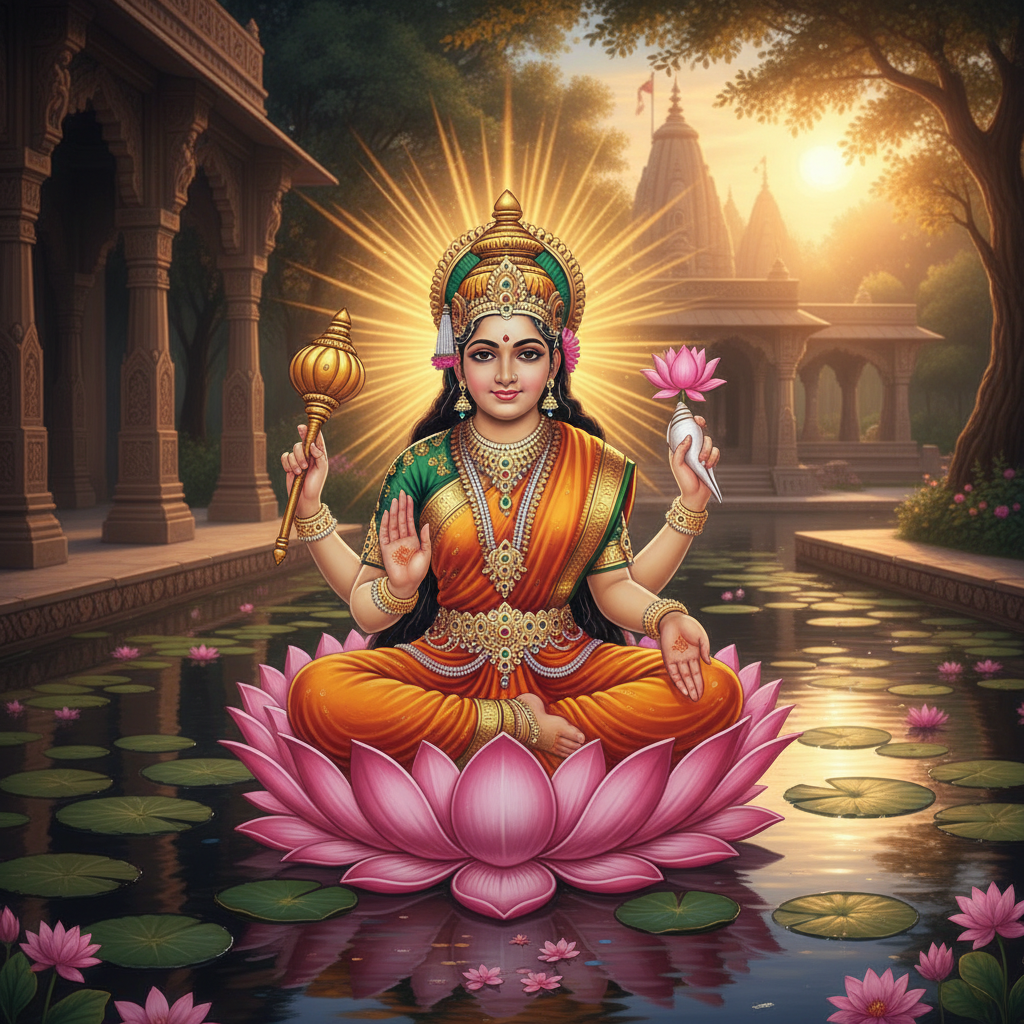
- The goddess Kanaka Durga, in a standing form with eight arms, holding weapons and with her foot on the buffalo demon
- The image is regarded as swayambhu, self manifested, rather than installed
- A Malleswara Swamy shrine to Shiva on the same hill, which is important and is explained below
- Steps and a road up the hill, with the Krishna and the city spread out below
The setting. The hill rises directly above the river and the city, and the view from the temple takes in the Prakasam Barrage, the Krishna and the whole of Vijayawada.
The temple is one of the busiest in Andhra Pradesh, and during Dasara it handles crowds in the hundreds of thousands.
Why the name Vijayawada. The traditional derivation is from Vijayavatika or a related form, the place of victory, referring to the goddess's victory over the demon at this hill.
So the city carries the name of what she did here, which is not a common arrangement even in India.
The Kathas of the Hill
Indrakeeladri carries more than one story, and they belong to different traditions that have settled on the same hill.
The demon and the goddess:
- The region was troubled by demons, and in the principal telling by Mahishasura, the buffalo demon
- The sages and the people appealed to the Devi
- She took form, fought and killed the demon on this hill
- She then remained here as Kanaka Durga, the golden Durga
- The victory gives the place its name
Arjuna and the Pashupatastra. This is the older and in some ways the more interesting association.
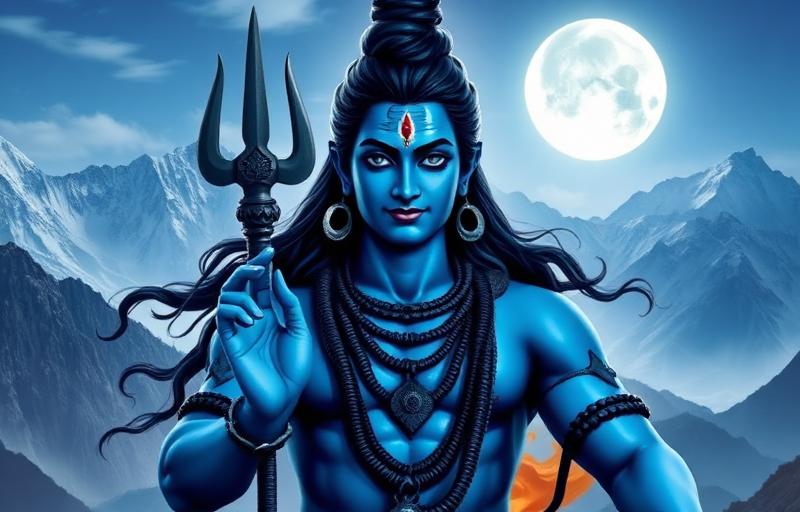
- During the exile, Arjuna performed severe penance to obtain the Pashupatastra, Shiva's weapon
- Shiva came to test him in the form of a Kirata, a forest hunter
- Both shot at the same boar, and a quarrel followed over whose arrow had killed it
- Arjuna fought the hunter and was overpowered
- He then recognised who it was, and Shiva, pleased with his courage, granted the weapon
- The episode is the subject of the Kiratarjuniya, one of the great Sanskrit mahakavyas, by Bharavi
- Tradition places the penance at Indrakeeladri, and the Malleswara shrine on the hill is connected to it
The Indrakeela element. In the story, Indra is said to have fixed the mountain in place, or the mountain itself did penance and asked to be the seat of the Devi, and the name Indrakeeladri, the hill of Indra's peg, is read from that.
What the two stories together do. The hill holds both a Devi shrine and a Shiva shrine, with the Devi as the principal deity.
The usual pattern elsewhere is a Shiva temple with a Devi shrine attached. Here it runs the other way, and both stories are needed to hold the arrangement together.
Dasara and the Nine Alankarams
Dasara at Vijayawada is the temple's principal season and one of the largest festivals in Andhra Pradesh.
The alankarams. Over the nine nights, the goddess is presented in a different form each day. The sequence varies slightly by year, but the practice is constant.
Commonly:
- Bala Tripura Sundari on the first day
- Gayatri
- Annapoorna
- Mahalakshmi
- Saraswati, on the day associated with learning
- Lalita Tripura Sundari
- Durga
- Mahishasura Mardini, on the day of the killing
- Rajarajeswari, at the culmination
What the practice means. This is a compact statement of a large theological idea.
- The goddess is not nine different deities appearing in turn
- She is one, presented across nine aspects, so that the devotee sees the whole rather than one facet
- The gentle forms and the fierce forms are the same goddess
- The mother who feeds, the goddess of learning, the goddess of wealth and the killer of the demon are not in tension
Why that is worth saying. People often have a favoured form and are uneasy about the others, and particularly uneasy about the fierce ones.
The alankaram sequence is the tradition's own answer to that. Come nine nights running and you will have seen her feed, teach, enrich, protect and kill, and the tradition's position is that you have been looking at one person the whole time.
Saraswati Puja and Vijayadashami. Children's slates and books, and craftsmen's tools, are placed before the goddess and taken up again after Vijayadashami, a practice widespread across the south.
Theppotsavam, the float festival, is held on the Krishna, with the utsava deities taken out on a decorated float.
Crowds. Dasara at Indrakeeladri draws very large numbers, and the queue can run for many hours. Plan for it, or come outside the season if darshan rather than the festival is what you want.
The Krishna and the City
The temple cannot really be separated from the river below it, and it is worth understanding why Vijayawada is where it is.
The Krishna:
- Rises at Mahabaleshwar in the Western Ghats
- Runs east across the Deccan through Maharashtra, Karnataka and Telangana
- Cuts through the Nallamala hills
- Emerges onto the coastal plain at Vijayawada, where the hills close in on both banks
- Forms its delta below and reaches the Bay of Bengal
Why the site matters. At Vijayawada, the river is squeezed between hills, which makes it the natural crossing point and the natural place to control the river.
- The Prakasam Barrage stands here, and before it a nineteenth century anicut
- The barrage feeds the canal system that irrigates the Krishna delta, one of the most productive agricultural regions in India
- The city grew as the point where road, rail and river met
The temple sits directly above all of this, on the hill at the throat of the river.
Durga Ghat and river bathing. Devotees bathe in the Krishna below the temple before darshan, and the ghat below the hill is used for this and for last rites.
Krishna Pushkaram. Once every twelve years, when Jupiter enters Kanya, the Krishna holds its Pushkaram, and enormous numbers come to bathe at Vijayawada and along the river.
The pushkaram cycle. Each of India's major rivers has a twelve year turn, keyed to Jupiter's passage through the zodiac, so that one river is in pushkaram each year. Ganga, Godavari, Krishna, Kaveri, Narmada and the rest each take their turn.
A practical note on bathing. The Krishna at Vijayawada is a large regulated river with a barrage above and currents that are not obvious from the bank. Bathe only at the ghats, in shallow water, and never at a place where nobody else is bathing.
Malleswara and the Order of Worship
The Malleswara Swamy shrine on the same hill is often skipped by visitors in a hurry, and it should not be.
What it is:
- A Shiva shrine on Indrakeeladri, close to the Durga temple
- Connected in tradition to Arjuna's penance and to Shiva's presence on the hill
- Older in some accounts than the Devi shrine's present form
The order. Practice at Indrakeeladri is that the arrangement is Durga first, which is unusual.
- At most sites where a Devi and a Shiva shrine share a hill, Shiva is the principal deity
- Here the Devi is, and Malleswara is on her hill
- Devotees commonly visit both, and local practice on the order varies. Ask at the temple
Why the pattern is worth noticing. Across India, the relationship between Shaiva and Shakta worship at a shared site is a good indicator of the site's history.
- A Devi shrine subordinate to a Shiva temple usually indicates a Shaiva foundation with the goddess added
- A Shiva shrine on a hill that belongs to the goddess usually indicates an older goddess site that has taken on Shaiva features
- Kanaka Durga is generally read the second way, as an ancient goddess hill that Shaiva tradition later joined
That pattern repeats all over the subcontinent. Underneath a great many temples with elaborate Sanskritic apparatus there is a hill, a stone or a tree that people were worshipping first, and the goddess is very often what was there.
Ghat road and steps. There is a road to the top and there are steps. Devotees who walk the steps do so as an offering, and it is a reasonable climb.
Kumkum and offerings. Kumkum, bangles, saris and the standard Devi offerings are made here. Prasadam is available from the temple counters.
Visiting Kanaka Durga
Getting there
- Indrakeeladri, Vijayawada, Andhra Pradesh, above the Krishna
- Vijayawada Junction is one of the busiest railway stations in India, with connections everywhere
- Vijayawada airport at Gannavaram, about 20 km
- The temple is within the city. Autos and buses go to the foot, and a ghat road runs to the top
Timings
- The temple opens very early and runs through the day with breaks. Check current timings, which change with the season and with festivals
Darshan
- Several categories are offered, including free darshan and paid quick darshan, and specific sevas such as Kumkumarchana, Chandi Homam and Antaralaya darshan
- Book online through the temple's official system where available
- On ordinary weekdays the wait is manageable. On Fridays, Tuesdays, new moon and full moon, and throughout Dasara, it is not
When to go
- Dasara, September or October, for the nine alankarams, if you are prepared for the crowds
- Ordinary weekday mornings for actual darshan
- November to February for weather. Vijayawada is very hot from March to June
- Krishna Pushkaram, when it falls, for the river
Practicalities
- Traditional dress is expected
- Mobile phones, cameras and bags are not permitted inside and lockers are available
- Footwear is left at the stands
- Carry water. The climb and the queue are both hot
Combining the visit
- Malleswara Swamy on the same hill
- Undavalli caves, about 8 km, rock cut with a large reclining Vishnu
- Mogalarajapuram caves in the city
- Amaravati, about 35 km, the great Buddhist stupa site and the Amareswara temple, which is one of the Pancharama Kshetras
- Kondapalli fort and the toy makers
- Mangalagiri, about 12 km, with the Panakala Narasimha temple
On Amaravati. If you have any interest in early Indian art, the Amaravati stupa site is one of the most important in the country, and the sculpture from it, now largely in Chennai and London, defines a whole school. The site itself is quiet and the local museum is worth an hour.
A closing thought. Most temple hills are approached as an ascent away from the world. Indrakeeladri is not. You climb it and the world is entirely visible below you, river, barrage, traffic and all, and the goddess is looking at the same thing.
Frequently Asked Questions
Where is the Kanaka Durga temple?+
On Indrakeeladri hill at Vijayawada, Andhra Pradesh, above the north bank of the Krishna. Vijayawada Junction is one of India's busiest railway stations, the airport at Gannavaram is about 20 km, and a ghat road and steps run up the hill.
Why is Vijayawada called Vijayawada?+
The traditional derivation is from Vijayavatika or a related form, meaning the place of victory, referring to the goddess's victory over the buffalo demon at Indrakeeladri. She remained on the hill afterwards as Kanaka Durga, and the city carries the name of what she did there.
What is the connection with Arjuna?+
Tradition places Arjuna's penance for the Pashupatastra at Indrakeeladri. Shiva came to test him as a Kirata hunter, both shot the same boar, a quarrel followed, and after Arjuna fought and was overpowered he recognised Shiva, who granted the weapon. The episode is the subject of Bharavi's Kiratarjuniya, and the Malleswara shrine on the hill is connected to it.
What are the nine alankarams at Dasara?+
Over the nine nights the goddess is presented in a different form each day, commonly Bala Tripura Sundari, Gayatri, Annapoorna, Mahalakshmi, Saraswati, Lalita Tripura Sundari, Durga, Mahishasura Mardini and Rajarajeswari. The sequence varies slightly by year. The point is that she is one goddess seen across nine aspects, gentle and fierce alike.
What is the Malleswara shrine?+
A Shiva shrine on the same hill, close to the Durga temple and connected in tradition to Arjuna's penance. The arrangement is unusual because the Devi is the principal deity and Shiva is on her hill, which usually indicates an ancient goddess site that Shaiva tradition joined later rather than the reverse.
What is Krishna Pushkaram?+
Once every twelve years, when Jupiter enters Kanya, the Krishna holds its Pushkaram and very large numbers come to bathe at Vijayawada and along the river. Each major Indian river has a twelve year turn keyed to Jupiter's passage through the zodiac, so one river is in pushkaram each year.
About the author
Anjali Mehta · Editor, M.A. Religious Studies
Anjali is the managing editor for Vandnaa and oversees the festival and vrat coverage. She holds an M.A. in Religious Studies and reviews every published article for accuracy, accessibility, and tradition-fidelity.
Meet the Vandnaa editorial team →