The Question at the Stream
Jayatirtha, roughly 1345 to 1388, is the greatest commentator the Dvaita tradition produced, and the reason it became a school that the rest of Indian philosophy had to answer.
His title: Tikacharya, the acharya of commentaries, and it is how he is normally referred to.
Where he came from
Mangalvedhe, in what is now Solapur district, Maharashtra, and readers of this series will recognise the name: it is also Chokhamela's village and Kanhopatra's, both of whom have entries here.
His family were Deshastha brahmanas holding an administrative and military position: his father, Raghunatha Deshpande, was a local officer, and the household was a landed and armed one.
And the young man was a horseman.
Which is not the standard opening for the biography of a commentator, and the tradition keeps it because of what happens next.
What happened
He was riding, and he was thirsty, and he came to water.
And he did not get down.
The accounts are specific: he leaned from the saddle and drank from the stream directly, with his mouth, the way a horse does.
And a sannyasi was there.
Akshobhya Tirtha, in the line from Madhvacharya, and he asked one question.
Kim pashuh purvadehe: were you an animal in a previous body?
Why it worked
Because it was not an insult and it was not a lecture.
A rebuke would have produced a defence. A young armed man of a landed family, publicly criticised for his manners by a monk at a stream, has a standard response available and it is not reflection.
A question does not offer that.
And the question is literal, which is the part that makes it land: in a tradition that takes rebirth as fact, asking somebody what they were before is a real question with a real answer, and the young man asked for it.
What Akshobhya told him
That he had been an ox.
And specifically, in the tradition's account, the bull that had carried Madhvacharya's books.
And that is where he got off the horse.
How to hold the previous life claim
As the tradition's, reported as the tradition reports it, and with an observation about what the story is doing.
It is not saying he was worthless. The claim is that the previous body was in service to the work he is about to give his life to, and that the connection has been there the whole time.
Which is a specific kind of consolation, and it is one this literature offers repeatedly: the thing you are about to start is not a departure from your life, it is what your life has been for.
And there is a version of the story that requires no rebirth at all, and is worth having: somebody asked him one question that he could not answer well, and it changed what he did with the rest of his life.
Which happens, and it does not require a previous body.
What he gave up
A position, land, and a family that had both.
And the accounts describe resistance: his family objected, and the tradition records that his father came after him, and that he did not go back.
He took sannyasa from Akshobhya Tirtha and became Jayatirtha.
What Dvaita Actually Says
Since this is the first of several Madhva entries in this series, the system belongs here.
Madhvacharya, thirteenth century, of Udupi, has an entry of his own in this app. Dvaita is his school and the word means duality, though the more precise name for the position is bheda vada, the doctrine of difference.
The five differences
Pancha bheda, and this is the whole system in one list.
Five differences, all of them real, all of them permanent, none of them resolved at liberation:
- Between the divine and each soul
- Between the divine and matter
- Between one soul and another
- Between souls and matter
- Between one piece of matter and another
And the argument is that these are not appearances, not provisional, and not removed by knowledge. They are how things are.
Set against the alternatives in this series:
- Advaita holds that only Brahman is real and difference is appearance
- Vishishtadvaita holds that reality is one with real internal distinctions, related as body to soul
- Shaiva Siddhanta holds three eternal realities and a union that is inseparable but not identical
- Dvaita holds that the differences are simply and permanently real
Which is the furthest point on that spectrum, and it is why Dvaita is often described as the most straightforwardly theistic of the Indian systems.
Taratamya
Gradation, and it is the doctrine people find hardest.
Souls are not equal. They differ in their intrinsic nature, svarupa, and the differences are not the result of what they have done. A soul's capacity is part of what it is.
And there is a hierarchy, set out in detail, running from Vayu at the top of the created order down through the deities and then through human souls.
Vayu
Mukhyaprana, the chief life breath, the highest of all souls, and the intermediary between the divine and everything else.
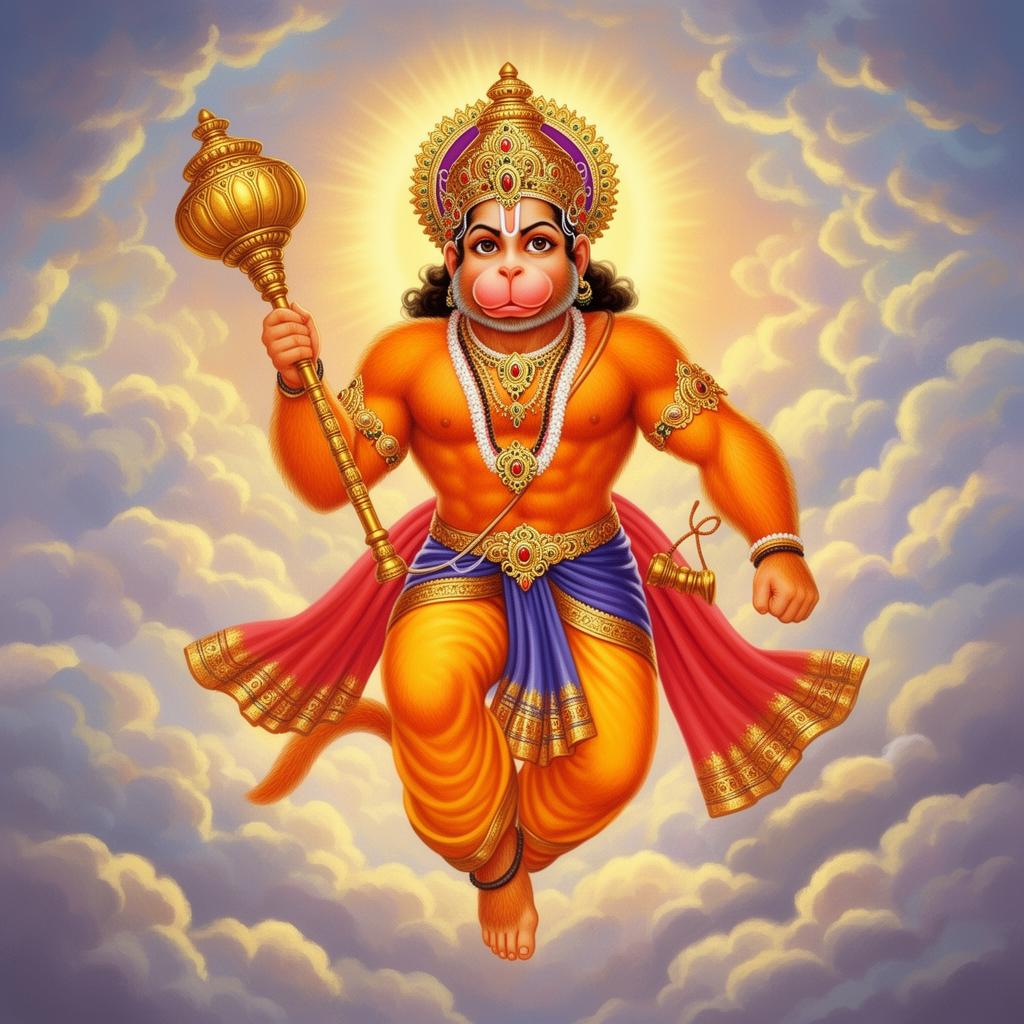
And his three incarnations: Hanuman, Bhima, and Madhvacharya.
Which is a striking claim and it is central: the tradition holds that its own founder was the third avatara of Vayu, and the entire devotional practice of the Madhva community runs through Hanuman as much as through Vishnu.
Bimba pratibimba
Original and reflection, the image the system uses for the soul's relation to the divine.
A reflection is entirely dependent on the original, has no existence apart from it, and is not it. And the reflection is real, which is the difference from Advaita: it is not an illusion, it is a genuine second thing whose whole being is derived.
The uncomfortable doctrine, stated openly
Tamo yogya.
Madhva's system holds that souls fall into three permanent classes by intrinsic nature: those fit for liberation, those who remain in cycling, and those destined for tamas, darkness.
And the third class does not get out.
This is genuinely unusual. It is the only classical Indian system with something resembling permanent damnation, and every other school in this series rejects it, on the grounds that a soul's condition is beginningless but not a verdict.
How the tradition itself handles it
With more internal disagreement than outsiders assume. There are readings within Dvaita that soften it, readings that place it in a purely metaphysical register about the structure of possibility rather than about identified people, and a general reluctance to apply it to anybody.
And this app's position, plainly
Nobody can identify which class anybody is in, and nobody should try.
Whatever the doctrine means at the level of metaphysics, it is not a tool for sorting people, and there is no version of it that licenses treating a living human being as beyond help.
If you have been told by anybody that you or somebody you love is of the class that does not get out, that person is not qualified to make that judgement and nobody is.
And the practical test this series keeps offering applies here too: a teaching that leads to somebody being written off is being used wrongly, whatever the text says.
The Nyaya Sudha
What Jayatirtha did, and why the tradition calls him Tikacharya.
The problem he inherited
Madhvacharya wrote badly on purpose.
Which needs explaining. His Sanskrit is famously compressed, elliptical and abrupt. Positions are asserted rather than argued out, objections are answered in a phrase, and a great deal is left implicit.
Some of that is style, and some of it is the sutra habit of packing maximum content into minimum words, and the result is a body of work that is very hard to use.
And a school whose founding texts cannot be argued from is not going to survive contact with Advaita, which by the fourteenth century had six hundred years of commentarial refinement behind it and some of the sharpest logicians in India.
What Jayatirtha did about it
Wrote it all out.
The Nyaya Sudha, the nectar of reasoning, is his commentary on Madhva's Anuvyakhyana, which is itself Madhva's verse commentary on the Brahma Sutras.
So it is a commentary on a commentary on the foundational text, which is the normal architecture of this literature.
And it is enormous, and it is the central text of Dvaita Vedanta.
What it does: takes every compressed assertion in Madhva and unpacks it into a full argument, states the opposing position properly, raises the objections an opponent would actually raise, and answers them in the technical vocabulary of the debate.
Its standing
Mastering the Nyaya Sudha is a formal qualification.
A person who has completed a full study of it under a teacher is called a Sudha pandita, and the completion of a full reading is marked with a ceremony, Sudha mangala, which is a significant occasion in Madhva institutions.
And that is still true. The study is still conducted, in Sanskrit, over years, at the Madhva mathas and in Udupi, Bangalore and elsewhere, and it is one of the very few living traditions of full length classical commentarial study in India.
His other works
He commented on almost everything Madhva wrote:
- Tattva Prakashika, on Madhva's Sutra Bhashya
- Prameya Dipika, on the Gita Bhashya
- Nyaya Dipika, on the Gita Tatparya
- Commentaries on the Dasha Prakaranas, Madhva's ten short treatises, including the Vishnu Tattva Vinirnaya and the Tattva Sankhyana
- Vadavali commentary
And one original work: the Pramana Paddhati, on epistemology, which is the standard Dvaita statement of how knowledge works: what the valid means of knowing are, what makes a cognition true, and how error happens.
Why he matters beyond his own tradition
Because without him there is no Vyasatirtha.
Vyasatirtha, whose entry comes later in this batch, wrote the Nyayamrita, which forced a full scale response from the Advaita side in Madhusudana Sarasvati's Advaita Siddhi, and that exchange is one of the most technically demanding sequences in Indian philosophy.
None of it is possible without the Nyaya Sudha, because Vyasatirtha is arguing from a position that Jayatirtha had made argumentable.
Which is a general point worth having: the founder is not always the person who makes the thing usable.
Madhva had the positions. Jayatirtha built the machine that could defend them.
Where he is
His brindavana is at Malkheda, Malkhed, on the Kagina river in Kalaburagi district, Karnataka.
And it is one of the principal Madhva pilgrimage sites, along with Udupi, Mantralayam, Navavrindavana and Sode, all of which have entries in this batch or in this app.
The Short Version
Who: Jayatirtha, roughly 1345 to 1388, called Tikacharya, the acharya of commentaries, and the greatest commentator the Dvaita tradition produced. Born at Mangalvedhe in what is now Solapur district, Maharashtra, which is also Chokhamela's village and Kanhopatra's, into a Deshastha brahmana family holding an administrative and military position, his father Raghunatha Deshpande being a local officer.
The stream: he was riding, thirsty, came to water, and drank from the saddle without dismounting, leaning down with his mouth the way a horse does. A sannyasi was there, Akshobhya Tirtha, in the line from Madhvacharya, and asked one question: were you an animal in a previous body. It worked because it was a question rather than a rebuke, and because in a tradition that takes rebirth as fact it is a literal question with a real answer. Akshobhya told him he had been the ox that carried Madhvacharya's books, and he got off the horse. The story is not saying he was worthless: the claim is that the previous body was in service to the work he is about to give his life to. And there is a version requiring no rebirth at all, which is that somebody asked him one question he could not answer well and it changed what he did with the rest of his life.
Dvaita in one list: pancha bheda, five differences, all real, all permanent, none resolved at liberation, between the divine and each soul, the divine and matter, one soul and another, souls and matter, and one piece of matter and another. Taratamya holds that souls are not equal but differ in intrinsic nature, with a hierarchy running from Vayu down. Vayu is Mukhyaprana, the highest of all souls, and his three incarnations are Hanuman, Bhima and Madhvacharya, which is why Madhva devotion runs through Hanuman as much as through Vishnu. Bimba pratibimba, original and reflection, is the image for the soul's relation to the divine: entirely dependent, not identical, and genuinely real rather than illusory.
The uncomfortable doctrine: tamo yogya, the holding that souls fall into three permanent classes by intrinsic nature and that the third does not get out. It is the only classical Indian system with something resembling permanent damnation, there is more internal disagreement about how to read it than outsiders assume, and this app's position is plain: nobody can identify which class anybody is in and nobody should try. A teaching that leads to somebody being written off is being used wrongly whatever the text says.
The Nyaya Sudha: Madhva's Sanskrit is famously compressed and elliptical, asserting rather than arguing, which makes a school hard to defend against six hundred years of Advaita commentarial refinement. Jayatirtha's Nyaya Sudha, his commentary on Madhva's Anuvyakhyana, unpacks every compressed assertion into a full argument. Mastering it is a formal qualification, a Sudha pandita, marked by the Sudha mangala ceremony, and the study is still conducted in Sanskrit over years at the Madhva mathas, one of very few living traditions of full length classical commentarial study in India. Without it there is no Vyasatirtha and no Nyayamrita. His brindavana is at Malkheda on the Kagina river in Karnataka.
Quick Answers
Who was Jayatirtha?+
The greatest commentator the Dvaita tradition produced, roughly 1345 to 1388, called Tikacharya, the acharya of commentaries. He was born at Mangalvedhe in what is now Solapur district, Maharashtra, into a Deshastha brahmana family holding an administrative and military position, and was a horseman before he renounced. He took sannyasa from Akshobhya Tirtha and wrote the Nyaya Sudha, the central text of Dvaita Vedanta, along with commentaries on almost everything Madhvacharya wrote. His brindavana is at Malkheda on the Kagina river in Karnataka.
What is the story of the question at the stream?+
The young Jayatirtha was riding, was thirsty, came to water, and drank from the saddle without dismounting, leaning down and drinking with his mouth the way a horse does. The sannyasi Akshobhya Tirtha was there and asked one question: were you an animal in a previous body. It worked because it was a question rather than a rebuke, since a young armed man of a landed family publicly criticised by a monk has a standard response available and it is not reflection, whereas a question does not offer that. And the question is literal: in a tradition that takes rebirth as fact, asking what somebody was before is a real question with a real answer, and he asked for it. Akshobhya told him he had been the ox that carried Madhvacharya's books, and he got down from the horse and did not go home.
What are the five differences in Dvaita?+
Pancha bheda, and they are the whole system in one list: the difference between the divine and each soul, between the divine and matter, between one soul and another, between souls and matter, and between one piece of matter and another. All five are real, all are permanent, and none is resolved at liberation. The argument is that these are not appearances, not provisional, and not removed by knowledge, but simply how things are. Against the alternatives, Advaita holds only Brahman real and difference an appearance, Vishishtadvaita holds reality one with real internal distinctions related as body to soul, Shaiva Siddhanta holds three eternal realities and a union inseparable but not identical, and Dvaita holds the differences simply and permanently real, which is the furthest point on that spectrum.
Why is Madhvacharya considered an incarnation of Vayu?+
In Dvaita, Vayu is Mukhyaprana, the chief life breath, the highest of all created souls and the intermediary between the divine and everything else, and the tradition holds that he has taken three incarnations: Hanuman, Bhima and Madhvacharya. It is a striking claim and it is central rather than decorative, since the entire devotional practice of the Madhva community runs through Hanuman as much as through Vishnu. It also connects to taratamya, the doctrine that souls are not equal but differ in intrinsic nature, with a hierarchy running from Vayu at the top of the created order down through the deities and then through human souls.
Does Dvaita really teach eternal damnation?+
The doctrine of tamo yogya holds that souls fall into three permanent classes by intrinsic nature: those fit for liberation, those who remain in cycling, and those destined for tamas, darkness, and the third class does not get out. It is genuinely unusual, being the only classical Indian system with something resembling permanent damnation, and every other school in this series rejects it on the grounds that a soul's condition is beginningless but not a verdict. The tradition itself handles it with more internal disagreement than outsiders assume, including readings that soften it and readings that place it in a purely metaphysical register about the structure of possibility rather than about identified people. This app's position is plain: nobody can identify which class anybody is in and nobody should try. Whatever the doctrine means metaphysically, it is not a tool for sorting people, and if anybody has told you that you or somebody you love is beyond help, that person is not qualified to make that judgement and nobody is.
What is the Nyaya Sudha?+
The nectar of reasoning, Jayatirtha's commentary on Madhva's Anuvyakhyana, which is itself Madhva's verse commentary on the Brahma Sutras, and the central text of Dvaita Vedanta. Madhva's own Sanskrit is famously compressed and elliptical, asserting positions rather than arguing them out and answering objections in a phrase, which makes his work very hard to use and a school hard to defend against Advaita, which by the fourteenth century had six hundred years of commentarial refinement behind it. The Nyaya Sudha unpacks every compressed assertion into a full argument, states the opposing position properly, and answers the objections an opponent would actually raise. Mastering it is a formal qualification: a person who has completed a full study under a teacher is called a Sudha pandita, and completion is marked by the Sudha mangala ceremony. The study is still conducted in Sanskrit over years at the Madhva mathas, and it is one of very few living traditions of full length classical commentarial study in India.
About the author
Pandit Ravindra Sharma · Vedic Rituals & Bhakti, 22+ years
Pandit Ravindra is the Vandnaa editorial team's resident specialist on aarti, chalisa, and daily devotion. He has performed home and temple pujas across Varanasi and Delhi for over two decades and contributes the bhakti-focused articles on this site.
Meet the Vandnaa editorial team →