A Temple With No Idol
Jwalamukhi, or Jwala Ji, is in Kangra district, Himachal Pradesh, and it is unlike almost every other major temple in India in one specific way.
There is no image of the deity.
What is there instead:
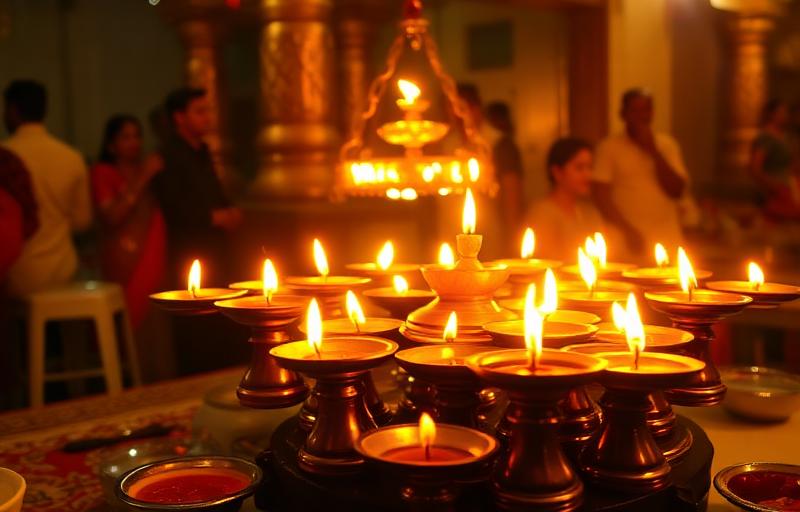
- Nine flames, burning from fissures in the rock inside the sanctum and around the complex
- They burn continuously, with no fuel supplied and no wick
- Each is identified with a goddess and named accordingly
- The principal flame burns in a silver plated pit in the sanctum
- Devotees offer to the flame directly
The nine flames are generally named as:
- Mahakali, the principal flame
- Annapurna
- Chandi
- Hinglaj
- Vindhyavasini
- Mahalakshmi
- Saraswati
- Ambika
- Anjana or Anji Devi
Why this matters theologically. Indian worship is overwhelmingly image based. The deity is present in a murti, a linga or a natural object, and darshan is an act of seeing.
At Jwalamukhi the deity is present as fire, which is not a thing but a process. There is nothing to make, nothing to install, nothing to consecrate and nothing that could be moved or replaced.
That puts the temple in a very small category alongside:
- The Agni of Vedic sacrifice, which is the oldest layer of Indian worship
- The Arunachala hill at Tiruvannamalai, understood as Shiva in the form of fire
- The jyoti, the flame, at any arati, which is what every devotee is shown
- The akhand jyoti, the unbroken lamp, kept burning at many Devi temples
Jwalamukhi is where that idea is not a symbol. The fire is not lit by a priest and could not be put out by one.
The building. The temple has a gilded dome, given by Maharaja Ranjit Singh, and a considerable complex around it, all built around a natural phenomenon that was there first.
What Is Actually Burning
The flames have a straightforward explanation and it is worth setting out, for the reasons discussed at Yaganti and Mangalagiri.
The mechanism:
- Natural gas, principally methane, seeps upward through fissures in the rock
- It emerges at the surface and, once ignited, burns continuously as long as the supply lasts
- The gas is of geological origin, generated at depth and migrating up through fractures
- The Himalayan foothills, with their complex faulting and thrust structures, provide the pathways
This is not unique to Jwalamukhi. Perpetual natural gas flames occur at a number of places worldwide and several have become religious sites.
- Yanartas in Turkey, burning since antiquity, associated with the Chimaera of Greek myth
- Baba Gurgur in Iraq
- The Ateshgah fire temple near Baku in Azerbaijan, a Zoroastrian and later Hindu site built over natural gas vents, where Indian merchants worshipped and left inscriptions in Sanskrit and Punjabi
- Eternal Flame Falls in New York state
- Several sites in India, including the flames at Jwalamukhi and gas seeps elsewhere in the Himalayan belt
The Ateshgah connection is worth a paragraph. That temple near Baku, on the Absheron peninsula, was a site of natural gas flames used successively by Zoroastrians and by Indian traders on the Caspian route.
Its inscriptions include Sanskrit and Gurmukhi, left by Hindu and Sikh merchants who worshipped there in the seventeenth and eighteenth centuries. The gas supply eventually failed, drawn down by the region's oil industry, and the flame is now fed by a pipeline.
That is a caution worth noting. A natural gas flame is not eternal in fact. It burns as long as the reservoir does.
How to hold the geology and the devotion together. The framework set out at Yaganti applies precisely.
- The geologist explains where the gas comes from and why it burns
- The devotee says the Devi's tongue fell here and burns
- Neither statement contradicts the other
- The mechanism does not address the question of meaning
And there is something the geology adds rather than takes away.
The fire at Jwalamukhi has been burning for as long as anyone has recorded it, from a source nobody put there, through rock that nobody drilled, in a place people found rather than chose. That is a genuinely remarkable thing to have found on a hillside, and the tradition's response, which was to build a temple around it and give the flames names, is not an unreasonable one.
On flame stability. The flames vary in size and occasionally an individual vent weakens or shifts. That is normal behaviour for a gas seep and the temple has managed it for a very long time.
The Shakti Peetha
Jwalamukhi is one of the Shakti Peethas, and the network is worth understanding because it is one of the largest sacred geographies in the world.
The katha:
- Sati, Shiva's wife, was the daughter of Daksha
- Daksha held a great sacrifice and did not invite Shiva, insulting him deliberately
- Sati attended uninvited and, hearing her husband abused, gave up her body in the sacrificial fire or by yoga
- Shiva took up her body and performed the tandava, the dance of destruction, threatening the world
- Vishnu, to end it, cut the body with his chakra as Shiva carried it
- The pieces fell across the subcontinent
- Each place where a piece fell became a Shakti Peetha, a seat of the goddess
At Jwalamukhi, the tongue is said to have fallen, and the flames are the tongue.
The network:
- Counts vary: 51, 52, 64 or 108 depending on the list
- They extend across India, into Pakistan at Hinglaj in Balochistan, into Bangladesh at several sites, into Nepal at Guhyeshwari, into Sri Lanka and into Tibet at Manasarovar in some lists
- Each has an associated Shakti and Bhairava, the goddess and the form of Shiva who guards her
Why the network matters. It is one of the most striking things about Indian religious geography.
- It maps a body onto a subcontinent
- It makes the entire landmass a single sacred object rather than a collection of separate sites
- It crosses every modern political boundary in the region
- It predates every state that has ever governed the ground it covers
Hinglaj specifically. One of the nine flames here is named Hinglaj, after the Shakti Peetha in Balochistan, Pakistan, where the head is said to have fallen.
That shrine is still active, is visited by Pakistani Hindus and by Muslim pilgrims who know it as Nani Mandir, and lies in desert country reached across a considerable distance.
A flame at Kangra named for a shrine in Balochistan is a small piece of evidence of how large this network's reach was before partition.
The Kangra cluster. Himachal holds an unusually dense concentration of Devi shrines, several of them Peethas or associated with them.
- Jwalamukhi, the tongue
- Brajeshwari at Kangra, the left breast
- Chintpurni, associated with the feet in some accounts
- Chamunda Devi, near Palampur
- Naina Devi, at Bilaspur, the eyes
These five are commonly done as a circuit, and pilgrims travelling from Punjab, Delhi and Haryana often take all of them over two or three days. The circuit is described in the visiting section.
The Story About Akbar

The best known story at Jwalamukhi concerns an attempt to put the flames out, and it is told at the temple with a physical exhibit.
As it is told:
- Akbar heard of the flames and was sceptical, or wished to test them
- He had a channel of water dug and diverted over the flames to extinguish them
- The flames continued to burn through the water
- Akbar, convinced, came to the temple and offered a chhatra, a ceremonial parasol, of gold
- The goddess did not accept it, and the chhatra turned to a base metal on being offered
- The chhatra is displayed at the temple
The Dhyanu Bhagat version. A related story, more widely told in Punjab, gives the episode a different shape.
- Dhyanu Bhagat, a devotee, was travelling to the temple with a large group of pilgrims
- Akbar detained them and demanded proof of the goddess's power
- He had a horse beheaded and challenged Dhyanu to have it restored
- Dhyanu prayed at the temple, and in some tellings offered his own head
- The horse was restored
- Akbar then made the offering described above
How to read these stories. The same caution set out at Karmanghat applies.
- Akbar's religious policy is very well documented and included substantial engagement with Hindu traditions, the Ibadat Khana debates, marriage alliances with Rajput houses, and the abolition of the jizya
- There is no contemporary record of the Jwalamukhi episode outside the temple's own tradition
- Stories in which a Muslim ruler tests a Hindu shrine and is convinced are a recognisable narrative type, and they attach to several rulers at several temples
- The base metal chhatra exists and is shown; what it is and when it arrived is a separate question
What the story does. It is worth thinking about what a community gains from telling it.
- It states that the deity's power is not dependent on patronage and cannot be tested or bought
- It puts the most powerful man in the world at the temple, unable to do anything
- It converts a period of political subordination into a story where the shrine is unaffected
- The rejected offering is a particularly sharp detail, since it says the goddess would not even take his gold
And a note on how to use it now. As with Karmanghat, stories of this shape are pressed into service in present day arguments about communities.
That is worth resisting. Akbar's relationship with Hindu institutions was, on the documentary record, complicated and in many respects generous, and a temple story is not evidence about anybody alive.
Ranjit Singh's dome. A better documented royal association is the gilded dome given by Maharaja Ranjit Singh of the Sikh empire in the early nineteenth century.
That is straightforwardly recorded, is visible, and is a reminder that the temple's patronage history includes rulers of more than one faith.
Gorakh Dibbi and the Nath Connection
A second phenomenon at Jwalamukhi is less famous and worth seeking out.
Gorakh Dibbi:
- A small tank of water within the complex
- The water appears to boil, bubbling continuously
- It is cold to the touch
- The explanation is gas bubbling up through the water from the same seeps that feed the flames
So the temple has fire that water will not extinguish, and water that appears to boil without heat. Both are the same gas doing two different things, which is a rather elegant arrangement.
The Gorakhnath connection. The name links the site to Gorakhnath and the Nath tradition.
As the story is told:
- Gorakhnath was here and was hungry
- He asked the goddess to boil water while he went to beg for alms
- She set the water to boil
- He never returned, and the water is still waiting
- It will boil properly when he comes back, which will be in the next age
Who the Naths were:
- A yogic tradition, associated with Matsyendranath and Gorakhnath, that spread across northern India and Nepal from around the tenth century
- Practitioners of hatha yoga, which the tradition largely developed, and of alchemical and tantric practice
- Organised as an order of ascetics, the Nath yogis or Kanphata yogis, named for their split ears and large earrings
- Deeply influential on later devotional and yogic traditions across north India
Why the Naths matter for Himalayan temples. Nath figures appear at a very large number of shrines across the Himalaya and the plains.
- Gorakhnath's name is attached to sites from Gorakhpur in Uttar Pradesh to Gorkha in Nepal, from which the Gurkhas take their name
- Nath shrines and caves are found across Himachal, Uttarakhand, Punjab and Rajasthan
- The tradition sat somewhere between Shaiva orthodoxy and the wandering ascetic world, and its stories frequently show a yogi in conversation with a deity as an equal
The Gorakh Dibbi story is exactly that. A yogi tells a goddess to put the kettle on and then does not come back. That is not how devotees usually speak to the Devi, and the familiarity is the point.
Hatha yoga's origins. Worth knowing since the subject comes up constantly.
The physical practices now taught worldwide as yoga descend substantially from the hatha yoga tradition, which developed within Nath and related tantric circles from roughly the tenth to fifteenth centuries, and is set out in texts including the Hatha Yoga Pradipika and the Gheranda Samhita.
Those texts are considerably later than the Yoga Sutras of Patanjali, which are concerned with meditation and mental discipline and mention asana only briefly.
So the postures and the philosophy come from different periods and different traditions, which are frequently conflated.
Visiting Jwalamukhi
Getting there
- Jwalamukhi, Kangra district, Himachal Pradesh
- About 35 km from Kangra town and roughly 55 km from Dharamshala
- Pathankot is the nearest major railhead, about 120 km, with the Kangra Valley narrow gauge line also serving the area
- Gaggal airport near Dharamshala is about 45 km; Amritsar and Chandigarh are the larger options
- Buses run from Kangra, Dharamshala, Pathankot and Chandigarh
Timings
- The temple opens early and runs through the day with a midday break. Timings change seasonally. Check locally
- Aratis are performed several times a day and are the best time to be there
When to go
- Navratri, twice a year in Chaitra and Ashwin, March or April and September or October, which is the principal season and extremely crowded
- March to June and September to November for weather
- Winter is cold but manageable, and the temple is at low elevation compared with the rest of Himachal
- Early morning for a quieter darshan
Practicalities
- Traditional dress is appropriate. Head covering is customary
- Offerings include rabri, milk, sweets and red cloth
- Photography inside the sanctum is not permitted
- The temple is busy year round and very busy during Navratri
- Accommodation is available in the town and at Kangra and Dharamshala
The Himachal Devi circuit. Most pilgrims do Jwalamukhi as part of a group of shrines, and it is worth planning as one.
The five principal shrines:
- Jwalamukhi, the flames
- Brajeshwari Devi, at Kangra, about 35 km
- Chintpurni, in Una district, about 55 km
- Chamunda Devi, near Palampur, about 60 km
- Naina Devi, at Bilaspur, about 100 km
A three day route. Naina Devi and Chintpurni on the first day coming up from the plains, Jwalamukhi and Brajeshwari on the second, Chamunda Devi and on to Dharamshala on the third.
That is the standard circuit and it is done by very large numbers from Punjab, Haryana and Delhi, particularly during Navratri.
Other things nearby
- Kangra fort, one of the oldest and largest forts in India, above the confluence of the Banganga and Manjhi
- Masroor rock cut temples, about 40 km, a group of monolithic temples carved from a single rock ridge in the eighth century, damaged in the 1905 earthquake and among the most underrated monuments in India
- Dharamshala and McLeod Ganj
- Palampur and the tea gardens
- Baijnath, with its Shiva temple
- Pong dam reservoir, a major bird site in winter
Masroor deserves emphasis. It is a rock cut temple complex in the manner of Ellora, carved out of living rock rather than built, in a state where almost nobody goes to see it.
It was badly damaged by the 1905 Kangra earthquake and what survives is a fragment of what was planned. It is still remarkable and it is forty kilometres from Jwalamukhi.
A closing thought. Every temple in India will tell you the deity is present. Almost all of them will then show you a stone.
At Jwalamukhi they show you a flame that nobody lit, coming out of the ground, that has been burning since before anybody thought to build a wall around it. You can put your hand near it. It is warm.
What People Ask Most
Where is Jwalamukhi temple?+
In Kangra district, Himachal Pradesh, about 35 km from Kangra town and roughly 55 km from Dharamshala. Pathankot is the nearest major railhead about 120 km away, Gaggal airport near Dharamshala is about 45 km, and buses run from Kangra, Dharamshala, Pathankot and Chandigarh.
Is there an idol at Jwalamukhi?+
No. There is no image of the deity. Nine flames burn from fissures in the rock, continuously and with no fuel supplied, each identified with a goddess and named accordingly, with the principal Mahakali flame in a silver plated pit in the sanctum. Devotees offer to the flame directly.
What makes the flames burn?+
Natural gas, principally methane, seeps upward through fissures in the rock and burns continuously once ignited. The Himalayan foothills provide the pathways through their faulting. Perpetual gas flames occur worldwide and several have become religious sites, including Yanartas in Turkey and the Ateshgah near Baku, where Indian merchants left Sanskrit and Punjabi inscriptions.
Which Shakti Peetha is Jwalamukhi?+
The tongue is said to have fallen here when Vishnu cut Sati's body with his chakra as Shiva carried it, and the flames are the tongue. The Shakti Peethas number 51, 52, 64 or 108 depending on the list and extend across India and into Pakistan, Bangladesh, Nepal, Sri Lanka and Tibet, mapping a body onto a subcontinent.
What is the Akbar story?+
Tradition says Akbar had a channel of water diverted over the flames to extinguish them and they continued to burn, after which he offered a gold chhatra which turned to a base metal on being offered. The chhatra is displayed. There is no contemporary record outside the temple's own tradition, and stories of a ruler testing a shrine and being convinced are a recognisable narrative type.
What is Gorakh Dibbi?+
A small tank of water in the complex that appears to boil, bubbling continuously, but is cold to the touch, because gas from the same seeps that feed the flames bubbles up through it. The story is that Gorakhnath asked the goddess to boil water while he went for alms, never returned, and the water is still waiting.
About the author
Anjali Mehta · Editor, M.A. Religious Studies
Anjali is the managing editor for Vandnaa and oversees the festival and vrat coverage. She holds an M.A. in Religious Studies and reviews every published article for accuracy, accessibility, and tradition-fidelity.
Meet the Vandnaa editorial team →