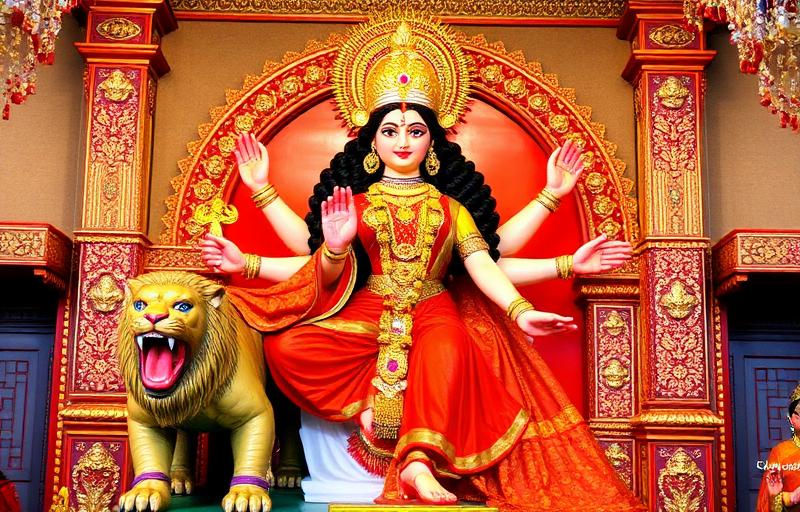
Maa Kali at Kalighat
On the banks of the Adi Ganga in south Kolkata stands the Kalighat Kali Temple, one of the most visited Shakti Peethas in the whole of India. Here the Devi is worshipped as Maa Kali, the fierce and compassionate mother who destroys evil and protects her devotees like her own children.
The deity at Kalighat has a distinct form, a black stone face with three large eyes and a golden tongue, adorned with garlands and a crown. Devotees believe that the city of Kolkata itself takes its name from this ancient temple, a sign of how deeply the Devi is woven into the life of the city.
The Legend of the Shakti Peeth
According to the well loved katha of the Shakti Peethas, when Sati gave up her life at her father Daksha's yagna, a grieving Lord Shiva carried her body across the skies in unbearable sorrow. To calm his grief and restore balance to creation, Lord Vishnu released his Sudarshan Chakra, cutting Sati's body into many parts, which fell at different places on earth. Each of these places became a Shakti Peeth, a seat of the Devi's power.
At Kalighat, tradition holds that the toes of Sati's right foot fell here, and the site came to be worshipped as a powerful centre of the Devi's shakti. Over the centuries, the temple grew from a humble shrine into one of the most important pilgrimage sites of eastern India, drawing devotees from every part of the country.
Significance and What Devotees Pray For
Kalighat is regarded as a Siddha Peeth, a place where devotees believe prayers offered with a sincere heart are quickly heard. As per tradition, devotees come here seeking the Devi's blessings for courage in difficult times, protection from harm, and freedom from fear.
Maa Kali at Kalighat is seen not merely as a goddess of destruction but as a loving mother, whom devotees turn to in moments of helplessness. Many come to offer thanks after a wish is fulfilled, tying a red thread or offering a saree and vermilion as a mark of gratitude. Worship here is an act of faith and love, not a transaction.
Darshan Guide: Timings and Festivals
The temple follows a daily pattern of Mangala Aarti in the early morning, followed by darshan hours through the day, with a break in the afternoon before evening aarti. Devotees are advised to check locally for the exact schedule, as timings can shift slightly with the season and on festival days.
The temple is at its most vibrant during Kali Puja on the night of Amavasya in the month of Kartik, when the whole complex is lit with lamps and thousands gather for darshan. Durga Puja and Navratri are also celebrated here with great devotion, and Tuesdays and Saturdays traditionally see larger crowds of devotees.
How to Reach Kalighat
Kalighat is located in south Kolkata, West Bengal, and is well connected within the city. The Kalighat Metro Station on the Kolkata Metro is one of the most convenient ways to reach the temple, being within easy walking distance.
For those travelling from outside the city, Kolkata's Netaji Subhas Chandra Bose International Airport and the city's major railway stations, including Howrah and Sealdah, connect Kolkata to the rest of India, from where local transport can be taken to the temple.
Mantra to Chant and Takeaway
Devotees often chant the simple mantra Om Krim Kalikayai Namah (salutations to Goddess Kali) while offering prayers at Kalighat, invoking her protection and grace.
A visit to Kalighat is a reminder that the divine mother resides not in fear but in fierce, protective love. Whether you can travel to Kolkata or simply hold the Devi in your heart, worship at a Shakti Peeth is ultimately an offering of devotion, not a demand for results.
Reader Questions Answered
Which Shakti Peeth is Kalighat Kali Temple?+
Kalighat is one of the 51 Shakti Peethas of the Devi. According to tradition, the toes of Sati's right foot fell at this site, making it a powerful seat of the Devi's shakti in Kolkata.
What is the best time to visit Kalighat Kali Temple?+
Devotees can visit through the year, but the temple is especially vibrant during Kali Puja in Kartik month and during Navratri and Durga Puja, when special rituals and larger crowds mark the celebrations.
How is the city of Kolkata connected to Kalighat temple?+
According to popular belief, the name Kolkata is connected to this ancient temple, reflecting how central the Devi's worship has been to the identity and history of the city.
About the author
Pandit Ravindra Sharma · Vedic Rituals & Bhakti, 22+ years
Pandit Ravindra is the Vandnaa editorial team's resident specialist on aarti, chalisa, and daily devotion. He has performed home and temple pujas across Varanasi and Delhi for over two decades and contributes the bhakti-focused articles on this site.
Meet the Vandnaa editorial team →