The Gates of Kuram
Kuresha, also Kurattalvan and in Sanskrit Srivatsanka Mishra, eleventh into twelfth century, is the closest of Ramanuja's disciples and one of the most striking figures in the whole Srivaishnava record.
Where he was from: Kuram, near Kanchipuram, from which his name comes.
What he had
A great deal.
The accounts describe him as extremely wealthy: a large estate, a household of substance, and a level of income that placed him among the leading men of the district.
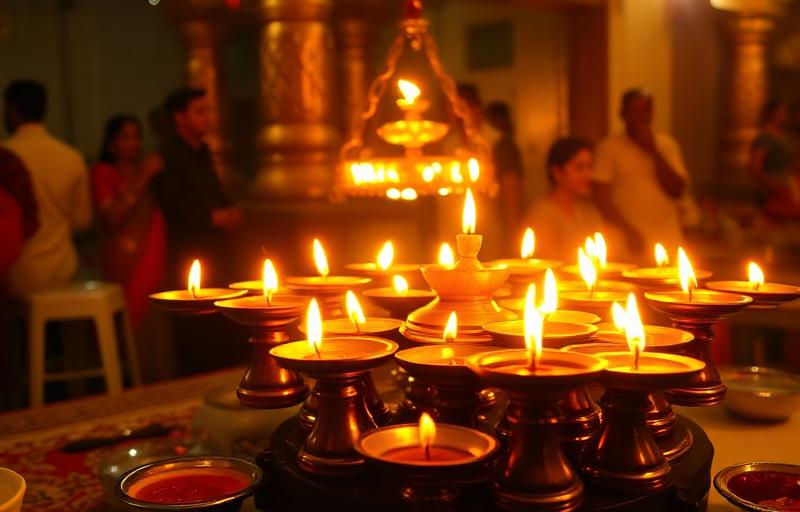
And what he did with it is the part the tradition dwells on. He ran what amounted to a permanent open kitchen: anybody who came was fed, travellers were housed, and the accounts describe lamps kept burning all night at the entrance so that people arriving late could see their way in.
And then he gave it up
He left Kuram at night, with his wife, on foot, with nothing.
And the detail the tradition preserves is the sound of the gates.
As they walked away, the servants were closing the gates of the estate behind them, and the closing went on and on, gate after gate, because the property was that large.
And his wife asked him what the noise was.
And he said it was the sound of everything he had just stopped owning.
Why the detail survives
Because renunciation stories usually have nothing to renounce.
Most of the saints in this series were poor: Kabir wove, Ravidas worked leather, Dhanna farmed, Chokhamela was outside the village, Janabai was a servant. Giving things up is easier when there are not many.
Kuresha had everything and walked out of it at night, and the story keeps the sound of the gates because the sound is the measure.
His wife
Andal, also Andalamma, and she is not a minor figure.
The best known story about her belongs to their first period at Srirangam, when they had nothing and were living on what the community gave.
She was hungry, and pregnant, and the household had run out.
And she said so to Ranganatha, directly, at the temple.
And food came. The accounts have the temple offering arriving at their house, sent by the deity or by the temple staff acting on an instruction nobody could trace.
And the son she was carrying was Parasara Bhattar, who has the next entry but one in this batch.
Their sons
Two: Parasara Bhattar and Vyasa Bhattar.
And the names are deliberate. Yamunacharya had died with three unfinished wishes, and one of them was that Parasara and Vyasa should be honoured by having disciples named after them.
Ramanuja named Kuresha's sons.
Which is a small thing and is not: a promise made over a dead man's body was kept, twenty or thirty years later, by naming two children.
The Manuscript He Read Once
The feat Kuresha is most famous for, and the reason the Sri Bhashya exists.
The problem
Ramanuja was writing a commentary on the Brahma Sutras, which is the standard qualification for founding a school of Vedanta: Shankara had written one, and any competing position had to be argued on the same ground.
And he wanted an older commentary, the Bodhayana Vritti, an ancient work that took the position he was arguing for, and which would show that his reading was not an innovation but a recovery.
And the manuscript was in Kashmir.
The journey
Ramanuja and Kuresha went north, to the Sarada Pitha in Kashmir, which was one of the great libraries of the subcontinent.
They were permitted to read it and not to take it.
The accounts vary on why: the custodians' rules, sectarian objection, or plain reluctance to let a manuscript leave. The outcome is the same. They could read, and then they had to leave it behind.
And in some accounts they were given very little time, or read it over a small number of nights.
What Kuresha did
He memorised it.
In a single reading, in the strongest version of the account, and over a few sittings in the more moderate ones.
And on the journey back he reproduced it, from memory, and Ramanuja wrote the Sri Bhashya using it.
How to hold that claim
With the observation that this was a culture built on exactly this skill.
The entire Vedic corpus was transmitted orally for centuries, by people trained from childhood in memorisation systems of great sophistication: the pada, krama, jata and ghana recitation patterns exist precisely to make a text impossible to corrupt in transmission, and men who could recite the whole of a Veda with those permutations were not rare.
Against that background, a trained brahmana memorising a philosophical commentary from a small number of readings is remarkable but not impossible, and the tradition reports it as remarkable rather than as a miracle.
And the Bodhayana Vritti itself is lost. No copy survives, and modern scholars have argued about whether it existed in the form the tradition describes.
What is not in doubt is that the Sri Bhashya exists, that it is one of the major works of Indian philosophy, and that the tradition credits its existence to one man's memory.
What the Sri Bhashya says, briefly
The core of Vishishtadvaita, qualified non dualism:
- Reality is one, and Brahman is the only ultimate
- And that one has real internal distinctions. Selves and matter are genuinely real and genuinely distinct, and they are related to Brahman as body to soul
- The self is not identical with Brahman and does not become identical on liberation
- The personal deity is not a lower truth. Narayana with attributes is the highest reality, not a stepping stone to a featureless absolute
- Bhakti and prapatti are the means, and prapatti is available to anybody
And the body soul analogy is the whole system in one image: your body is real, distinct from you, entirely dependent on you, and is not you.
The Court, and What He Asked For Afterwards
The episode covered from the other side in the Periya Nambi entry, told here from Kuresha's.
What the tradition says happened
A Chola king summoned the Srivaishnavas of Srirangam to sign a declaration that no god is higher than Shiva.
Ramanuja was the target, and was got out of Srirangam. Kuresha went in his place, in Ramanuja's own robes in some accounts, together with Periya Nambi.
What Kuresha said at the court
And this is the detail that makes the story his.
The declaration to be signed read, in Sanskrit, that there is nothing higher than Shiva: Shivat parataram nasti.
And Kuresha wrote, or said, that there is something higher: the drona.
Which is a joke about grain measures. A shiva or a similar term was a unit of measure, and a drona is a larger one, so the sentence reads, perfectly grammatically, that a drona is bigger than a shiva.
He refused to sign by making a pun about weights and measures in the king's court.
What happened next
He lost his eyes.
The accounts differ and the difference matters.
In one version the king ordered it, in anger at the mockery.
In the other, and the more widely told, Kuresha put out his own eyes, saying that eyes that had looked at the face of a man who could do this had no further use.
Periya Nambi, very old, died on the road home.
Kuresha survived and lived blind for many years.
What he asked for afterwards
This is the part of his life the tradition rests on.
Ramanuja, when they were reunited, sent him to Kanchi, to Varadaraja Perumal, to ask for his sight.
And the account has the deity granting the request and asking what he wanted.
And Kuresha asked for the salvation of the men responsible.
The king who ordered it, and Naluran, the man who had informed on them and set the whole thing in motion, and who in the accounts had been a member of the community.
Not for his eyes.
Some versions have his sight partly restored anyway, some have him remaining blind, and the tradition does not treat that as the point.
Why this is not sentimental
Because forgiveness stories are usually cheap and this one is not.
He was not forgiving a slight. He was blind for the rest of his life, and the man who arranged it was a former associate, and the tradition names him.
And he was not saying it did not matter. The account does not have him deny the injury or minimise it.
He was asked what he wanted, having been given one request, and spent it on the people who had done it to him.
And the honest note about the framing
As with the Periya Nambi entry, the historical detail is disputed. The king's identity, the extent of the persecution and the specific ordeal are argued about by historians of the Cholas, and the sectarian shape of the story is exactly what a later community would produce.
And the same caution applies, more urgently.
Shiva and Vishnu are not rivals. The overwhelming weight of the Hindu traditions treats them as one, Harihara is a form that exists to say so, and stories of one Hindu tradition persecuting another are used, now, by people who want conflict, in both directions.
What survives the historical uncertainty is the shape of the thing the tradition wanted to say about its own man: that he refused to certify a claim he did not hold, that it cost him his sight, and that when he was offered one thing he asked for the welfare of the men who had taken it.
The Five Stotras

Kuresha wrote, and the works survive, which is more than can be said for many figures of his period.
The Pancha Stava, the five hymns
One. Sri Stava.
On Sri, Lakshmi, and it is the theologically weightiest of the five.
Its importance: the Srivaishnava doctrine of Sri as purushakara, the mediator through whom the approach to Narayana happens, is given its formal statement here. The tradition is called Sri Vaishnavism because of this position, and the Sri Stava is where it is set out.
Two. Sri Vaikuntha Stava.
On the divine realm, and the fullest description in the literature of what the tradition means by Vaikuntha: not a location reached as a reward, but the state of the divine in its own nature.
Three. Atimanushya Stava.
The hymn on the more than human.
It takes the episodes of Rama and Krishna that look like ordinary human actions and argues that each is a deliberate concealment: the divine choosing to appear limited. A whole theology of avatara in hymn form.
Four. Sundarabahu Stava.
On the deity at Thirumaliruncholai, Azhagar Koyil, near Madurai, one of the Divya Desams.
Five. Varadaraja Stava.
On Varadaraja at Kanchipuram, which is where he went to ask for his eyes.
And note the order it puts him in: Thirukkachi Nambi fanned that deity daily for a lifetime, Ramanuja carried water for its bath as a young man, and Kuresha wrote its hymn after losing his sight. Three of the five men in this batch are attached to the same temple.
What his poetry is like
Sanskrit, formally accomplished, and unusually warm.
It is not the poetry of a man showing what he can do. The stotras are technically fine and the technique is not the point; they are addressed, they ask for things, and they are frequently funny.
And there is a specific quality in them that comes from the biography and cannot be faked: a man who has given away a fortune, memorised a lost book, and lost his eyes, writing hymns that do not mention any of it.
His place in the tradition
Kurattalvan, the alvar of Kuram, and the title is deliberate: alvar is the term for the twelve Tamil poet saints, and giving it to him places him in that class.
His descendants run the Bhattar line at Srirangam, and the family has held temple offices there for many centuries.
And Ramanuja outlived him, and the accounts of Ramanuja's grief are among the plainest passages in the whole hagiography.
Where to go
- Kuram, near Kanchipuram, his birthplace, where there is a temple
- Srirangam, Tiruchirappalli, where he lived and where the Bhattar family serves
- Varadaraja Perumal, Kanchipuram
- Thirumaliruncholai, near Madurai, for the fourth stotra
- Melkote, Karnataka
The Short Version
Who: Kuresha, also Kurattalvan and in Sanskrit Srivatsanka Mishra, eleventh into twelfth century, the closest of Ramanuja's disciples. From Kuram near Kanchipuram, from which his name comes.
What he gave up: a large estate and a household of substance, on which he ran a permanent open kitchen with lamps kept burning all night so late arrivals could find their way in. He left at night on foot with his wife and nothing, and the tradition preserves the sound of the gates closing behind them, going on and on because the property was that large, and his answer when his wife asked what the noise was: the sound of everything he had just stopped owning. The detail survives because most renunciation stories have little to renounce.
His wife Andal: hungry and pregnant in their first destitute period at Srirangam, she said so directly to Ranganatha at the temple, and food came. The son she was carrying was Parasara Bhattar. Their two sons, Parasara Bhattar and Vyasa Bhattar, were named by Ramanuja to fulfil one of Yamunacharya's three unfinished wishes.
The manuscript: Ramanuja needed the Bodhayana Vritti, an ancient commentary on the Brahma Sutras, to show that his reading was a recovery rather than an innovation. It was at the Sarada Pitha in Kashmir and they were permitted to read it but not take it. Kuresha memorised it, in a single reading in the strongest version, and reproduced it on the journey back, and Ramanuja wrote the Sri Bhashya from it. That culture was built on exactly this skill, since the Vedic corpus was transmitted orally through the pada, krama, jata and ghana recitation systems. The Bodhayana Vritti itself is lost.
What the Sri Bhashya holds: reality is one and Brahman the only ultimate, but with real internal distinctions; selves and matter are genuinely real and related to Brahman as body to soul; the self does not become identical with Brahman on liberation; the personal deity with attributes is the highest reality rather than a stepping stone; and bhakti and prapatti are the means. The body soul image is the whole system: your body is real, distinct from you, wholly dependent on you, and is not you.
The court: asked to sign that there is nothing higher than Shiva, shivat parataram nasti, Kuresha answered that the drona is higher, a pun on grain measures, since a drona is a larger unit. He lost his eyes, in one version by the king's order and in the more widely told version by his own hand, saying eyes that had looked at such a face had no further use. Sent afterwards by Ramanuja to Varadaraja at Kanchi and granted a request, he asked not for his sight but for the salvation of the king and of Naluran, the former associate who had informed on them.
Reader Questions Answered
Who was Kuresha?+
The closest of Ramanuja's disciples, also called Kurattalvan and in Sanskrit Srivatsanka Mishra, of the eleventh into twelfth century, from Kuram near Kanchipuram. He was extremely wealthy and ran what amounted to a permanent open kitchen, with lamps kept burning all night at the entrance so that late arrivals could find their way in, and he gave it all up and walked to Srirangam with his wife and nothing. He memorised the Bodhayana Vritti so that Ramanuja could write the Sri Bhashya, he lost his eyes refusing to sign a declaration at a Chola court, and he wrote the Pancha Stava, five Sanskrit hymns that survive.
What is the story of the gates of Kuram?+
Kuresha left his estate at Kuram at night, on foot, with his wife, taking nothing. As they walked away the servants were closing the gates behind them, and the closing went on and on, gate after gate, because the property was that large. His wife asked what the noise was, and he said it was the sound of everything he had just stopped owning. The detail survives because renunciation stories usually have little to renounce: most of the saints in this series were poor, and giving things up is easier when there are not many. Kuresha had everything and walked out of it at night, and the sound of the gates is the measure.
How did Kuresha help Ramanuja write the Sri Bhashya?+
Ramanuja wanted the Bodhayana Vritti, an ancient commentary on the Brahma Sutras that took the position he was arguing for, so that his reading would appear as a recovery rather than an innovation. The manuscript was at the Sarada Pitha in Kashmir and they were permitted to read it but not to take it. Kuresha memorised it, in a single reading in the strongest version of the account and over a few sittings in the more moderate ones, and reproduced it from memory on the journey back, and Ramanuja wrote the Sri Bhashya using it. That culture was built on exactly this skill, since the entire Vedic corpus was transmitted orally through the pada, krama, jata and ghana recitation systems designed to make corruption impossible. The Bodhayana Vritti itself is lost and no copy survives.
What did Kuresha say at the Chola court?+
He was asked to sign a declaration reading, in Sanskrit, that there is nothing higher than Shiva, shivat parataram nasti. He answered that there is something higher: the drona. It is a joke about grain measures, since a shiva or similar term was a unit of measure and a drona is a larger one, so the sentence reads, perfectly grammatically, that a drona is bigger than a shiva. He refused to sign by making a pun about weights and measures in the king's own court. He lost his eyes afterwards, in one version by the king's order and in the more widely told version by his own hand, saying that eyes which had looked at the face of a man capable of this had no further use.
What did Kuresha ask for when offered his sight back?+
The salvation of the men responsible: the king who ordered it, and Naluran, the former member of the community who had informed on them and set the whole thing in motion. Not his eyes. Ramanuja had sent him to Varadaraja at Kanchi to ask for his sight, and when the request was granted and he was asked what he wanted, he spent it on them. This is not sentimental forgiveness. He was blind for the rest of his life, the man who arranged it was a former associate whom the tradition names, and the account does not have him deny the injury or minimise it. Some versions have his sight partly restored anyway and some have him remaining blind, and the tradition does not treat that as the point.
What did Kuresha write?+
The Pancha Stava, five Sanskrit hymns. The Sri Stava, the theologically weightiest, which gives the formal statement of Sri or Lakshmi as purushakara, the mediator through whom the approach to Narayana happens, the position from which the tradition takes its name. The Sri Vaikuntha Stava on the divine realm. The Atimanushya Stava, the hymn on the more than human, which takes the episodes of Rama and Krishna that look like ordinary human actions and argues that each is a deliberate concealment, giving a whole theology of avatara in hymn form. The Sundarabahu Stava on the deity at Thirumaliruncholai near Madurai. And the Varadaraja Stava on the deity at Kanchipuram, where he went to ask for his eyes.
About the author
Pandit Ravindra Sharma · Vedic Rituals & Bhakti, 22+ years
Pandit Ravindra is the Vandnaa editorial team's resident specialist on aarti, chalisa, and daily devotion. He has performed home and temple pujas across Varanasi and Delhi for over two decades and contributes the bhakti-focused articles on this site.
Meet the Vandnaa editorial team →