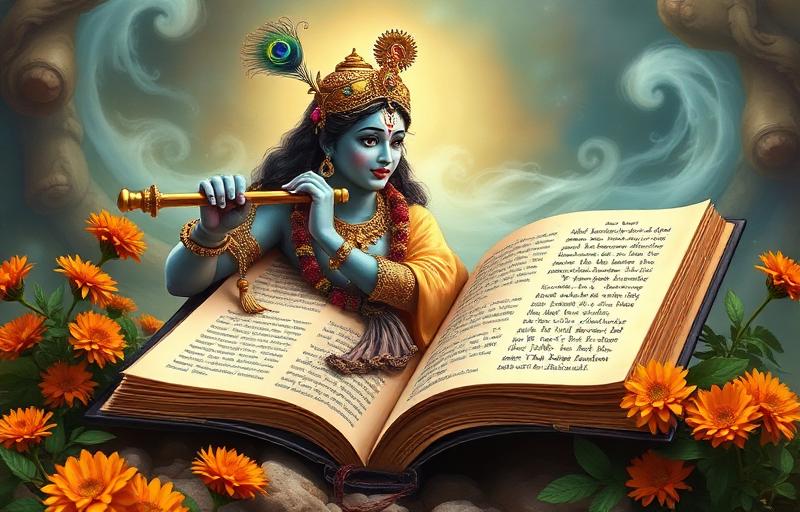
A Text That Describes Its Own Growth
The Mahabharata is unusual among ancient epics in that it openly narrates its own textual history inside itself. The Adi Parva describes three successive stages of the work: an original composition by Vyasa called Jaya, of 24,000 verses, dealing with the core Kuru-Pandava conflict; a second, expanded recitation called Bharata, of around 100,000 verses, first recited by Vyasa's student Vaishampayana at King Janamejaya's snake sacrifice, the same sacrifice covered elsewhere in this series through Astika's intervention; and finally the version known today as the Mahabharata, further elaborated by the bard Ugrashrava Sauti when he narrated it to the sages at Naimisharanya forest.
The text's own famous opening claim, that the Mahabharata contains everything found elsewhere and that what is not found in it is found nowhere else, is made about this final, fullest stage, not about Jaya, which the text itself distinguishes as the leaner core underneath everything that came after.
What Jaya Is Thought to Have Contained
Scholars working on the Mahabharata's textual history, most notably in the critical edition compiled at the Bhandarkar Oriental Research Institute in Pune, have long tried to distinguish which parts of the surviving text likely belong to an older narrative core and which were added over centuries of transmission by different reciter communities.
The working consensus is that Jaya likely covered the direct spine of the story: the dynastic dispute between the Kaurava and Pandava lines, the dice game, the exile, and the eighteen-day war itself, largely without the vast didactic material, the philosophical discourses, the embedded sub-stories, and the cosmological framing that the fuller Mahabharata now carries. Sections like the Bhagavad Gita's extended philosophical content, much of the Shanti Parva's political and ethical teaching, and many of the smaller inset tales covered throughout this series are generally understood to belong to the later, expanded layers rather than to the leanest Jaya core, though scholars differ considerably on exactly where to draw each line.
The title itself, Jaya, meaning victory, is significant: it suggests the earliest version of the story was understood and transmitted primarily as an account of the Pandavas' triumph, a war narrative in the older heroic tradition, before the later layers turned it into something closer to what Krishna himself calls it in some traditions, a fifth Veda, containing dharma, artha, kama and moksha all at once.
Why This Matters to a Devotional Reader
None of this textual history is meant to diminish the epic as it exists today, which the tradition has received and used as a unified whole for well over a thousand years, and which this entire series has treated the same way, drawing on episodes across every layer without distinguishing older from newer.
What the Jaya framework does offer is a way to understand why the Mahabharata feels like several different kinds of book stitched together: a lean war epic at its core, wrapped in layers of ethical teaching, cosmology and folklore added by generations of reciters who understood themselves not as inventing new material but as unfolding what was already implicit in Vyasa's original compression. The text's own honesty about this process, naming its own growth stages rather than hiding them, is arguably part of why it has remained flexible enough to keep absorbing new commentary, new regional retellings and new devotional readings for three thousand years without breaking.
Common Questions From Devotees
Is Jaya a separate surviving text?+
No independent manuscript of Jaya as a standalone 24,000-verse text survives; its existence is known from the Mahabharata's own description of its textual history in the Adi Parva, and scholars reconstruct its likely content by analysis of the fuller text.
How many verses does the Mahabharata have today?+
The commonly cited figure is around 100,000 shlokas, making it roughly four times the combined length of the Iliad and Odyssey, though exact counts vary slightly between regional manuscript traditions.
Who is telling the Mahabharata to whom in its own frame story?+
The version most readers encounter is framed as Sauti narrating it to sages gathered at Naimisharanya forest, itself a retelling of Vaishampayana's earlier recitation to King Janamejaya, which was itself based on Vyasa's original composition.
About the author
Anjali Mehta · Editor, M.A. Religious Studies
Anjali is the managing editor for Vandnaa and oversees the festival and vrat coverage. She holds an M.A. in Religious Studies and reviews every published article for accuracy, accessibility, and tradition-fidelity.
Meet the Vandnaa editorial team →