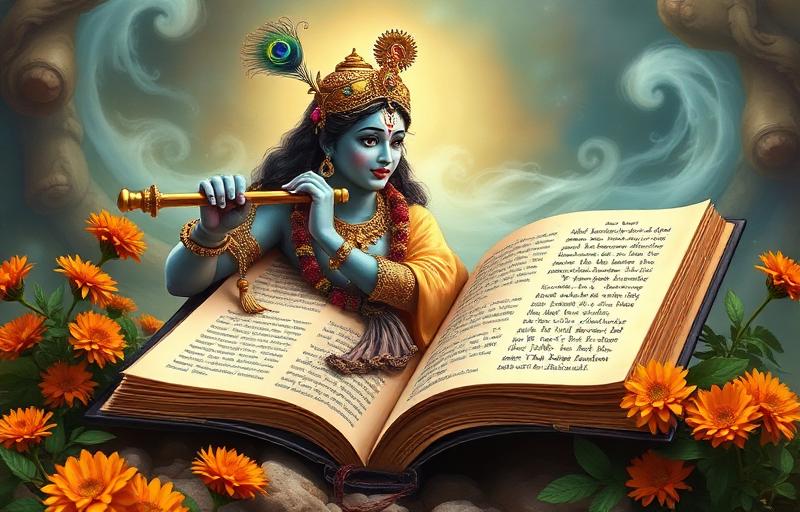
A Life's Work That Did Not Settle Him
The Bhagavata Purana opens its own account of its origin with an unusual admission: Vyasa, having already divided the single Veda into four for easier transmission, composed the eighteen Puranas, and written the Mahabharata itself as a fifth Veda accessible to those excluded from Vedic study, still sat by the banks of the Sarasvati river in a state of dissatisfaction he could not name.
He had, by any external measure, completed the largest literary and religious project undertaken by a single figure in the tradition. And yet the text describes him as troubled, sensing that something essential had still not been said, despite having covered dharma, artha, kama and the paths to liberation extensively across everything he had already composed.
Narada's Visit and Diagnosis
It is at this point that Narada, the wandering sage who appears across this entire series as a recurring catalyst in other people's stories, arrives at Vyasa's ashram and asks him directly why, despite everything he has accomplished, he still seems unsatisfied.
Narada's diagnosis is precise: Vyasa has described dharma, the pursuit of wealth, the pursuit of pleasure and the philosophy of liberation at great length, but has not, in any single sustained work, made the glories and the personal, intimate nature of the divine, specifically Krishna as the fullest expression of the divine, the direct and central subject of a text in its own right. Everything Vyasa has written treats devotion as one element within a larger frame of duty and philosophy. Narada tells him that until bhakti itself is given a text where it is not a supporting theme but the entire point, his work will remain, in some sense, incomplete, because the deepest human need is not primarily for correct conduct or philosophical clarity but for a direct relationship with the divine.
Narada is also said to remind Vyasa of his own earlier life, in some tellings identifying himself as having once been a servant boy who found devotion through the company of wandering sages, a story covered elsewhere in this series, using his own transformation as evidence for what he is now telling Vyasa about the sufficiency of devotion alone.
The Book Written in That State
Following this conversation, Vyasa is described entering a state of deep meditative absorption at his ashram at Shamyaprasa, and from that state composing the Bhagavata Purana, centred specifically on Krishna's life and the devotional relationship between the divine and the devotee, in a way none of his prior compositions had been. The tradition holds this to be his final and, in an emotional if not strictly chronological sense, most complete work.
The text is also, notably, the one Vyasa is said to have taught first to his own son Shukadeva, and which Shukadeva later recited in full to the dying king Parikshit, the same Parikshit whose birth and eventual death by snakebite are covered elsewhere in this series, closing a circle that runs from Vyasa's own restlessness through his son's teaching to a king's final week of listening as the appropriate use of the last days of a life.
Read this way, the Bhagavata Purana's traditional origin story is itself doing what the text argues devotion does generally: it takes something Vyasa had already achieved by every external measure and insists that achievement alone, without a direct, personal, loving orientation toward the divine, was never going to be the resting point.
What People Ask Most
Did Vyasa write the Bhagavata Purana before or after the Mahabharata?+
The traditional account places it after, as the culmination of his literary work, written specifically in response to the restlessness he felt once every other major text, including the Mahabharata, was already complete.
Who is Shukadeva and why does he matter to this story?+
Shukadeva is Vyasa's own son, born already a realised sage, who received the Bhagavata Purana from his father and became its primary narrator, reciting it to King Parikshit in the frame story that opens the text.
Is Narada considered the source of the bhakti tradition because of this story?+
Narada is closely associated with the codification of bhakti as a distinct path, including texts traditionally attributed to him such as the Narada Bhakti Sutra, and this episode is one of several where he is shown actively directing others toward devotion as sufficient in itself.
About the author
Pandit Ravindra Sharma · Vedic Rituals & Bhakti, 22+ years
Pandit Ravindra is the Vandnaa editorial team's resident specialist on aarti, chalisa, and daily devotion. He has performed home and temple pujas across Varanasi and Delhi for over two decades and contributes the bhakti-focused articles on this site.
Meet the Vandnaa editorial team →