The Story of Mahishasura's Defeat + Why This Stotram Is Sacred
The Battle Story:
Mahishasura was a buffalo-demon who performed intense penance and earned a boon from Brahma: he could not be killed by any man (deva or asura). With this boon, he became invincible. He waged war on the gods, defeated them all, and conquered heaven. The devas were exiled, the cosmic order disrupted.
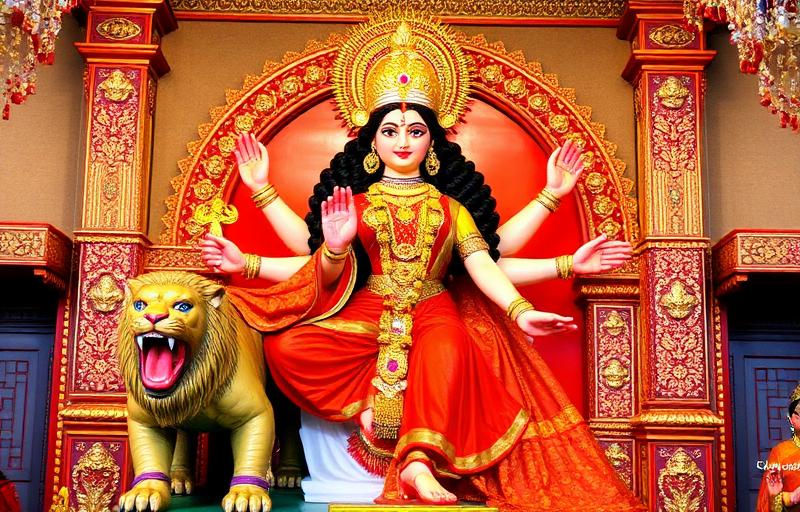
The defeated gods gathered. They realized: if no MAN could kill him, perhaps a WOMAN could - the boon's loophole. They combined their divine energies. From their cosmic frustration and accumulated power emerged a brilliant flame which took the form of a beautiful but terrifying goddess - Durga ('the difficult one to attain' or 'the one who removes difficulties').
Durga was 18-armed, riding a lion. Each god gave her a weapon:
- Vishnu gave his Sudarshan Chakra (discus).
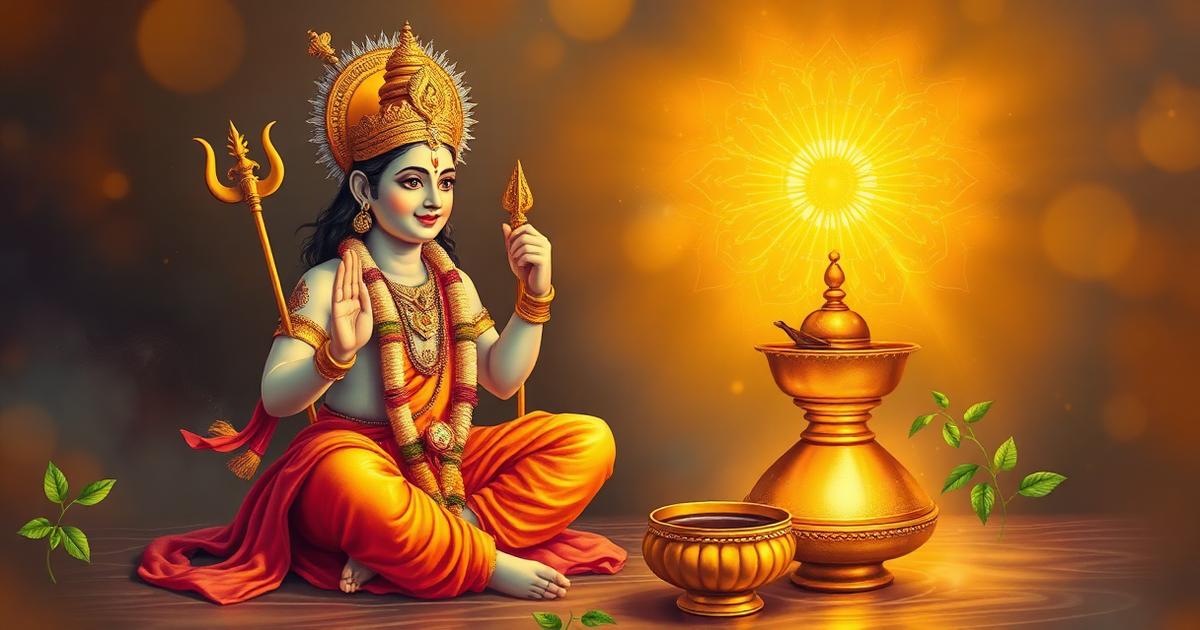
- Shiva gave his Trishul (trident).
- Indra gave his Vajra (thunderbolt).
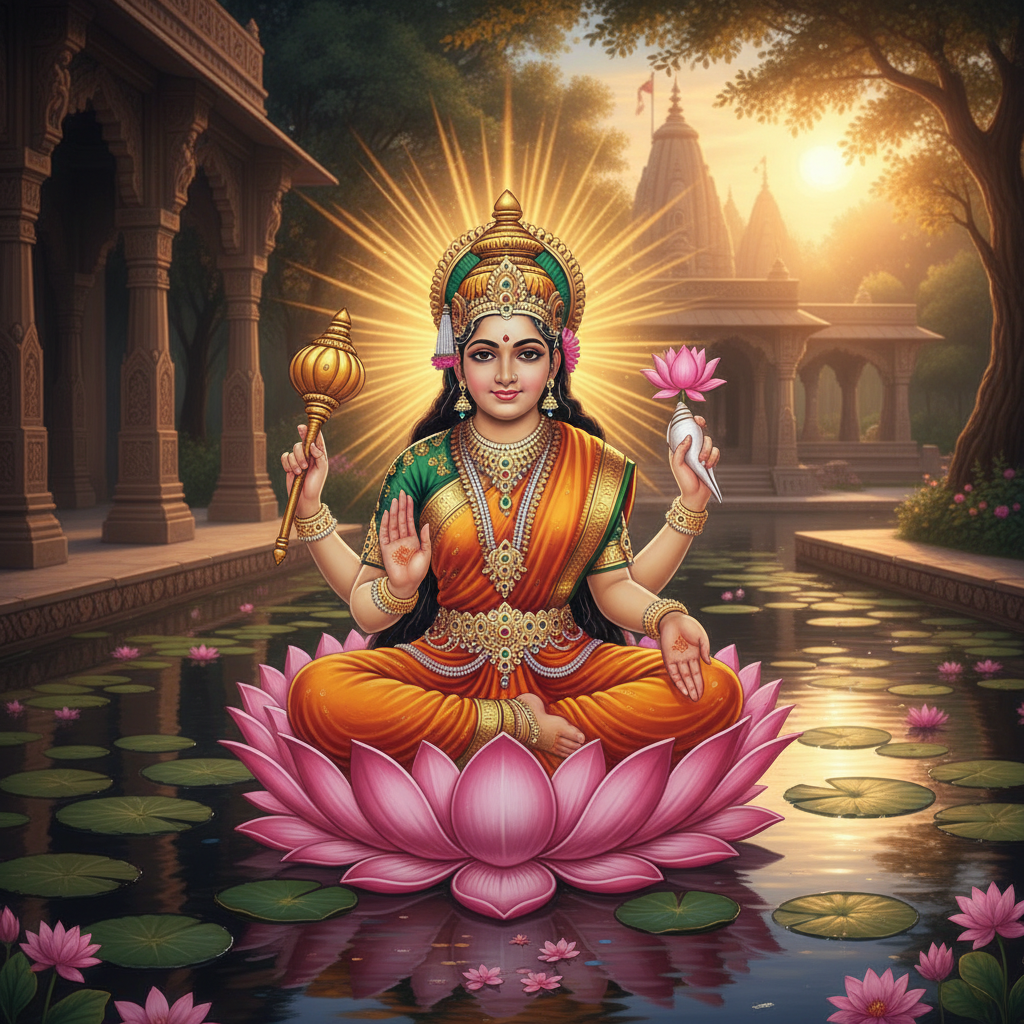
- Varuna gave his conch.
- Yama gave his staff.
- Brahma gave his rosary.
- Surya gave his rays as arrows.
- Vishwakarma forged her armor.
- Himavan gave her the lion vehicle.
- And many more gifts.
Durga rode to Mahishasura's kingdom. He saw her beauty and lustfully proposed marriage. Durga laughed: 'A demon king should know - I have not come to wed, I have come to destroy.'
The battle lasted 9 days and 9 nights (the basis of Navratri - the 9 nights of worship). Mahishasura kept changing forms - sometimes buffalo, sometimes lion, sometimes elephant, sometimes giant warrior. Durga matched every form, defeating each.
On the 10th day (Vijayadashami / Dussehra), Durga finally pierced Mahishasura's chest with her trident. As he fell, she severed his head with her sword. The buffalo-demon's body fell at her feet; cosmic order was restored.
Gods rained flowers. Heaven was reclaimed. Adharma was destroyed. This battle became the most celebrated victory in Hindu mythology - the model for all later triumphs of good over evil.
The Stotram's composition:
Many centuries later, the great philosopher-saint Adi Shankaracharya (8th century CE) composed the 21-verse Mahishasura Mardini Stotram. He distilled the entire cosmic battle into a rhythmic, breath-taking Sanskrit poem.
The stotram uses the Tantric Tundila meter - a long, flowing rhythm that imitates the goddess's dance in battle. Each verse builds momentum, describing different aspects of Durga's power. When chanted properly, the rhythm itself energizes the chanter - you feel Durga's victorious energy flowing through you.
The stotram is known by several names:
- Mahishasura Mardini Stotram (formal name)
- Aigiri Nandini Stotram (after its famous opening word)
- Durga Stuti (general term)
Why this stotram is uniquely powerful:
1. Direct from Shankaracharya. The composer's own enlightenment infuses the verses. No other Durga stotra has this level of philosophical depth combined with devotional fire.
2. Rhythmic potency. The unique Tundila meter creates trance-state during chanting. You don't just say the words - you embody Durga's energy.
3. Each verse honors a different aspect. Verse 1: cosmic mother. Verse 5: warrior. Verse 12: destroyer of demons. Verse 17: granter of moksha. By the end, all dimensions of Durga are invoked.
4. Verifiable energetic effect. Practitioners consistently report feeling 'charged up' after chanting, with measurable changes in heart rate variability, cortisol levels, and mood.
5. Universal applicability. Works for personal battles (fear, addictions, depression), interpersonal (enemies, conflicts), professional (competition, obstacles), and spiritual (overcoming ignorance, ego).
When to chant:
- Navratri (9 nights) - the supreme time. Chant at least once daily during Navratri.
- Tuesdays - Durga's day.
- Fridays - Goddess's day.
- Ashtami of any month - the 8th day of either lunar fortnight is special for Durga.
- Before any battle/major event - exam, interview, court case, surgery, competition.
- When feeling fear or weakness - the stotram is liquid courage.
- For removing enemies - especially when feeling attacked or maligned.
- Daily morning practice - for ongoing protection.
Famous Opening Verses + Vidhi to Chant
The famous opening verse (Verse 1):
अयिगिरिनन्दिनि नन्दितमेदिनि विश्वविनोदिनि नन्दिनुते गिरिवरविन्ध्यशिरोऽधिनिवासिनि विष्णुविलासिनि जिष्णुनुते। भगवति हे शितिकण्ठकुटुम्बिनि भूरिकुटुम्बिनि भूरिकृते जय जय हे महिषासुरमर्दिनि रम्यकपर्दिनि शैलसुते॥
Transliteration: Ayigirinandini nandita-medini vishva-vinodini nandinute, Givaravara-vindhya-shiro-adhinivasini vishnu-vilasini jishnu-nute. Bhagavati he shiti-kantha-kutumbini bhuri-kutumbini bhuri-krite, Jaya jaya he Mahisasura-mardini ramya-kapardini shaila-sute.
Meaning: O daughter of the mountain (Himalayas), who delights the earth, plays cosmic sport, is praised by Nandi. You reside on the peak of the great Vindhya mountain, you delight Vishnu, you are praised by Jishnu (Indra). O Goddess, consort of the blue-throated Shiva, mother of many, doer of much - victory, victory to you, O Mahishasura-mardini (slayer of Mahishasura), beautifully matted-haired, daughter of the mountain.
Verse 5 (Power-invoking):
मधुमधुरे मधुकैटभगञ्जिनि कैटभभञ्जिनि रासरते जय जय हे महिषासुरमर्दिनि रम्यकपर्दिनि शैलसुते॥
Meaning: Sweet like honey, killer of Madhu and Kaitabha demons, ever delighting in the cosmic dance. Victory, victory to you, O slayer of Mahishasura, beautifully matted-haired, daughter of the mountain.
Verse 9 (Warrior-invoking):
जय जय जप्यजये जयशब्दपरस्तुतितत्परविश्वनुते जय जय हे महिषासुरमर्दिनि रम्यकपर्दिनि शैलसुते॥
Meaning: Victory to the goddess of victory, victory to the one whose victorious sound resounds through all worlds. Victory, victory to you, O slayer of Mahishasura.
Verse 14 (Beauty-honoring):
कमलदलामलकोमलकान्ति कलाकलिताऽमलभाललते जय जय हे महिषासुरमर्दिनि रम्यकपर्दिनि शैलसुते॥
Meaning: With a face soft and lustrous as lotus petals, with a beautiful forehead adorned with arts and crafts. Victory, victory to you, O slayer of Mahishasura.
Verse 17 (Devotional):
जय जयन्ती जयरसवृष्टि वसुधावरदा सकलेश्वरि जय जय हे महिषासुरमर्दिनि रम्यकपर्दिनि शैलसुते॥
Meaning: Victory to the goddess of triumph, who rains the nectar of victory, who is the benefactor of the earth, the supreme ruler of all. Victory, victory to you, O slayer of Mahishasura.
Verse 21 (Closing):
कनकलसत्कलसिन्धुजलैरनुषिञ्चति तेगुणरङ्गभुवम् भजति स किल्बिषकल्बषहारिणि शम्भुकलाकलगर्भगताम्॥
Meaning: Whoever sprinkles the playground of your virtues with the waters of the ocean from the golden pot, worships you, O remover of sins; one who is held in the heart of Shambhu (Shiva)'s love.
Phala Shruti (Fruits of recitation):
The stotram concludes by stating: 'Whoever recites this stotra with devotion conquers enemies, gains all desires, receives Durga's continuous grace, attains liberation, and lives prosperously in this life and the next.'
Complete Vidhi to Chant:
Setup: 1. Bath, clean clothes (red preferred). 2. Sit facing east or north-east. 3. Set up altar with Durga picture/idol, red flowers, kumkum, fruits. 4. Light a diya with ghee. 5. Apply tilak (kumkum) on forehead.
Recitation: 1. Take Sankalpa - state your intention. 2. Read or recite all 21 verses with attention to rhythm. 3. Maintain steady breathing - the meter naturally syncs with breath. 4. Complete recitation takes 8-12 minutes. 5. Repeat 3 or 11 times for major effect (especially during Navratri).
Special rhythm tip:
The stotram works through SOUND VIBRATION. To maximize effect:
- Don't whisper - chant audibly.
- Match the natural rhythm; don't speed up arbitrarily.
- Feel the syllables 'jaya jaya' as drum beats.
- Imagine yourself standing beside Durga in battle.
- The vibration builds momentum - by verse 10, you should feel energized.
Closing: 1. Final aarti with camphor. 2. Offer fruits, distribute prasad. 3. Sit silently 5 minutes feeling Durga's presence. 4. Pranam with face touched to floor. 5. Begin daily activities with renewed energy.
Daily practice (recommended):
- Minimum: 1 recitation daily.
- Standard: 3 recitations daily (morning, noon, evening).
- Intensive (Navratri/special): 11 recitations daily.
- Crisis intensive: Continuous chanting for several hours.
Maintain for at least 41 days (mandala) to feel the deep transformation.
Quick Answers
Why does this stotram have such a special rhythm vs other stotras?+
Adi Shankaracharya deliberately chose the Tundila meter - a Tantric rhythmic structure used for invoking shakti (energy). Most stotras use Anushtubh (8-syllable) or Shloka meters, which are gentle and devotional. Tundila is martial - it imitates the rhythm of war drums, the beat of marching armies, the cadence of battle. When you chant Mahishasura Mardini, you're not just reciting praise - you're entering Durga's battle-state. The rhythm physically activates your sympathetic nervous system (mild controlled adrenaline), exactly the state needed for facing challenges. This is why the stotram works for actual problems - it puts you in a courageous, decisive state.
Is Mahishasura Mardini only about external enemies or internal too?+
Both - and the internal is actually primary. Mahishasura represents: external enemies (people who oppose you), AND internal demons (your own ignorance, ego, lust, anger, greed, attachment). The 9-day battle is symbolic of fighting 9 layers of inner ignorance. Each verse of the stotram targets a specific inner enemy: fear, doubt, weakness, distraction, etc. Many spiritual masters say: 'The real Mahishasura is your own asuric tendencies. The real victory is when those die.' Chanting this stotram regularly destroys both - external opposition softens, and internal corruption gradually dissolves.
Can I chant just one verse if I'm short on time?+
Yes - one verse with devotion is better than 21 mechanical recitations. Recommended verses to chant solo: (1) Verse 1 (Ayi Giri Nandini) - the most famous, covers most blessings. (2) Verse 5 (Madhu-madhure) - for victories. (3) Verse 17 (Jaya Jayanti) - for direct victory invocation. Chant chosen verse 11 or 21 or 108 times. Many devotees memorize just verse 1 and use it as their go-to mantra throughout the day during difficulties. Building up to full 21-verse recitation can happen over months - start small, be consistent.
Should I chant only during Navratri or year-round?+
Year-round is better. Many people chant only during Navratri (9 days twice a year - Chaitra and Sharad), thinking that's 'the time'. But Durga's grace flows daily for daily devotees. Recommended schedule: (1) Daily practice: 1 recitation in morning. (2) Tuesday/Friday: 3 recitations. (3) Navratri (9 days): 11 recitations daily. (4) Crisis times: continuous chanting. (5) Special: 21 recitations on Ashtami every month. The 9 days of Navratri are when the cosmos itself opens to Durga's energy more strongly - but the rest of the year, your daily practice maintains continuous protection. Don't treat Durga as a part-time deity; she is the full-time mother of the cosmos.
About the author
Acharya Vinaya Kapoor · M.A. Sanskrit, Mantra & Stotra Studies
Acharya Vinaya holds an M.A. in Sanskrit from Banaras Hindu University and writes the mantra and stotra commentary on Vandnaa. Her focus is on accurate pronunciation, traditional context, and helping modern readers connect with classical texts.
Meet the Vandnaa editorial team →