A Village of Temples
Maluti is a small village in Dumka district of Jharkhand, close to the West Bengal border, and it holds one of the most remarkable concentrations of temple architecture anywhere in eastern India.
Local tradition and documentation describe the village as having once had around a hundred and eight temples. Today roughly seventy survive, in varying condition, clustered through the village in groups, standing between houses and fields.
What they look like:
- Built in the chala style of eastern India, with curved roofs derived from thatched hut forms, the same idiom seen across Bengal
- Constructed in brick, faced with terracotta panels carved before firing
- Sized modestly, most of them small shrines rather than large temples
- Grouped in clusters, with several standing together in a single compound
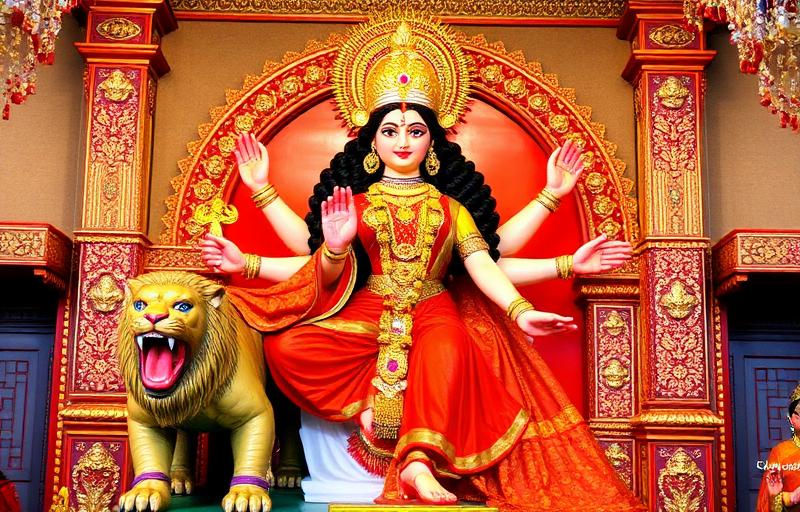
Most are Shiva temples, with lingas installed, alongside shrines to other deities. And at the centre of the village's devotional life is Maa Mauliksha, the goddess whose temple gives Maluti its religious identity.
The village receives a fraction of the attention that comparable heritage sites get, and it is the kind of place a visitor arrives at expecting a temple and finds a landscape.
Maa Mauliksha
Maa Mauliksha is the presiding deity of Maluti, worshipped as the kul devi of the Baj Basanta dynasty, the ruling family whose patronage built the village's temples.
Her temple is the focus of the village's continuous worship, and while the surrounding temples are visited as heritage, hers is visited as a shrine.
What devotees do here:
- Offer red chunri, sindoor, flowers, sweets and lamps, as at Devi shrines across the east
- Come during Durga Puja and Navratri, when the village fills
- Make vows for children, health and family matters, and return to complete them
- Bring newborns and perform mundan
The Devi is worshipped in the eastern Shakta manner, and the village's location, close to the border with Birbhum district in West Bengal, places it firmly within the Bengali Shakta devotional world rather than at its edge.
A tradition connects Maluti to Bamakhepa, the tantric saint of Tarapith, which lies a short distance away across the border. Local accounts hold that he spent time at Maluti and practised here before his association with Tarapith. For devotees who know the Tarapith tradition, that connection is a large part of why they come.
The Dynasty That Built Instead of Paying Tax
The reason a village this size has this many temples lies in the history of the Baj Basanta family.
The commonly told account in the region is that the family's founder, remembered as Basanta Rai, received the local zamindari from the ruler of Gaur in the medieval period, and that the family thereafter held the estate as a religious rather than a purely political holding.
What happened next is the interesting part. Rather than accumulate wealth, successive members of the family and its branches built temples in competition with each other, each generation adding to what stood. The village's temples were constructed over roughly the seventeenth to nineteenth centuries, in clusters corresponding to the family's branches.
This explains features that puzzle first time visitors:
- The temples are small and numerous rather than few and grand, because each was an individual act of patronage
- They stand in groups, because branches of the family built in their own compounds
- They are similar in style but varied in detail, reflecting a shared idiom applied over generations
- Many are Shiva temples, since a linga shrine is the standard form for this kind of merit building
The practice of building a temple as a devotional act, rather than commissioning a single large one, produced something no planned project could. A village where the ordinary built environment is made of shrines.
What the Terracotta Panels Show
The terracotta work is the reason art historians travel to Maluti, and the panels reward slow looking.
The subjects follow the eastern Indian terracotta tradition:
- Ramayana scenes, including the war at Lanka, laid out in sequence across a facade
- Mahabharata episodes
- Krishna lila, with the raas, the govardhan lifting and the childhood scenes
- Durga and the Mahishasura episode, and other Devi forms
- Dashavatara, the ten avatars, arranged in panels
- Scenes of ordinary life, including hunting, boats, processions, musicians and figures in period dress, which are among the most valuable records the panels carry
That last category is what makes terracotta temples historically important. A sculptor working in stone tends to stay with the prescribed iconography. A craftsman modelling clay panels for a small village temple includes what he sees, and these facades preserve details of dress, weapons, boats and daily life from the period they were made.
Condition varies considerably. Some temples retain nearly complete panel schemes, others have lost most of their facing, and vegetation and weather have damaged several. Conservation work has been undertaken, and the site has appeared on lists of endangered heritage, which reflects both its value and its fragility.
Visitors should treat the panels accordingly. Do not touch them, do not climb the structures, and do not pick up fallen fragments.
Maluti, Tarapith and the Shakta Belt
Maluti's location places it inside one of the densest Shakta regions in India, and understanding the neighbourhood explains the village.
- Tarapith, in Birbhum district of West Bengal, a short distance across the border, is one of the most important tantric shrines in the east, where the Devi is worshipped as Tara and where Bamakhepa practised
- Basukinath, a major Shiva shrine in Dumka district, drawing large Sawan crowds along with Baidyanath
- Baba Baidyanath Dham at Deoghar, one of the twelve Jyotirlingas, with the Shravani Mela
- The Rarh Shakta villages of Birbhum and Bankura, with their Devi and Dharmathakur shrines
- Maluti, with Mauliksha and its temple cluster
The Jharkhand and Bengal border here is a political line, not a devotional one. Families move across it, the same festivals are kept on both sides, and pilgrims travelling to Tarapith or Baidyanath pass through the same district roads.
For a devotee planning a route, this is a compact circuit. Deoghar for Baidyanath, Basukinath, Maluti and Tarapith can be covered in a few days from a base at Deoghar or Dumka, and it takes in a Jyotirlinga, a major tantric shrine, a village of terracotta temples and the Shakta countryside between them.
Visiting Maluti
Maluti is off the usual tourist route, which is both its difficulty and its appeal.
- Location - Dumka district, Jharkhand, close to the West Bengal border and to Tarapith
- Access - by road from Dumka, Rampurhat or Deoghar. Rampurhat in Birbhum is the nearest convenient railhead for many visitors.
- Best time - October to March. Durga Puja and Navratri bring the village to life at the Mauliksha temple.
- Time needed - a half day at least. The temples are spread through the village in clusters and are best seen slowly on foot.
- Facilities - minimal. Carry water, and plan meals at Dumka, Rampurhat or Tarapith.
- Guides - villagers can point out the temple groups and explain the panels, and asking locally is far more useful than any signage
What to keep in mind:
- These are protected heritage structures and living shrines at the same time. Some receive worship, some do not, and the difference is not always obvious.
- Do not touch the terracotta, climb on the temples or move any fragment
- Ask before photographing worship at the Mauliksha temple
- Take your waste away with you, since the village has limited arrangements
Maluti is the kind of place where the value is in the accumulation. One terracotta temple is interesting. Seventy of them, standing between houses in an ordinary Jharkhand village, is something else entirely, and it takes walking through the whole village to understand what the Baj Basanta family actually did here.
Reader Questions Answered
Who is Maa Mauliksha?+
Maa Mauliksha is the presiding deity of Maluti village in Dumka district, Jharkhand, worshipped as the kul devi of the Baj Basanta dynasty whose patronage built the village's temples. Her shrine is the centre of continuous worship in the village.
How many temples are there at Maluti?+
Tradition describes the village as having once had around a hundred and eight temples. Roughly seventy survive today in varying condition, standing in clusters between the houses and fields of the village.
Why did one village get so many temples?+
The Baj Basanta family held the estate as a religious holding, and successive members and branches built temples in competition with each other over roughly the seventeenth to nineteenth centuries, each generation adding small shrines rather than one large temple.
What do the terracotta panels depict?+
Ramayana and Mahabharata scenes, Krishna lila, Durga and the Mahishasura episode, the Dashavatara, and scenes of ordinary life including hunting, boats, processions and musicians, which preserve valuable detail of dress and daily life from the period.
What is Maluti's connection with Tarapith?+
Tarapith in Birbhum district of West Bengal lies a short distance across the border, and local tradition holds that the tantric saint Bamakhepa spent time at Maluti and practised there before his association with Tarapith.
How should visitors treat the temples?+
They are protected heritage structures and living shrines at the same time. Do not touch the terracotta, climb the temples or move fallen fragments, ask before photographing worship at the Mauliksha temple, and carry your waste away.
About the author
Pandit Ravindra Sharma · Vedic Rituals & Bhakti, 22+ years
Pandit Ravindra is the Vandnaa editorial team's resident specialist on aarti, chalisa, and daily devotion. He has performed home and temple pujas across Varanasi and Delhi for over two decades and contributes the bhakti-focused articles on this site.
Meet the Vandnaa editorial team →Explore on Vandnaa
Related Articles
Maa Dewri: The Sixteen Armed Goddess Served by Tribal and Brahmin Priests Together
8 min read

Tarapith Tara Maa Temple: The Tantra Peeth of Bengal
7 min read
Baidyanath Jyotirlinga (Deoghar) - Significance & Darshan
9 min read
Dharmathakur: The Bengal Deity Worshipped as a Stone, With No Brahmin Priest
8 min read