Blocked at the Gate
Ravana's travels, in the tradition, were not confined to his own kingdom. Flush with the boons he had won and the strength they gave him, he is said to have made his way toward Mount Kailash, Shiva's abode, at a time when Shiva and Parvati were in private retreat and had asked not to be disturbed. Nandi, the bull who serves as Shiva's principal attendant and gatekeeper, stood in Ravana's path and refused him entry.
Ravana, unused to being stopped by anyone, mocked Nandi's appearance, his bull-like face and form, laughing openly at him rather than accepting the refusal with any grace. Different tellings render the exact insult differently, some have him comparing Nandi's face to a monkey's, which is the detail that gives the story its sting in hindsight. Nandi, deeply angered at being ridiculed while simply doing his duty, did not strike back physically. He spoke instead, and what he said was a curse: that Ravana's kingdom, and Ravana himself, would one day be destroyed by beings with faces like the one he had just mocked.
The Mountain He Tried to Move
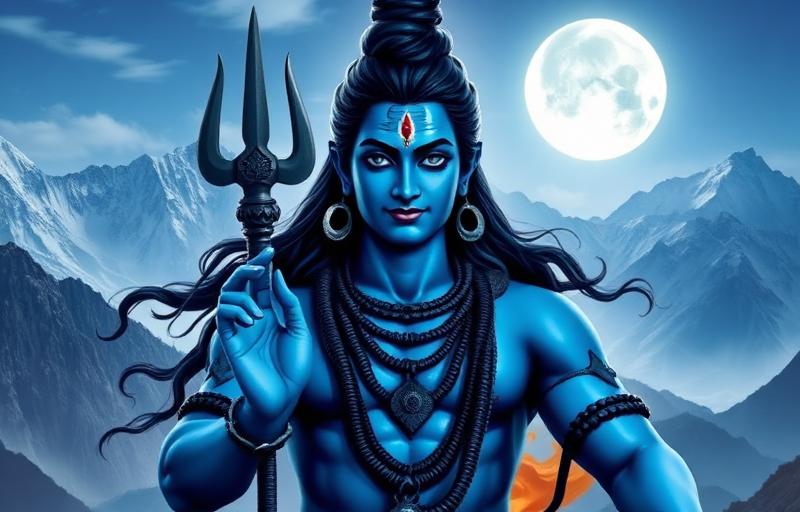
The Shiva Purana and later regional retellings often connect this refusal to a further episode in which Ravana, frustrated at being denied entry, decided to uproot Kailash itself and carry it away, an act of raw defiance against being blocked by anyone, divine gatekeeper included. He wedged his many arms beneath the mountain and began to lift it. Shiva, sensing the tremor, is said to have pressed down with nothing more than his big toe, pinning Ravana's arms under the mountain's weight for years.
This particular episode, and the hymn Ravana is sometimes said to have composed in his agony to win release, belongs more properly to its own story and is treated separately on this site rather than repeated here in full. What matters for Nandi's curse specifically is the sequence it sits inside: an insult at the gate, a curse in response, and years later an army of vanaras, monkey-faced exactly as Ravana had mocked, arriving at Lanka's shore to end his rule precisely as Nandi had said they would.
A Curse Fulfilled by an Army
What makes this episode worth telling on its own, rather than as a footnote to the Kailash-lifting story, is how directly it explains a structural choice at the heart of the Ramayana: why the war against Ravana is won specifically by an army of vanaras rather than by human soldiers, celestial armies, or any other force available to Rama. Hanuman, Sugriva, Angada and Nala and Nila are not simply the allies who happened to be available in the forest; in this telling, they are the specific instrument of a curse spoken years earlier at the gate of Kailash.
The episode circulates today mostly in Shiva Purana retellings and in Ramlila performances that stage it as a prelude scene explaining Ravana's fate before the main action of the Ramayana even begins, giving audiences the satisfaction of watching an old insult come due. It is a smaller story than the war it sets up, but it is the reason the war takes the shape it does.
What People Ask Most
Did Ravana know about Nandi's curse when he later fought the vanara army?+
The texts do not generally depict Ravana connecting the two events in the moment, which is part of what gives the story its dramatic irony: the audience knows the curse is being fulfilled even as Ravana treats the vanara army as an unexpected obstacle rather than a fate he brought on himself.
Is Nandi always shown as a bull, or does he have another form in this story?+
Nandi is generally depicted with a bull's head or a fully bull form as Shiva's vahana and gatekeeper, which is exactly what Ravana is mocking in this episode. Some tellings describe Nandi taking a more humanoid but still bull-faced form specifically to deliver the curse.
Is this the same story as Ravana's ten heads or his name's origin?+
No, those come from a separate episode connected to the Kailash-lifting incident and Ravana's cry of pain, which this article deliberately does not retell in full. Nandi's curse is its own earlier episode, at the gate rather than under the mountain.
About the author
Anjali Mehta · Editor, M.A. Religious Studies
Anjali is the managing editor for Vandnaa and oversees the festival and vrat coverage. She holds an M.A. in Religious Studies and reviews every published article for accuracy, accessibility, and tradition-fidelity.
Meet the Vandnaa editorial team →