The Shrine in the Water
Nishkalank Mahadev stands off the village of Koliyak, about twenty five kilometres from Bhavnagar in Gujarat, roughly a kilometre out from the shore in the Gulf of Khambhat.
What is there:
- A raised stone platform in the sea, square, reached across the exposed sea bed at low tide
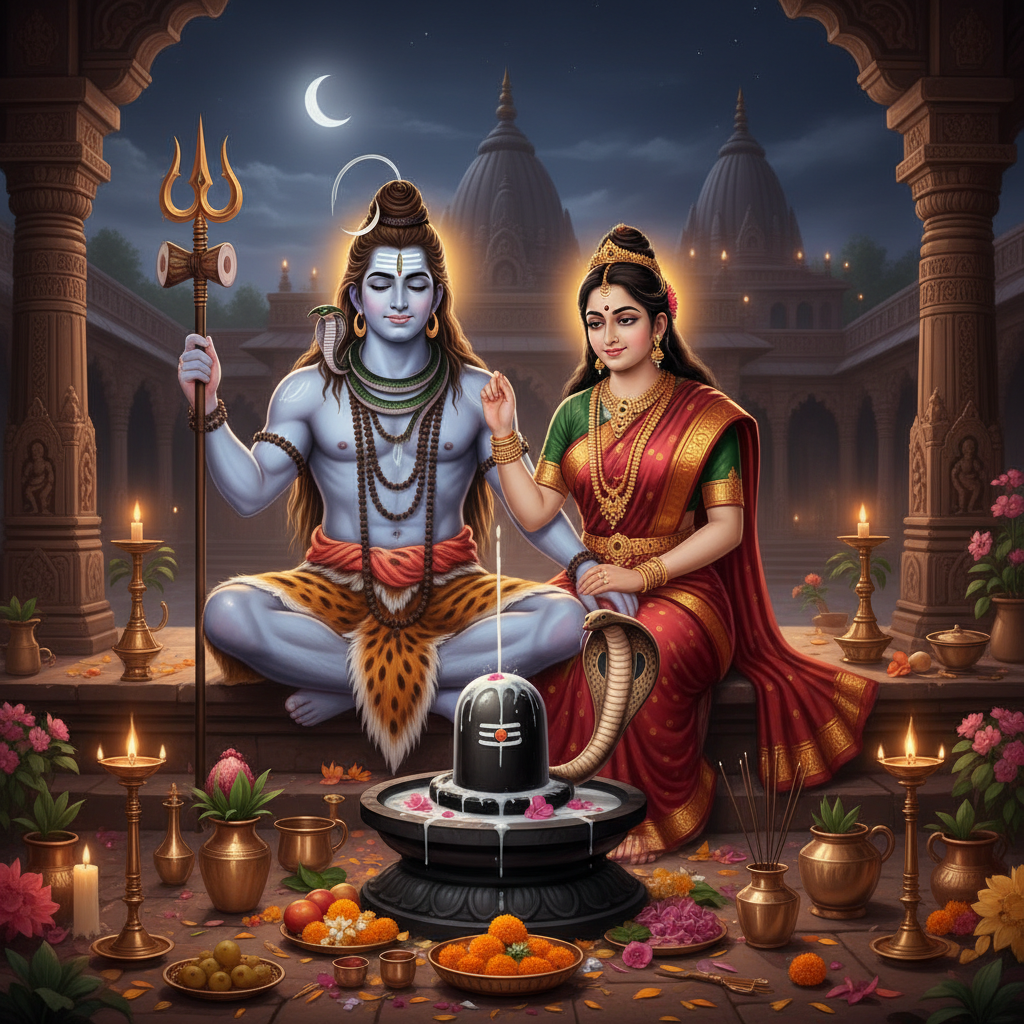
- Five lingas on the platform, each with a Nandi before it, held to be swayambhu
- A flagpole carrying a dhwaja, which is the only thing visible when the tide is in
- A small kund on the platform
- No building over the shrine. It is open to the sky and the sea
How it is reached:
- Only at low tide, on foot, across a kilometre or so of sea bed
- The walk takes twenty minutes or more depending on the tide and the ground
- At high tide the entire platform is under water and only the flag shows
The name says what the place is for. Nishkalank means without stain or blemish, and the shrine is understood as the place where a stain was removed.
Gujarat has two famous tidal Shiva shrines, this one and Stambheshwar further up the coast in Bharuch district. They work in the same way physically and mean quite different things, which is worth understanding before visiting either.
The Katha of the Black Flag
The story here belongs to the aftermath of the Mahabharata, and it is about a problem the epic takes very seriously.
The situation:
- The war was won, and the Pandavas held the kingdom
- They were also responsible for the deaths of cousins, teachers and elders, which the tradition treats as gotra hatya, the killing of one's own
- Victory did not settle this. The epic is explicit that the Pandavas were unable to enjoy what they had won
- They went to Krishna and asked how the stain could be removed
What Krishna gave them:
- A black flag and a black cow
- They were told to follow the cow, carrying the flag, and to keep walking
- When both the flag and the cow turned white, the place where it happened would be where their guilt had lifted
- They walked a very long way
Where it happened:
- At Koliyak, on this coast, the flag and the cow turned white
- The Pandavas stopped and meditated, and Shiva appeared to them there
- He appeared as five lingas, one for each brother, which are the five on the platform
- The shrine took the name Nishkalank, the stainless, because that is what they had become
Why the story is constructed this way. The details are not decorative:
- The remedy is a journey of unknown length, not a ritual of fixed duration. They were not told how far
- The sign of release is visible and external, so it could not be argued about or claimed prematurely
- The place is as far from Hastinapur as India allows, on the far western sea, which is the point
Guilt of that kind, the tradition is saying, is not settled at home by a ceremony. You walk until something changes.
Why Five Lingas
The number is the detail most visitors ask about, and the arrangement carries the meaning of the shrine.
What is on the platform:
- Five lingas, set apart from one another rather than grouped
- A Nandi before each, so each is a complete shrine in itself
- They are of different sizes, and are held to be swayambhu, self manifest rather than installed
What the five stand for:
- One for each of the Pandava brothers, Yudhishthira, Bhima, Arjuna, Nakula and Sahadeva
- Each brother is understood to have received his own, and to have worshipped separately
Why this matters. It would have been simpler, and would have made a neater shrine, to give them one linga to worship together. The tradition did not do that.
- Guilt in this tradition is not collective in a way that dissolves the individual. Each brother carried his own share and had to answer for it himself
- The brothers acted together throughout the war, and the shrine still separates them at the moment of release
- Five shrines on one platform is a precise image of exactly that. Together, and each alone
The wider pattern. Groups of shrines standing for a set of individuals recur across India, and they usually make the same point:
- The Panch Kedar in the Himalaya, five shrines where parts of Shiva as the bull appeared, visited by the Pandavas in that katha as well
- The Pancharama kshetras in Andhra, five Shiva shrines from a single shattered linga
- The Ashtavinayak in Maharashtra, eight Ganesha shrines that must be visited in sequence
Each case takes something singular and distributes it, so that reaching the whole requires effort and the parts keep their identity. Nishkalank does it inside one platform in the sea.
Bhadarvi Amas
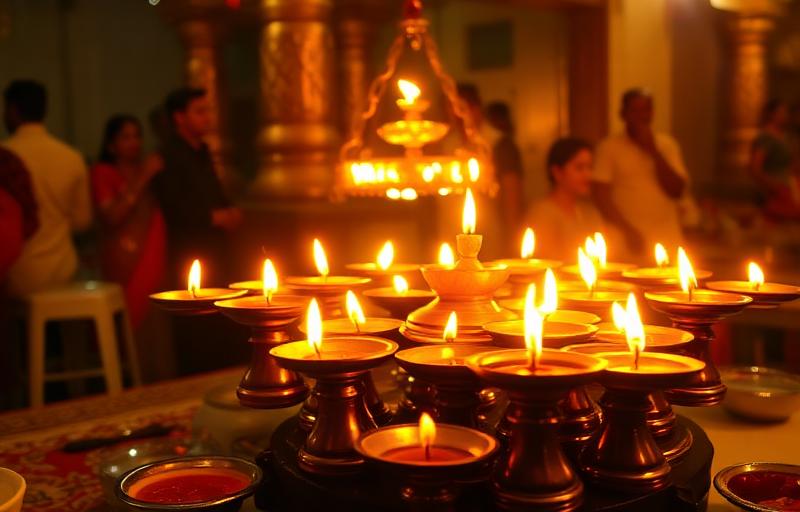
The shrine's great occasion is Bhadarvi Amas, the new moon of the month of Bhadrapada, which falls in August or September.
What happens:
- Very large numbers of devotees come, counted in lakhs across the days around it
- A mela is held at Koliyak, with the village and the shore given over to it
- The dhwaja, the flag on the pole, is changed, and the raising of the new flag is the central ceremony
- Devotees walk out at low tide in enormous numbers to take darshan and perform abhishek
- Many come specifically to perform rites for ancestors, which the shrine's association with expiation makes fitting
Why a new moon. The tidal range is greatest at new moon and full moon, so the sea withdraws furthest and the platform is exposed longest. A festival on amavasya at a tidal shrine is not a coincidence of the calendar. It is the day the shrine is most available.
The rest of the year:
- Mahashivratri, observed as at any Shiva temple, with the tide governing the day
- Shravan Mondays
- Amavasya each month, when the low tide is at its most generous
- Ordinary days, when the walk out can be made almost alone
A note about the festival crowd. Bhadarvi Amas puts an extremely large number of people on a sea bed that will be under water within hours, in the humid tail of the monsoon.
If you go then, go early in the window, keep your group together, keep children held, do not linger at the platform when people begin moving back, and treat instructions from the organisers as instructions rather than suggestions. On an open flat with the sea returning, crowd management is not bureaucracy.
Two Tidal Shrines, Two Ideas
Gujarat's two famous tidal Shiva shrines are often mentioned together and are usually confused with each other. They are worth separating.
Stambheshwar, at Kavi Kamboi in Bharuch district:
- A single linga in a small structure
- The katha is Kartikeya's, who installed lingas in expiation after killing a devotee of Shiva
- The submersion is understood as abhishek performed by the sea
- The temple disappears entirely and returns, and the emphasis is on that rhythm
Nishkalank, off Koliyak in Bhavnagar district:
- Five lingas on an open platform, one for each Pandava
- The katha is the Pandavas', and the theme is expiation completed at the end of a long walk
- A flagpole remains visible at high tide, so the shrine is never wholly hidden
- The emphasis is on the walk out, a kilometre across the sea bed, which is itself the last stage of the story
What they share is the theme, and it is striking that both of Gujarat's sea shrines are about expiation rather than about boons.
That is not accidental. Water is the tradition's standard medium for the removal of impurity, from the daily snan to the immersion of ashes to the Ganga's whole theology. A shrine that the sea itself washes twice a day is the largest available statement of that idea, and a shrine you can only reach by walking out into the sea bed and back is a physical enactment of going somewhere to be cleared and returning.
If you are visiting both, go to Nishkalank for the walk and the story, and to Stambheshwar for the disappearance. They are about four hours apart by road.
Visiting Nishkalank Mahadev
Getting there
- Koliyak village, about 25 km from Bhavnagar, Gujarat, on the Gulf of Khambhat
- Bhavnagar has an airport and a railway station, and is well connected to Ahmedabad by road, roughly 200 km
- Autos and taxis run from Bhavnagar to Koliyak
- The shrine is about a kilometre out from the shore, reached on foot
Timing your visit
- Access is only during the low tide window. Check the day's timings before setting out and confirm locally
- Allow time for the walk each way, which takes twenty minutes or more
- Amavasya and Purnima give the greatest exposure
The walk out
- The sea bed is wet, uneven and slippery in places, with shells, weed and soft patches
- Wear footwear that grips and that can be ruined. Many walk barefoot, which is a choice, not a requirement, and shells cut
- Keep to the route people are using rather than striking out across the flat
- Carry as little as possible. Whatever you take will get wet
When to go
- October to March for comfortable weather
- Bhadarvi Amas in Bhadrapada for the great mela, accepting very heavy crowds
- Mahashivratri and Shravan Mondays
- Avoid rough weather and the height of the monsoon
Safety
- The sea returns on schedule. Start back before the window closes rather than at its edge
- Do not walk out in poor light or low visibility
- Keep children held throughout, not walking ahead
- There is no shade and no shelter on the flat. Carry water and cover up
- Follow local instruction without argument
Combining the visit
- Bhavnagar for the old town, Takhteshwar temple on its hill, and the Gandhi Smriti museum
- Velavadar blackbuck national park is within reach
- Palitana, the great Jain temple hill, is about 50 km from Bhavnagar and is one of the most remarkable religious sites in India
- Alang shipbreaking yards lie along this coast, visible from the road
A closing thought. The Pandavas in this story are not given a mantra or a fee schedule. They are handed a flag and a cow and told to walk until the colour changes. Then they are made to stop at the edge of the country, at a place that is only there half the time. As images of what it takes to put something down, it is hard to improve on.
What People Ask Most
Where is Nishkalank Mahadev?+
About a kilometre out to sea off Koliyak village, roughly 25 km from Bhavnagar in Gujarat, in the Gulf of Khambhat. Bhavnagar has an airport and railway station and is about 200 km from Ahmedabad by road, with autos and taxis running to Koliyak.
Why are there five lingas?+
One for each of the Pandava brothers, Yudhishthira, Bhima, Arjuna, Nakula and Sahadeva, each with its own Nandi so that each is a complete shrine. The arrangement makes the point that each brother carried his own share of the guilt and answered for it himself.
What is the katha of the black flag?+
After the Mahabharata war the Pandavas carried the stain of killing their own kin. Krishna gave them a black flag and a black cow and told them to walk until both turned white. At Koliyak they did, the Pandavas meditated, and Shiva appeared as five lingas. The shrine took the name Nishkalank, the stainless.
When is the main festival?+
Bhadarvi Amas, the new moon of Bhadrapada, falling in August or September, when lakhs of devotees come and the flag on the pole is changed. New moon gives the greatest tidal range, so the platform is exposed longest, which is why the festival falls then.
How is it different from Stambheshwar Mahadev?+
Stambheshwar at Kavi Kamboi has a single linga, follows Kartikeya's katha, and disappears entirely, with the submersion understood as abhishek by the sea. Nishkalank has five lingas on an open platform, follows the Pandava katha, keeps a flagpole visible at high tide, and emphasises the kilometre walk out across the sea bed.
What should I be careful about on the walk?+
The sea bed is wet, uneven and slippery with shells, weed and soft patches, so wear footwear that grips. Keep to the route others are using, start back before the low window closes rather than at its edge, keep children held throughout, avoid poor light and rough weather, and carry water since there is no shade at all.
About the author
Pandit Ravindra Sharma · Vedic Rituals & Bhakti, 22+ years
Pandit Ravindra is the Vandnaa editorial team's resident specialist on aarti, chalisa, and daily devotion. He has performed home and temple pujas across Varanasi and Delhi for over two decades and contributes the bhakti-focused articles on this site.
Meet the Vandnaa editorial team →