The Samadhi at Trimbakeshwar
The Nivruttinath samadhi temple stands at Trimbakeshwar in Nashik district, Maharashtra, below the Brahmagiri hill from which the Godavari rises.
What is there:
- The samadhi of Nivruttinath, the eldest of the four siblings of Apegaon and Alandi
- A temple built over it, with a mandapa and a courtyard
- A steady flow of Varkari devotees, particularly around the sant's own observances
- The town of Trimbakeshwar around it, which is a major pilgrimage centre in its own right for the jyotirlinga
Who he was, in one line. Nivruttinath was the elder brother and the guru of Dnyaneshwar, whose Marathi commentary on the Bhagavad Gita, the Dnyaneshwari, is one of the founding texts of the entire devotional culture of Maharashtra.
Why he is less known. The younger brother wrote the book. Dnyaneshwar is the name everyone knows, his samadhi at Alandi is one of the most visited shrines in the state, and his palkhi is the most famous in the Wari.
Nivruttinath taught him, and is honoured in the tradition precisely as the one who did. In a culture where the guru is placed above the disciple as a matter of course, the fact that the more famous brother's teacher is the less visited shrine is a small irony that the tradition itself notices.
The Four Children
The story of these four is one of the hardest in Marathi devotional history, and it is told without softening.
The parents:
- Vitthalpant of Apegaon took sannyas, renouncing household life, and went to Kashi
- His guru there, learning that he had a wife living, instructed him to return to household life, which he did
- Four children were born after his return: Nivruttinath, Dnyaneshwar, Sopandev and Muktabai
What happened to them:
- The local brahmin community held that a man who had taken sannyas could not return, and treated the children as illegitimate
- The family was excluded. The children were denied the thread ceremony and the standing that went with it
- The parents sought a ruling and were told that the only expiation was their own deaths
- Vitthalpant and Rukmini ended their lives, so that the children might be readmitted
- The community still refused, and the children remained outcast
What the four then did. This is the part that matters.
- They did not petition further
- Nivruttinath received initiation into the Nath tradition and became guru to the others
- Dnyaneshwar wrote the Dnyaneshwari in Marathi, deliberately in the spoken language rather than in Sanskrit, so that anyone could read the Gita
- Muktabai, the youngest and the only girl, is remembered for her abhangas and for her fierce good sense, including the episode in which she talks Dnyaneshwar out of a sulk
- All four took samadhi young
Why the biography matters to the teaching. A tradition of devotional literature in the vernacular, arguing that access to God does not run through birth or through Sanskrit, was written by four children who had been denied both on the grounds of birth.
The Dnyaneshwari is not an abstract argument for accessibility. It was written by someone the system had shut out, in the language of the people who had been shut out with him.
The Cave on Brahmagiri
The event that makes Trimbakeshwar the place for Nivruttinath happened, in the tradition, on the hill above it.
The account:
- The family, excluded and wandering, was in the forest around Brahmagiri
- A tiger appeared and the group scattered
- Nivruttinath, separated from the others, took shelter in a cave
- Inside was Gahininath, a siddha of the Nath tradition
- Gahininath initiated him, and Nivruttinath emerged as a Nath adept
- He then initiated Dnyaneshwar, who initiated Sopandev, who initiated Muktabai
The lineage this places them in. The Nath sampradaya traces itself through Adinath, understood as Shiva, to Matsyendranath, then Gorakhnath, then Gahininath, and thence to Nivruttinath.
Why that matters enormously:
- It gave four excluded children a lineage that the brahmin community's ruling could not touch
- The Naths were yogis outside the caste system, drawing from all communities, and their authority came from realisation rather than from birth
- A Nath initiation was recognised, respected and entirely independent of the social apparatus that had rejected them
What this produced. The Dnyaneshwari begins from a Nath framework and moves toward Vaishnava devotion, and the Varkari tradition that grew from it carries both. That is why Maharashtra's devotional culture has a strong yogic strand running under its bhakti, and it enters through this cave.
A rejected family found a door that did not require anyone's permission, and walked through it. The whole of the Varkari movement, several centuries of literature and the largest annual pilgrimage in western India follow from that.
The Palkhi from Trimbakeshwar
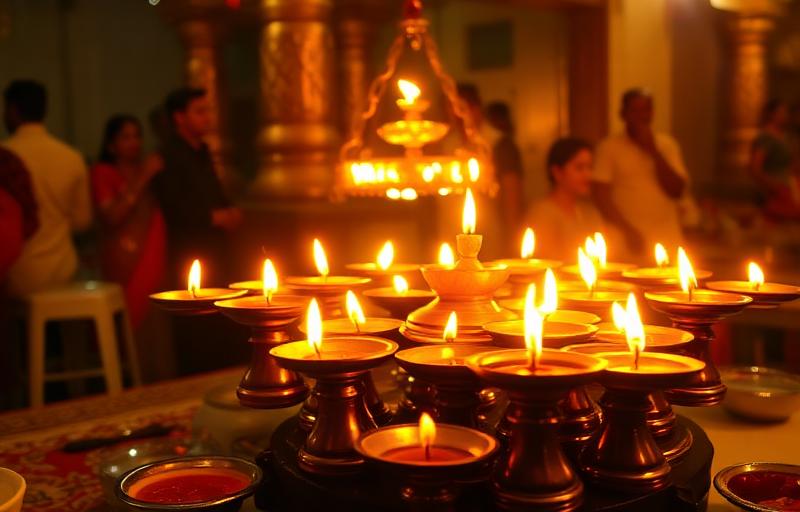
Nivruttinath's samadhi is one of the starting points of the great annual movement of Maharashtra's devotional life.
How the system works:
- Each major sant's samadhi sends a palkhi, a palanquin carrying the sant's padukas, their sandals
- The palkhis travel on foot, accompanied by dindis, organised walking groups, singing abhangas the whole way
- They converge on Pandharpur for Ashadhi Ekadashi, in the month of Ashadha
- The whole movement is the Wari, and those who walk it are Varkaris
The principal palkhis:
- Dnyaneshwar from Alandi
- Tukaram from Dehu
- Nivruttinath from Trimbakeshwar
- Sopandev from Sasvad
- Muktabai from Muktainagar
- Eknath from Paithan
- Along with many others
What is striking about the arrangement. The sants are not gathered in one place. They are distributed across Maharashtra, and once a year they are carried toward a common point.
The result is that the pilgrimage is not only a journey to Pandharpur. It is the state itself moving, along roads that connect the towns where the sants lived, in a pattern that repeats every year and has done for centuries.
On what the Wari is like. Hundreds of thousands of people walk, for up to three weeks, in the monsoon. The dindis are organised, disciplined and self managed to a degree that surprises people who see it for the first time. There is singing, ringing of taal, and the ringan, a formation in which a horse runs through the assembled walkers.
It is one of the largest recurring pedestrian movements on earth, and it starts at a handful of small samadhi temples, of which Trimbakeshwar is one.
Trimbakeshwar Around It
The town is a major pilgrimage centre for reasons other than Nivruttinath, and a visit will take in both.
What Trimbakeshwar has:
- The jyotirlinga, one of the twelve, in the main temple, with its own arrangements and queue system
- Brahmagiri hill above the town, held to be the source of the Godavari, with a stepped climb to the top
- Kushavarta kund, the tank in the town where the Godavari is taken to emerge, and the point from which the river is formally counted
- The Nivruttinath samadhi, a short distance away
- Rites for ancestors, for which Trimbakeshwar is a recognised centre, particularly certain observances performed here rather than elsewhere
The Godavari. The river rises on Brahmagiri and becomes, over its course, the longest river of peninsular India, crossing Maharashtra, Telangana and Andhra Pradesh to the Bay of Bengal.
As at Amarkantak with the Narmada, standing at the source of a river of that scale is the attraction. The water in the Kushavarta kund is the same river that irrigates a large part of the Deccan.
The Kumbh. Trimbakeshwar and Nashik together host the Simhastha Kumbh, one of the four Kumbh sites, roughly every twelve years. During that period the town is transformed and access to everything changes completely.
How to fit the two together. Most visitors come to Trimbakeshwar for the jyotirlinga and leave without knowing that Nivruttinath is there.
If you have any interest in the Varkari tradition, or have been to Alandi or Pandharpur, the samadhi is the reason to stay an extra hour. It is where the lineage that produced the Dnyaneshwari begins.
Visiting Nivruttinath
Getting there
- Trimbakeshwar, Nashik district, Maharashtra, about 30 km from Nashik town
- Nashik Road is the railway station, and Nashik has an airport with limited connections
- Buses and taxis run constantly from Nashik
- From Mumbai the drive is roughly 180 km, and from Pune about 240 km
Timings
- The samadhi temple keeps daily hours, generally longer than the jyotirlinga temple's darshan sessions
- The jyotirlinga has its own queue and timing arrangements, including paid darshan options, which need checking in advance
When to go
- October to March for comfortable weather
- Pausha, when Nivruttinath's own yatra is observed at Trimbakeshwar and the town fills with Varkaris
- Ashadha, when the palkhi departs for Pandharpur, which is worth seeing if you can time it
- Mahashivratri and Shravan, when the jyotirlinga draws very heavy crowds
- Avoid the Simhastha Kumbh period unless you specifically want it
What to do there
- The Nivruttinath samadhi and its temple
- The jyotirlinga, allowing for queues
- Kushavarta kund
- The climb to Brahmagiri, which is a stepped ascent of some length. Carry water and start early
Practical notes
- Trimbakeshwar enforces dress and conduct rules at the main temple, and there are restrictions on entry to certain areas. Check before going in
- Phones and cameras are deposited at counters at the jyotirlinga
- The town has dharamshalas and modest hotels. Nashik is the comfortable base
- If you are having rites for ancestors performed, arrange the priest in advance through the temple rather than at the gate
Combining the visit
- Nashik and the Panchavati area, with its Ramayana associations
- Alandi, Dnyaneshwar's samadhi, near Pune
- Dehu, Tukaram's town, also near Pune
- The Anjaneri hill near Trimbakeshwar, associated in tradition with Hanuman's birth
A closing thought. Indian tradition insists that the guru comes before the deity in the order of gratitude. Trimbakeshwar is a place where you can test how seriously that is meant, since the queue for the jyotirlinga runs for hours and the queue for the man who taught Dnyaneshwar usually does not.
Quick Answers
Who was Nivruttinath?+
The eldest of the four siblings of the Apegaon family, elder brother and guru of Dnyaneshwar, who wrote the Dnyaneshwari. He was initiated into the Nath tradition by Gahininath and in turn initiated Dnyaneshwar, Sopandev and through them Muktabai. His samadhi is at Trimbakeshwar.
Why were the four siblings excluded?+
Their father Vitthalpant had taken sannyas and then returned to household life on his guru's instruction. The local brahmin community held that a man who had taken sannyas could not return, treated the children as illegitimate, and denied them the thread ceremony. The parents ended their lives seeking to have them readmitted, and the community still refused.
How did Nivruttinath receive initiation?+
Tradition holds that while the family was in the forest around Brahmagiri, a tiger appeared and the group scattered. Nivruttinath took shelter in a cave where Gahininath, a siddha of the Nath tradition, was present, and was initiated by him. The lineage runs from Adinath, understood as Shiva, through Matsyendranath and Gorakhnath to Gahininath.
What is the palkhi from Trimbakeshwar?+
A palanquin carrying Nivruttinath's padukas, which travels on foot to Pandharpur for Ashadhi Ekadashi, accompanied by dindis singing abhangas. It is one of the principal palkhis of the Wari, alongside Dnyaneshwar's from Alandi, Tukaram's from Dehu, Sopandev's from Sasvad, Muktabai's from Muktainagar and Eknath's from Paithan.
Where is Trimbakeshwar and how do I reach it?+
In Nashik district, Maharashtra, about 30 km from Nashik town. Nashik Road is the railway station and Nashik has an airport with limited connections. Buses and taxis run constantly from Nashik, and the drive is roughly 180 km from Mumbai and 240 km from Pune.
What else should I see at Trimbakeshwar?+
The jyotirlinga in the main temple, Kushavarta kund from which the Godavari is formally counted, and the stepped climb up Brahmagiri hill held to be the river's source. Trimbakeshwar is also a recognised centre for rites for ancestors, and with Nashik it hosts the Simhastha Kumbh roughly every twelve years.
About the author
Anjali Mehta · Editor, M.A. Religious Studies
Anjali is the managing editor for Vandnaa and oversees the festival and vrat coverage. She holds an M.A. in Religious Studies and reviews every published article for accuracy, accessibility, and tradition-fidelity.
Meet the Vandnaa editorial team →