The Padukas at the Confluence
Narsobawadi, also written Narsobachi Wadi and formally Narasimhawadi, stands in Shirol taluka of Kolhapur district, Maharashtra, at the sangam where the Panchganga joins the Krishna.
What is there:
- The manohar padukas, a pair of carved footprints, on the riverbank
- A temple built around them, with a courtyard opening toward the water
- Ghats descending to the Krishna
- Dharamshalas and the small town that has grown around the shrine
- An audumbar tree, the cluster fig associated with Dattatreya
What is not there. There is no principal image. The object of worship is the padukas, and only the padukas.
Whose they are. They are held to be the footprints of Shri Narasimha Saraswati, regarded in the Datta sampradaya as the second major avatar of Dattatreya, who lived in the fifteenth century and stayed at this spot for twelve years.
Why this is worth understanding before you go. A shrine where the deity is present as absence, marked only by where he stood, works differently from one built around an image. Devotees here are not looking at a face. They are standing where somebody else stood, and the entire devotional logic of the place follows from that.
Who Dattatreya Is
The Datta tradition is one of the major devotional streams of Maharashtra and Karnataka, and it is less familiar outside that region than its size warrants.
Dattatreya:
- The son of the sage Atri and Anasuya, whose devotion is the subject of a well known katha
- He is understood as the combined form of Brahma, Vishnu and Shiva, and is shown with three heads and six arms
- He is accompanied by four dogs, generally read as the four Vedas, and by a cow, read as the earth or as dharma
- He stands beneath an audumbar tree, and the tree is treated as his presence
- He is the adi guru, the first teacher, and the tradition around him is above all a guru tradition
The succession of avatars, as the sampradaya counts them:
- Shripad Shri Vallabh, at Pithapuram in Andhra Pradesh, the first
- Shri Narasimha Saraswati, the second, whose padukas are at Narsobawadi
- Later figures including Swami Samarth of Akkalkot, Manik Prabhu, and Vasudevanand Saraswati, known as Tembe Swami
What holds it together. The Datta sampradaya is not organised around a temple hierarchy or a single institution. It is held together by:
- The Gurucharitra, its central text
- A chain of gurus, each of whom is regarded as continuous with Datta
- A set of sites, mostly on riverbanks, each associated with a period of one avatar's stay
- The audumbar tree, Thursday as the weekday of the guru, and a distinctive practice of paduka worship
It is, in effect, a devotional tradition organised around teachers rather than around a deity's temple, which is why its shrines so often enshrine footprints instead of images.
Why Footprints
Paduka worship is widespread in India and is worth understanding on its own terms, because visitors often read it as a lesser substitute for an image.
Where padukas appear:
- At the samadhis of sants across Maharashtra, and carried in the palkhis of the Wari
- At Vishnupad in Gaya, where a footprint of Vishnu is the object of worship
- At sites across India marking where a deity or teacher stood
- In guru worship generally, where the guru's padukas are honoured daily
What the form does:
- It marks a place, and asserts that the significance is in the ground rather than in an object that could be moved
- It represents the person by their relationship to the devotee, since what a disciple approaches is the guru's feet
- It avoids depicting the face, which for a historical teacher rather than a mythological deity is a real problem, since nobody knows what they looked like
- It is humble by design. The devotee is not looking a deity in the eye. They are at the feet
Charan sparsh, touching the feet of elders and teachers, is the ordinary daily version of the same gesture, and paduka worship is its formalisation.
Why this suits the Datta tradition particularly. This is a tradition of gurus, not of a single mythological figure with a fixed iconography. Its shrines commemorate teachers who lived, taught in a specific place, and moved on.
A pair of footprints says exactly that. Someone was here. They are not here now. What they left is the place and the teaching, and you may stand where they stood.
At Narsobawadi that is the entire proposition, and five centuries of devotion have been built on it without anyone feeling the need to add a statue.
The Gurucharitra
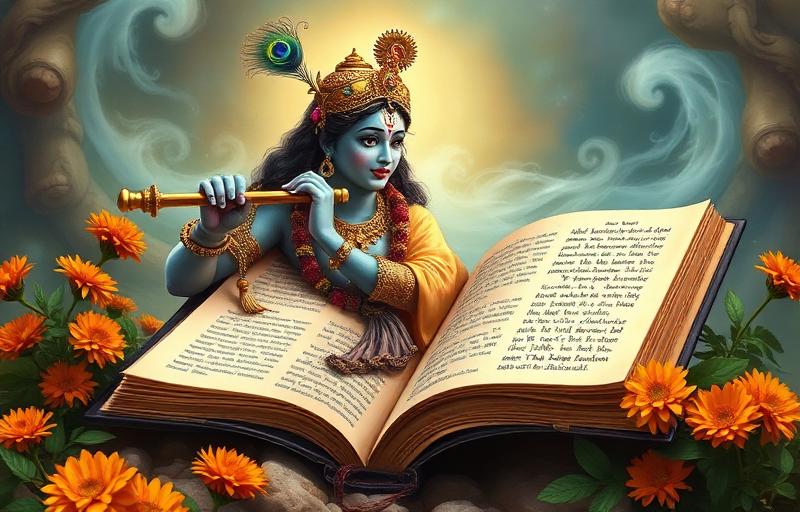
The Datta tradition's central text is worth knowing about, because it governs how devotees at Narsobawadi behave.
What it is:
- The Gurucharitra, a Marathi work in fifty one chapters
- It narrates the lives of Shripad Shri Vallabh and Shri Narasimha Saraswati, with a large body of teaching and episode attached
- It is attributed to Saraswati Gangadhar, and belongs to the sixteenth century
- It is, for the Datta sampradaya, what the Dnyaneshwari is for the Varkaris and the Ramcharitmanas is for much of north India
How it is read. This is the interesting part, because the text prescribes its own use.
- It is commonly read as a saptaha, a seven day recitation, with a set number of chapters each day
- The reading is undertaken with rules, on diet, conduct and daily routine, kept through the week
- Families undertake it at particular times, in fulfilment of a vow, or during difficulty
- Group readings are held at Datta shrines, and Narsobawadi is one of the principal places for it
What visitors should know. If you arrive during a saptaha you will find people who are in the middle of a week long observance with real restrictions, not casual visitors.
That affects how you should behave in the temple, and it also explains the atmosphere. Datta shrines tend to be quieter and more inward than large deity temples, with fewer vendors and less noise, because a substantial proportion of the people there are in the middle of a personal discipline rather than making a stop on a tour.
On taking a text's claims seriously. The Gurucharitra makes strong promises about what its recitation achieves. Devotees take those seriously. A visitor need not, but should not treat a room full of people doing a seven day reading as a photo opportunity.
The Shrine That Floods
Narsobawadi sits at a river confluence on the Krishna, and what that means in the monsoon is part of the shrine's identity.
What happens:
- In the monsoon the Krishna rises, and at the sangam the levels can go very high
- In heavy years the water reaches the temple, and the padukas go under
- The town is regularly affected, and there have been severe flood years in this region within living memory
- Worship arrangements change accordingly, and the temple's routine adapts to the water
How devotees understand it. They do not regard the flooding as damage or as a failure of siting.
- The rising river is understood as the Krishna coming to perform abhishek on the padukas
- The shrine was placed at the sangam deliberately, and floods are what a sangam does
- The padukas are stone, they do not move, and the water goes down
The wider pattern. This is the same logic seen at the tidal Shiva shrines of Gujarat, and at riverbank temples across India that submerge annually.
Indian sacred siting frequently puts shrines exactly where water will reach them, rather than safely above the line:
- Ghats and riverbank temples along the Ganga, Yamuna and Godavari
- The Ram Ghat temples at Ujjain on the Shipra
- Countless village shrines on tank bunds and stream banks
The reasoning is consistent. Water is the medium of purification, and a shrine the river reaches is a shrine the river serves. A tradition that immerses its festival images deliberately is not going to be troubled by a river doing the same thing to a temple once a year.
A practical note for visitors. Whatever the theology, floodwater is dangerous. If you are travelling in the monsoon, check conditions before going, do not attempt to reach the shrine through moving water, and follow local instructions. The river has taken lives in this region and devotion offers no protection from a current.
Visiting Narsobawadi
Getting there
- Narsobawadi, Shirol taluka, Kolhapur district, Maharashtra, at the Krishna and Panchganga sangam
- Roughly 50 km from Kolhapur and about 20 km from Sangli, by road
- Miraj and Kolhapur are the nearest railway junctions, and Kolhapur has an airport with limited connections
- Buses and shared vehicles run from Kolhapur, Sangli and Jaysingpur
Timings
- The temple keeps a full daily schedule with aarti at set times
- Thursday is the day of the guru and the busiest day of the week
- Check timings locally, since the routine changes during floods and festivals
When to go
- October to March for comfortable weather and a stable river
- Datta Jayanti, on Margashirsha Purnima, the tradition's principal festival
- Guru Purnima, given the tradition's emphasis on the guru
- Thursdays for the weekly gathering
- The monsoon brings flooding. Check conditions before travelling
What to do there
- Darshan at the padukas
- Sit at the ghats by the sangam, which is where most of the atmosphere is
- The audumbar tree
- If you want to attend a Gurucharitra reading, ask at the temple in advance
Practical notes
- Dress conservatively and behave quietly. This is an inward shrine, not a busy pilgrimage circuit
- There are dharamshalas and simple lodges. Kolhapur and Sangli have hotels
- Follow the temple's rules on photography, particularly during readings
- Do not enter the river casually. The Krishna is a large river with currents
The wider Datta circuit
- Audumbar, further up the Krishna, another site of Narasimha Saraswati's stay
- Ganagapur in Kalaburagi district, Karnataka, his principal seat
- Akkalkot, the seat of Swami Samarth
- Pithapuram in Andhra Pradesh, associated with Shripad Shri Vallabh
- Kolhapur itself, for the Mahalakshmi temple, is close by
A closing thought. Indian religion is usually introduced through its images, which are its most visible feature. Narsobawadi is a useful corrective. A shrine that has drawn devotion for five hundred years without any image at all suggests the images were never quite the point.
Reader Questions Answered
Where is Narsobawadi?+
In Shirol taluka, Kolhapur district, Maharashtra, at the sangam where the Panchganga joins the Krishna. It is roughly 50 km from Kolhapur and about 20 km from Sangli, with Miraj and Kolhapur the nearest railway junctions.
What is worshipped at Narsobawadi?+
The manohar padukas, a pair of carved footprints held to be those of Shri Narasimha Saraswati, who stayed at this spot for twelve years. There is no principal image at all. The padukas are the entire object of worship.
Who is Dattatreya?+
The son of the sage Atri and Anasuya, understood as the combined form of Brahma, Vishnu and Shiva, shown with three heads and six arms, accompanied by four dogs read as the Vedas and a cow read as the earth. He stands beneath an audumbar tree and is the adi guru, the first teacher.
What is the Gurucharitra?+
The central text of the Datta sampradaya, a Marathi work in fifty one chapters attributed to Saraswati Gangadhar and belonging to the sixteenth century, narrating the lives of Shripad Shri Vallabh and Shri Narasimha Saraswati. It is commonly read as a saptaha, a seven day recitation kept with rules on diet, conduct and routine.
Why does the temple flood?+
It stands at a river confluence on the Krishna, and in the monsoon the levels can go very high, so in heavy years the padukas go under. Devotees understand the rising river as the Krishna performing abhishek on the padukas rather than as damage. Floodwater is genuinely dangerous, so check conditions before travelling in the monsoon.
What are the other Datta sites?+
Audumbar further up the Krishna, Ganagapur in Kalaburagi district of Karnataka which was Narasimha Saraswati's principal seat, Akkalkot the seat of Swami Samarth, and Pithapuram in Andhra Pradesh associated with Shripad Shri Vallabh, the first of the avatars in the sampradaya's reckoning.
About the author
Anjali Mehta · Editor, M.A. Religious Studies
Anjali is the managing editor for Vandnaa and oversees the festival and vrat coverage. She holds an M.A. in Religious Studies and reviews every published article for accuracy, accessibility, and tradition-fidelity.
Meet the Vandnaa editorial team →Explore on Vandnaa
Related Articles
Swami Samarth of Akkalkot: The Guru Maharashtra Turns To When It Is Afraid
8 min read

Kanifnath at Madhi: One of the Nine Naths and the Fair at His Samadhi
8 min read

Nivruttinath: The Elder Brother Who Was Dnyaneshwar's Guru
8 min read
Yogeshwari of Ambejogai: The Goddess Whose Wedding Never Happened
8 min read