What Is Om (Pranava)?
Om (ॐ), also called the Pranava, is the most sacred sound in the Hindu tradition - the primordial vibration from which the whole universe is said to have arisen. The Vedas call it the seed of all mantras; nearly every mantra begins with Om.
The Mandukya Upanishad teaches that all that exists - past, present and future - is Om, and even what lies beyond time is Om. It is not merely a sound but a symbol of Brahman, the supreme reality. To chant Om is to attune oneself to the very vibration of existence and to turn the mind toward the divine.
The Three Sounds: A - U - M
Om is made of three sounds - A (अ), U (उ) and M (म्) - which blend into a single, continuous vibration:
- A (अ) arises in the throat, at the very back of the open mouth - the beginning of all sound. It represents creation and the waking world.
- U (उ) rolls forward through the mouth - it represents sustenance and continuity.
- M (म्) closes the lips, the end of sound dissolving into silence - it represents dissolution and return to the source.
Together A-U-M holds the whole cycle of creation, preservation and dissolution - and is linked to Brahma, Vishnu and Shiva. The sound begins, expands and merges back, mirroring the journey of all that exists.
The Three States & the Silence Beyond
The Mandukya Upanishad links the three sounds of Om to the three states of consciousness:
- A = Jagrat (waking) - the world of the senses and the body.
- U = Swapna (dreaming) - the world of the mind and impressions.
- M = Sushupti (deep sleep) - the state of rest where the mind is still.
But Om is more than these three. After the sound fades, there is a fourth - Turiya, the silence beyond A-U-M. This silence is the pure Self, the witness of all three states, untouched and ever-free.
This is why chanting Om and then resting in the silence that follows is a profound meditation: the sound carries us through waking, dream and sleep, and the silence opens onto the stillness of the Self (Atman).
How to Chant Om & Its Benefits
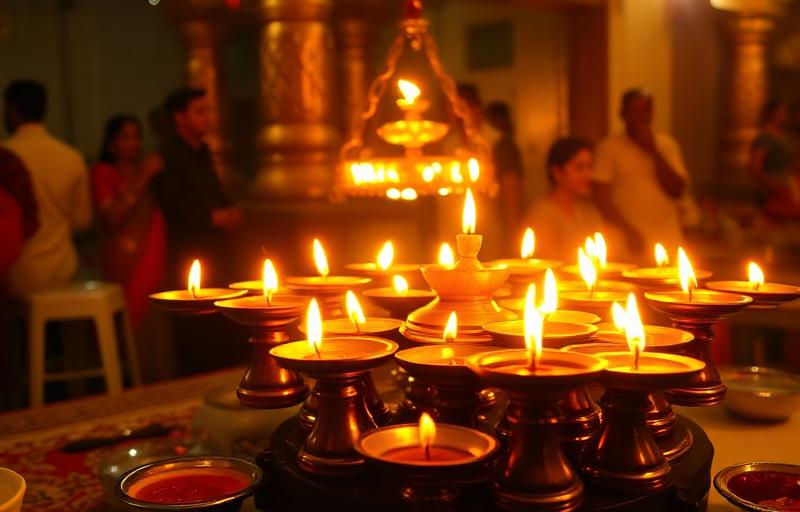
How to chant: 1. Sit comfortably with a straight spine, eyes gently closed, in a quiet place (early morning is ideal). 2. Take a deep breath, and on the out-breath chant A-U-M as one long sound - 'Aaa-Uuu-Mmm' - letting the M hum until the breath ends. 3. Rest in the silence that follows before the next chant. Repeat 7, 11 or 21 times. 4. Feel the vibration in the chest, throat and head.
Benefits (traditional):
- Calms the mind, steadies the breath and lowers restlessness
- Improves focus and prepares the mind for meditation
- Fills the space and the body with sattvic, peaceful vibration
- Turns the attention inward, toward the silent Self
Om can be chanted alone, before any prayer or mantra, or simply as a daily practice to begin and end the day in peace.
Frequently Asked Questions
What does Om (Aum) actually mean?+
Om is the primordial sound, the seed of all mantras and a symbol of Brahman, the supreme reality. Its three sounds A-U-M represent creation, preservation and dissolution, and the silence beyond them points to the pure Self.
What do the three sounds A, U and M represent?+
A represents creation and the waking state, U represents preservation and the dream state, and M represents dissolution and deep sleep. They are also linked to Brahma, Vishnu and Shiva. The silence after Om points to Turiya, the fourth state.
What is the fourth state beyond A-U-M?+
It is Turiya, the silence that follows the sound of Om. Turiya is the pure Self (Atman), the witness of waking, dream and deep sleep, untouched and ever-free. Resting in this silence is the goal of Om meditation.
How should a beginner chant Om?+
Sit with a straight spine, eyes closed, and on each out-breath chant A-U-M as one long sound, letting the M hum. Rest in the silence afterward. Repeat 7, 11 or 21 times, ideally in the early morning.
About the author
Acharya Vinaya Kapoor · M.A. Sanskrit, Mantra & Stotra Studies
Acharya Vinaya holds an M.A. in Sanskrit from Banaras Hindu University and writes the mantra and stotra commentary on Vandnaa. Her focus is on accurate pronunciation, traditional context, and helping modern readers connect with classical texts.
Meet the Vandnaa editorial team →