A Search That Began as a Fee for Education
When Krishna and Balarama completed their education under the sage Sandipani, an episode covered elsewhere in this series, their guru's requested fee was the return of his own son, long presumed drowned near Prabhasa. Krishna and Balarama travelled to the ocean at Prabhasa, and, on questioning Varuna, learned the boy had been taken by a demon named Panchajana, who lived permanently within a great conch shell at the bottom of the sea, using it as both dwelling and body.
Krishna dove into the ocean to confront this demon directly, entering a realm few beings could survive extended contact with, driven by the specific, concrete goal of fulfilling a debt owed to his teacher rather than by any broader campaign against sea-dwelling demons.
The Demon's Death and the Shell's New Purpose
Krishna located and killed Panchajana, and, on discovering the boy was not actually contained within the shell itself but had been taken further, to Yama's own realm, an episode covered elsewhere in this series, retained the demon's shell rather than discarding it.
He fashioned the shell into a conch and named it Panchajanya, after the demon from whose body it had come, keeping it as his own personal instrument from that point through the rest of his life, a detail the tradition treats without any discomfort about the object's origin, understanding the conch as having been transformed and purified through its new role in Krishna's service rather than remaining tainted by its previous demonic occupant.
The Sound That Would Later Open a War
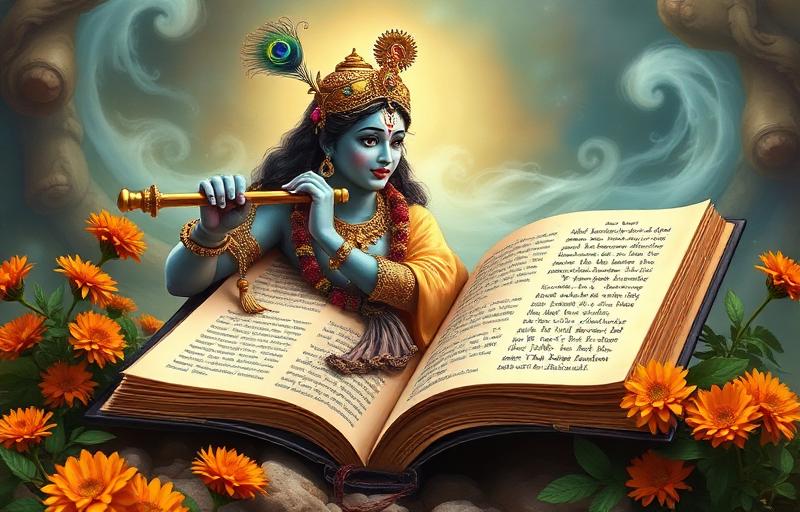
Panchajanya became one of Krishna's most recognisable attributes, appearing alongside his other emblems, the Sudarshana Chakra covered elsewhere in this series, the mace Kaumodaki, and the lotus, across virtually every classical depiction of him.
Its most famous later moment comes decades after this origin story, at the very start of the Bhagavad Gita's setting on the field of Kurukshetra, where Krishna sounds Panchajanya alongside the other warriors' conches to signal the war's formal beginning, a sound whose origin traces directly back to a demon killed in service of a guru's simple request rather than to any grander cosmic forging, making the conch a rare example in the tradition of a major divine weapon whose backstory is personal and almost domestic rather than epic in scale.
What People Ask Most
Did Krishna use Panchajanya as a weapon in combat, or only to make sound?+
Its primary recorded function throughout the epic is as a signalling instrument, sounded to announce presence, mark the start of battle, or signal victory, rather than as a direct offensive weapon.
Is Panchajana related to the other demons Krishna fought in childhood?+
No, the text does not connect him to Putana, Aghasura, or the other childhood threats covered elsewhere in this series; he is a distinct, adult-era demon encountered specifically during this guru dakshina mission.
Do other major figures in the epic also possess named conches?+
Yes, the Bhagavad Gita's opening chapter names several conches belonging to different warriors on both sides, including Arjuna's Devadatta and Bhima's Paundra, making Panchajanya one of several named instruments sounded together at the war's start.
About the author
Anjali Mehta · Editor, M.A. Religious Studies
Anjali is the managing editor for Vandnaa and oversees the festival and vrat coverage. She holds an M.A. in Religious Studies and reviews every published article for accuracy, accessibility, and tradition-fidelity.
Meet the Vandnaa editorial team →