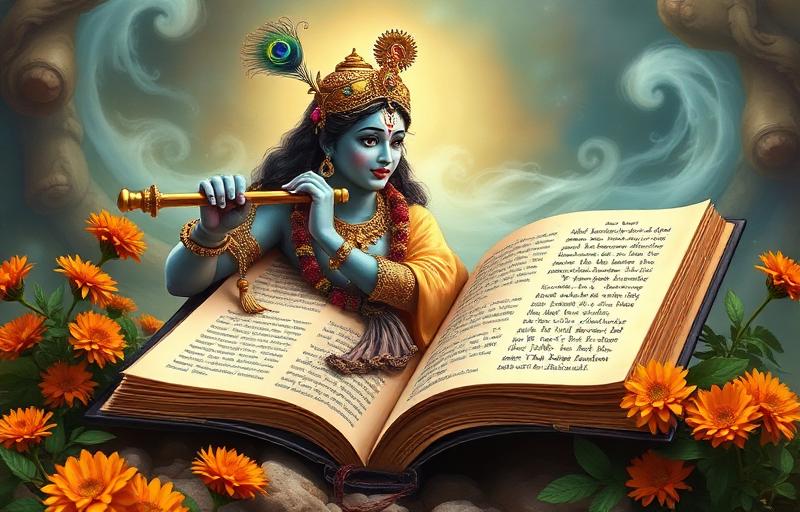
Sixty-Four Days for a Complete Education
After Kamsa's death, an episode covered elsewhere in this series, Vasudeva and Devaki arranged for Krishna and Balarama, now recognised princes of Mathura, to receive the formal education befitting their status, sending them to the ashram of the sage Sandipani in Avanti, in the region of present-day Ujjain.
Despite the traditional length of Vedic and martial education typically requiring many years, Krishna and Balarama, according to the text, completed the entire curriculum, the Vedas, their auxiliary sciences, archery, statecraft, and the sixty-four traditional arts, in a mere sixty-four days, their innate divine capability allowing them to absorb what would ordinarily take a lifetime of ordinary study.
The Fee Sandipani Actually Wanted
When the education concluded, Krishna and Balarama, following custom, asked their guru what fee, guru dakshina, he wished as payment for his teaching. Sandipani and his wife, rather than requesting wealth or any material reward, revealed a long-standing personal grief: their son had drowned years earlier in the ocean near Prabhasa and had never been recovered, and they asked their two students to bring him back if it was within their power.
Krishna and Balarama travelled to Prabhasa, where the ocean deity Varuna, on being approached, revealed that the boy had actually been taken by a demon named Panchajana, who lived in the ocean depths in the form of a conch shell. Krishna dove into the ocean, located and killed Panchajana, and from the demon's shell fashioned Panchajanya, the conch that would become his own signature weapon and one of his most recognisable attributes throughout the rest of the epic, an origin story tied elsewhere in this series to its role at Kurukshetra.
Retrieving the Boy From Yama's Own Realm
Killing Panchajana revealed the boy was not held within the shell itself, and Krishna and Balarama, taking Panchajanya with them, travelled further, to Yamapuri, the realm of Yama, god of death, to directly request the boy's return. Yama, recognising Krishna's divine nature and the legitimacy of the request as a guru dakshina owed to a worthy teacher, restored the boy and handed him over personally.
Krishna and Balarama brought Sandipani's son back to Avanti and presented him to his parents, completing a guru dakshina that exceeded any material payment by returning something the family had long grieved as permanently lost. This episode, alongside establishing Panchajanya's origin, is generally read as one of the clearest early demonstrations of Krishna's full divine authority, capable of negotiating directly with Yama rather than simply performing feats of strength or cunning, marking a shift in how the text presents his power compared to the childhood miracles that preceded it.
Frequently Asked Questions
Why is education completed in sixty-four days significant rather than any other number?+
Sixty-four corresponds to the traditional count of arts and sciences, the chausath kalas, a student was expected to master, making the number itself a marker that Krishna and Balarama's education was genuinely complete rather than an arbitrary duration.
Is Panchajanya the same conch used throughout the Mahabharata war?+
Yes, Panchajanya, fashioned from the demon Panchajana's shell in this episode, remains Krishna's signature conch throughout the rest of his life, including its famous sounding at the start of the Bhagavad Gita's setting on the Kurukshetra battlefield.
Did Sandipani's son remain with his parents after being restored?+
The text presents his return as complete and permanent, resolving the family's long grief, though it does not follow his life in detail beyond this reunion.
About the author
Anjali Mehta · Editor, M.A. Religious Studies
Anjali is the managing editor for Vandnaa and oversees the festival and vrat coverage. She holds an M.A. in Religious Studies and reviews every published article for accuracy, accessibility, and tradition-fidelity.
Meet the Vandnaa editorial team →