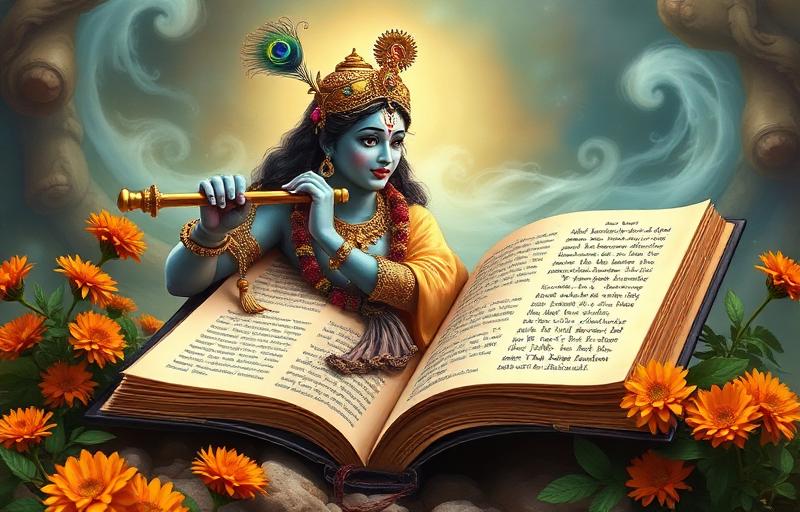
The King Who Said No to Seeing
As the armies gathered at Kurukshetra, Dhritarashtra, blind from birth and father to the hundred Kaurava brothers about to fight for their lives, was desperate to know how the war would go, without any way to witness it himself. Vyasa, the sage who had fathered Dhritarashtra through niyoga generations earlier and who is presented within the epic as the author of the very text recounting all of this, came to him before the fighting began and offered a direct solution: he could restore Dhritarashtra's eyesight completely, letting him watch the entire war unfold with his own eyes for the first time in his life.
Dhritarashtra's blindness itself traced back to that same practice of niyoga a generation earlier. When Vyasa, summoned by Satyavati to father children on her widowed daughters-in-law Ambika and Ambalika, approached Ambika, she kept her eyes shut throughout in fear of his fearsome, ascetic appearance, and Vyasa told Satyavati afterward that the son born of that union would be blind because of it. Dhritarashtra grew up capable and strong, and in many respects a competent ruler in practice, with Pandu formally holding the throne instead of him for exactly this reason, but the blindness itself never stopped shaping how the court, and later the epic's own audience, read his judgment.
Dhritarashtra refused. He told Vyasa he did not wish to see, with restored eyes, his own sons, grandsons, brothers and kinsmen being cut down in front of him, a war he had, by his own inaction and indulgence of Duryodhana, done far too little to prevent. It is one of the more genuinely human moments involving a king who is elsewhere in the epic often read as weak or complicit; whatever judgment the text invites about his failures as a father, his refusal here reads less as cowardice than as the one honest thing he could still control, choosing not to watch what he had failed to stop.
Vyasa offered an alternative instead. Rather than restoring Dhritarashtra's own eyes, he would grant divya drishti, divine sight, to Sanjaya, Dhritarashtra's minister and charioteer, a man of proven loyalty and steady character, so that Sanjaya could witness the entire war as it happened and narrate it back to the king in real time, becoming Dhritarashtra's eyes without ever putting the king himself in the position of having to look directly at what was coming.
What the Gift Actually Did
The divya drishti Vyasa granted was extensive by design. It let Sanjaya see events anywhere across the vast Kurukshetra battlefield, by day or by night, regardless of distance or physical obstruction, and by most accounts extended to perceiving warriors' thoughts and private intentions as well as their visible actions. He needed no food, drink or rest for the duration of the eighteen days, and could not be harmed even while effectively standing in the middle of the fighting to observe it, a kind of protected omniscience granted for exactly one purpose: to report back to a king who could not see for himself.
Sanjaya himself was not a randomly chosen vessel for this power. He was already serving as Dhritarashtra's minister and charioteer, a Suta by birth, the son of Gavalgana, and known at court for a steadiness and honesty that made him someone the king trusted completely even in ordinary matters. Vyasa's choice of Sanjaya over any other courtier for this gift is treated in the tradition as deliberate: divine sight granted to a man capable of reporting exactly what he saw without softening it for the king's comfort or distorting it to favor one side, a quality Sanjaya would need constantly over the following eighteen days as he narrated defeat after defeat for the army Dhritarashtra's own sons were leading.
This is not a minor detail tucked into the margins of the story. It is the literal narrative frame of the entire Mahabharata as it has come down to readers. The war books of the epic, and famously the Bhagavad Gita itself, are structured as Sanjaya's spoken narration to Dhritarashtra, delivered from the palace in Hastinapura even as the events being described unfold many miles away on the battlefield. Every major scene of the war, Bhishma's fall, Abhimanyu's death, Karna's last duel, is technically something Sanjaya is telling Dhritarashtra he saw, not an anonymous narrator's direct account.
This is also, precisely, why the Gita opens the way it does. Its very first line is Dhritarashtra asking Sanjaya what happened on the field of dharma where his sons and the sons of Pandu had gathered to fight, and the entirety of Krishna's counsel to Arjuna that follows, delivered privately between the two of them on a chariot in the middle of the battlefield, reaches the reader only because Sanjaya, through this granted sight, witnessed and heard a conversation he was nowhere physically near, and recited it back word for word to a blind king waiting in his palace.
Why a Frame Story Still Matters
Framing the entire war, and the Gita within it, as one man's granted, witnessed report rather than an anonymous, all-knowing account is a deliberate choice, not a narrative convenience the tradition forgot about after the opening chapter. It means the epic presents its own most sacred content as testimony, given by a named, specific, ordinary man whose only extraordinary quality was the sight he was granted for exactly this purpose, rather than as truth simply asserted from nowhere. Every printed edition of the Gita still carries this structure visibly: each chapter closes with the tag Sanjaya uvacha, Sanjaya said, a small but constant reminder that the reader is receiving Krishna's words secondhand, through a specific witness, and not directly.
Many traditional recitations of the Gita still honour this structure rather than skip past it. A formal patha of the text often begins by reciting the frame verses first, Dhritarashtra's opening question and Sanjaya's reply establishing the scene, before moving into Krishna's actual teaching, treating Sanjaya's presence as the doorway through which the rest of the text has to pass rather than as scaffolding to be discarded once the main content starts.
Sanjaya's narration is, in fact, only the innermost of several nested frames the Mahabharata uses. The war itself is narrated by Sanjaya to Dhritarashtra; that entire exchange is in turn narrated by the sage Vaishampayana, a disciple of Vyasa, to King Janamejaya, Arjuna's great-grandson, at a snake sacrifice held generations after the war; and that retelling is itself being narrated by a wandering bard, Ugrashrava Sauti, to a gathering of sages at Naimisharanya forest, which is the frame in which the text as we have it actually opens. Layer upon layer of witnessed report, each one a step further from the events themselves, is built directly into the epic's own structure, and Sanjaya's divine sight is simply the innermost and most literal instance of a method the whole text relies on throughout.
Sanjaya's own story does not end with the war. He remained a counselor at Dhritarashtra's court afterward, and years later, when the old king, Gandhari and Kunti retired to the forest to live out their final years in austerity, Sanjaya accompanied them. After the three died together in a forest fire, an event Sanjaya is described as witnessing but surviving, he did not return to court life, and most accounts have him withdrawing to the Himalayas to spend his remaining years in solitude, a man whose entire recorded life had been spent watching and reporting other people's story finally, at its end, choosing to live one nobody was left to narrate.
Common Questions From Devotees
Why did Dhritarashtra refuse Vyasa's offer to restore his sight?+
He told Vyasa he did not wish to watch, with his own restored eyes, his sons, grandsons and kinsmen being killed in a war he had done too little to prevent. He asked instead that someone else witness it for him, which is how Sanjaya received divine sight in his place.
What exactly could Sanjaya do with his divine sight?+
He could see events anywhere on the battlefield by day or night regardless of distance, by most accounts including warriors' thoughts, without needing food, drink or rest for the eighteen days of the war, and without being harmed even while effectively present in the middle of the fighting.
Is the Bhagavad Gita actually narrated by Sanjaya rather than told directly?+
Yes. The Gita opens with Dhritarashtra asking Sanjaya what happened on the battlefield, and Krishna's entire teaching to Arjuna is presented as Sanjaya's word-for-word report of a private conversation he witnessed only through his granted divine sight. Every chapter still closes with the tag Sanjaya uvacha, Sanjaya said.
What happened to Sanjaya after the Kurukshetra war ended?+
He remained a counselor at Dhritarashtra's court and later accompanied the old king, Gandhari and Kunti when they retired to the forest. After the three died in a forest fire there, most accounts have Sanjaya withdrawing to the Himalayas to spend his remaining years in solitude.
About the author
Anjali Mehta · Editor, M.A. Religious Studies
Anjali is the managing editor for Vandnaa and oversees the festival and vrat coverage. She holds an M.A. in Religious Studies and reviews every published article for accuracy, accessibility, and tradition-fidelity.
Meet the Vandnaa editorial team →