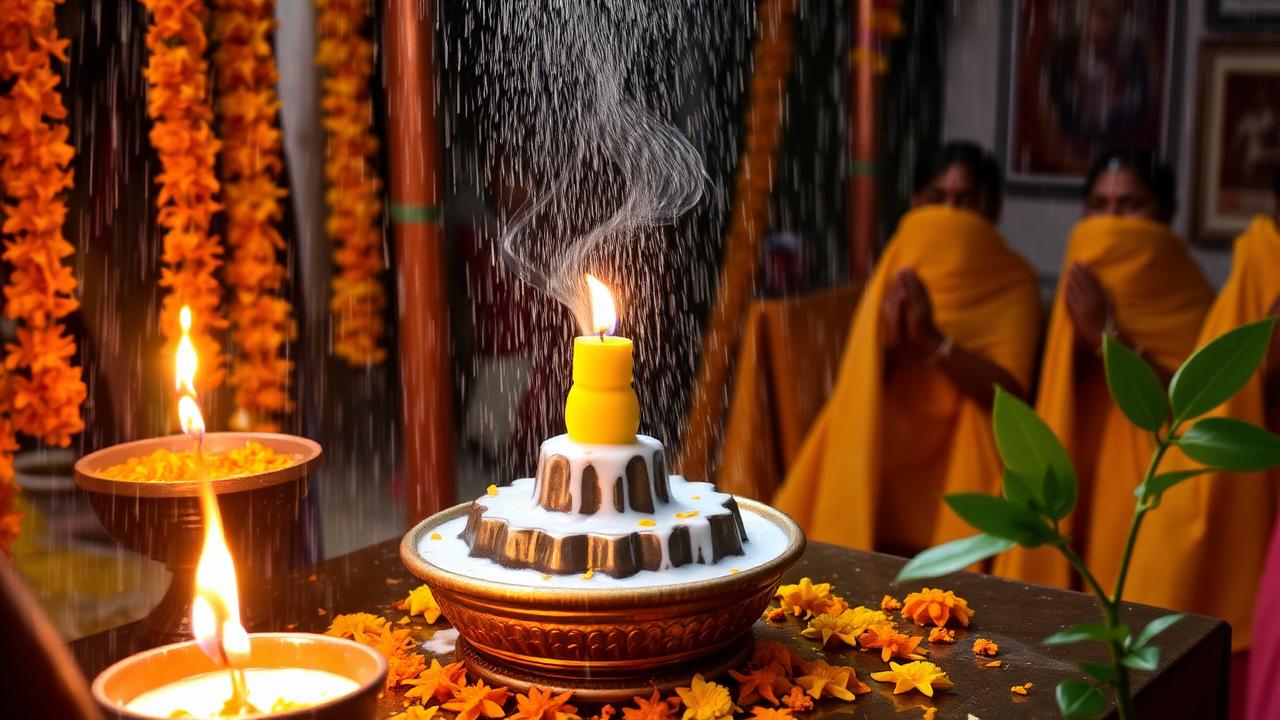
Shiva the Aughad: Understanding the Ascetic Beyond Convention
Among the Trimurti, Shiva occupies a category of his own. Brahma and Vishnu are depicted in royal ornaments and celestial abodes, while Shiva is described in the Puranas as Aughad and Bholenath - a wandering ascetic who smears his body in cremation-ground ash, wears animal skin instead of silk, keeps company with ghosts and spirits at Kailash, and lives on whatever comes without craving comfort or wealth. This is not incidental detail; it is central to why he is worshipped the way he is.
A king's deity receives sandalwood, silk, and gold. An ascetic's deity is offered what an ascetic himself would use or encounter - wild forest plants, not cultivated luxuries. Dhatura (thorn apple) and bhang (cannabis leaves) both grow wild, untended, often on wasteland and riverbanks, exactly the kind of terrain associated with Shiva's Himalayan and cremation-ground dwelling. Offering them is, in essence, an act of meeting Shiva on his own terrain rather than dressing him in ours.
This matters for how the offering is understood. Unlike milk or honey, which are offered because they are precious and pleasant, dhatura and bhang are offered because tradition holds Shiva to be genuinely fond of them - Puranic verses list them among his preferred articles of worship, alongside ash and rudraksha, precisely because they belong to the world of renunciation rather than indulgence.
Key points to hold onto:
- Shiva's iconography deliberately breaks from royal, ornamented depictions of other devas
- Dhatura and bhang are offered as symbols of what grows wild and unclaimed, matching his ascetic nature
- The offering is a gesture of relating to Shiva as he is depicted, not decorating him as something he is not
- This tradition is documented in Shaiva Puranic literature describing his preferred puja articles, distinct from Vaishnava worship customs
The Neelkanth Connection: Cooling Remedies for a Poisoned Throat
The deeper mythological thread runs back to the Samudra Manthan, the churning of the cosmic ocean by devas and asuras. Among the fourteen treasures that rose from the waters, the very first was Halahala, a poison so lethal that its fumes alone threatened to destroy every being in the three worlds. When neither devas nor asuras dared touch it, Shiva stepped forward, consumed the poison, and held it in his throat rather than swallowing it further - the act that turned his throat blue and earned him the name Neelkanth, the blue-throated one.
Sawan is the month devotees associate with this event, which is precisely why the entire month is built around cooling Shiva: pouring water and milk over the Shivling, applying chandan (sandalwood paste), and offering plants that folk tradition regards as having cooling or medicinal qualities relevant to poison and fever. Dhatura, despite its own toxicity if ingested, has long featured in traditional Ayurvedic and folk plant lore as an externally-applied remedy associated with relieving swelling and pain - which is likely why, symbolically, it came to be seen as an offering fit for a throat that had absorbed the universe's poison.
The symbolic logic devotees follow:
- Shiva absorbed poison to save creation - dhatura and bhang, plants with their own potent, poison-adjacent reputation, are offered back as an echo of that same substance he mastered
- Offering the very category of plant that could harm an ordinary being, to the one being who can hold poison without being destroyed by it, becomes a devotional statement about his power
- The coolness of bhang leaves and the milky sap of dhatura are described in some regional folk traditions as soothing, extending the same 'cooling the throat' logic used for water and milk abhishek
This is devotional symbolism passed through oral tradition and popular Puranic retellings rather than a single scriptural verse, but it is the explanation most commonly given by temple priests and elders when devotees ask why these particular offerings.
What Is Dhatura and Why It Is Called Shiva's Flower
Dhatura (thorn apple, botanically Datura stramonium or Datura metel) is a wild-growing shrub with trumpet-shaped white or pale purple flowers and a spiky, round fruit. It grows abundantly during and after the monsoon across much of North India, which lines up naturally with its Sawan association - it is, quite literally, in season at exactly the time devotees are looking for it.
Every part of the plant is genuinely poisonous if consumed - dhatura contains tropane alkaloids that can cause severe delirium, hallucination, and in significant doses, death. This is not folklore; it is well-documented in toxicology, and devotees are never meant to eat, drink, or ingest any part of the offered dhatura. Its role in Shiva puja is exclusively external and ritual - the fruit or flower is placed at the base of the Shivling or in the offering plate, never consumed as prasad.
The mythological reasoning devotees give:
- Dhatura is described in popular Puranic retellings as having sprung from Shiva's own body or breath after he consumed the Halahala poison, making it symbolically 'his' plant
- Its thorny, unglamorous fruit mirrors Shiva's own preference for the rugged and unconventional over the cultivated and pretty
- Some regional traditions associate the plant with Shiva's fierce, Aghori-adjacent form, distinguishing it from the gentler flowers offered to Vishnu or Devi
How it is correctly offered:
- Place one or a few dhatura fruits or flowers near the base of the Shivling, alongside bel patra, never allowing them to touch food items meant to be eaten as prasad
- Wash hands thoroughly after handling, since even skin contact with broken plant matter can occasionally cause irritation
- Never allow children to handle dhatura fruit directly, given both its toxicity and its spiky texture
- Buy from a trusted flower/puja vendor near temples during Sawan rather than picking unfamiliar wild plants, since several toxic look-alikes exist
Bhang, Vijaya and Shiva's Association With It
Bhang refers to the leaves and buds of the cannabis plant, which in Shaiva tradition carries the honorific name Vijaya (victory) - one of Shiva's own epithets applied to a plant, underlining how closely the two are linked in devotional imagination. Bhang appears in temple offerings, in the famous thandai consumed during Mahashivratri and Holi in parts of North India, and in the popular image of Shiva as the great yogi absorbed in meditation, detached from ordinary bodily concerns.
Why the association exists, according to tradition:
- Bhang is described in some Puranic and folk accounts as one of the plants Shiva favoured during his long periods of Himalayan tapasya (penance), tying it to his identity as the ultimate ascetic and yogi
- Its mildly intoxicating, consciousness-altering property is read symbolically as pointing toward the dissolution of ordinary ego-bound awareness - the same state Shiva is said to abide in permanently through deep meditation
- In Tantric and certain Shaiva sampradayas, bhang is used in small ritual quantities as part of specific, guided practices - this is a specialised context, not a general devotee instruction
An important legal and practical distinction: In most Indian states, bhang (as distinct from other cannabis preparations) has a narrow legal status around Shivratri-season sale and consumption in some regions, but laws vary significantly by state and change over time. Consuming any intoxicant as an act of personal indulgence, disguised as devotion, is not what the tradition asks of an ordinary devotee. Offering a few bhang leaves at the base of the Shivling - the way bel patra or flowers are offered - is entirely different from consuming bhang, and it is this ritual offering, not consumption, that forms the standard Sawan practice for the vast majority of devotees.
For most household worship, offering a small quantity of fresh bhang leaves purchased from a temple flower vendor, placed respectfully near the Shivling, is the complete and sufficient gesture.
How These Are Offered Correctly - and What Devotees Must Avoid
Both dhatura and bhang are offered as puja samagri (ritual articles), placed on or beside the Shivling in the same spirit as bel patra, akshat (rice grains), and white flowers. Neither is meant to be a large or elaborate offering - a small quantity is entirely sufficient, and tradition places far more weight on the sincerity of the gesture than the volume offered.
A simple, correct offering sequence: 1. After the main jalabhishek (water/milk abhishek) and bel patra offering, place one or two dhatura fruits or flowers at the base of the Shivling 2. Offer a small handful of fresh bhang leaves alongside, or gently sprinkle a few leaves over the linga 3. Chant Om Namah Shivaya or the specific line 'Dhatura pushpam samarpayami' (I offer the dhatura flower) while placing the item 4. Do not mix these with items meant to be taken back as edible prasad - they remain with the temple's disposal of used puja materials (visarjan), typically immersed in water or offered to a sacred tree, not eaten
What to actively avoid:
- Never consume dhatura in any form - it is genuinely dangerous and this is a firm, non-negotiable safety point, not merely a ritual preference
- Do not treat bhang-based prasad (like bhang thandai served at some temples during specific festivals) as something to be taken casually or in quantity - if unfamiliar with its effects, it is wisest to abstain from consuming it altogether
- Do not pressure children, elderly family members, or anyone with health conditions to consume any bhang preparation
- Do not confuse ritual offering with personal use - the puja act and any consumption tradition around Shivratri thandai are culturally distinct practices, and only the former is a universal Sawan requirement
If dhatura or bhang are simply unavailable in your area, they are not mandatory - water, milk, bel patra, and white flowers alone constitute a complete and fully accepted Shiv puja.
🙏 The Vandnaa App's Sawan puja checklist lists every traditional offering item, including which ones are optional in your region, so you never have to guess what belongs on the thali.
A Word of Caution and the Modern Devotee's Approach
For a first-time devotee watching a Sawan puja unfold, the sight of dhatura and bhang next to milk and honey can seem puzzling, even unsettling, especially given how strongly both plants are associated with danger and intoxication in everyday conversation. Understanding the symbolism resolves most of that discomfort: these offerings are not an endorsement of poison or intoxication as lifestyle choices, but a specific, contained ritual gesture rooted in Shiva's mythology as the one being who could hold poison without being destroyed by it.
The most balanced, modern approach a devotee can take:
- Treat dhatura and bhang exactly like any other puja samagri - offer with respect, keep it external to consumption, and move on to the next step of the ritual
- Never let curiosity about bhang's effects turn a devotional offering into a personal experiment; the two are unrelated acts even when they happen at the same festival
- If in doubt about local customs or availability, a priest at any Shiv temple can guide you on how much (if any) is appropriate for your specific puja
- Teach children the mythological reasoning rather than avoiding the topic - understanding why something is offered is a healthier lesson than either glamorising or fearing it silently
Ultimately, dhatura and bhang are two small items in a much larger offering list that includes water, milk, curd, honey, ghee, sugar, bel patra, and flowers. They matter because of what they represent - a devotee's willingness to meet Shiva in his own untamed, ascetic form - not because they are the most important item on the tray.
What People Ask Most
Is it necessary to offer dhatura and bhang to worship Shiva properly?+
No. They are traditional and well-loved offerings, but a complete Shiv puja can be performed with only water, milk, bel patra, and white flowers. Dhatura and bhang are additions rooted in regional and mythological tradition, not mandatory requirements.
Can I eat the dhatura offered on the Shivling as prasad?+
No, never. Every part of the dhatura plant is genuinely toxic and can cause severe illness or death if consumed. It is offered purely as an external ritual item and should never be eaten under any circumstance.
Why is bhang specifically linked to Lord Shiva and not other deities?+
Bhang carries the epithet Vijaya and is traditionally associated with Shiva's long periods of Himalayan tapasya and his identity as the supreme ascetic yogi, unlike the royal, ornamented imagery associated with deities like Vishnu or Lakshmi.
Is dhatura actually poisonous, or is that just a myth?+
It is genuinely poisonous, not a myth. Dhatura contains tropane alkaloids that are well documented in toxicology to cause severe delirium and can be fatal in significant doses. It must only ever be used as an external ritual offering, never ingested.
What can I offer instead if dhatura or bhang are not available where I live?+
Simply skip them. Bel patra, akshat (rice), white flowers such as datura's alternative aak, chandan, and a jalabhishek of water and milk together form a complete and fully sufficient Shiv puja without either item.
Is offering or consuming bhang legal in India during Sawan?+
The legal status of bhang varies by Indian state and can change over time, with some regions permitting limited, regulated sale, particularly around festivals. Ritually offering a few leaves at a Shivling is a separate matter from consumption, which carries its own state-specific legal and health considerations devotees should check locally.
About the author
Pandit Mahesh Trivedi · Festival Traditions & Panchang
Pandit Mahesh leads the festival-date and Panchang content on Vandnaa. He cross-references multiple regional panchangs (Drik, Vaishnava, Bengali, Marathi) for every festival date published on the site.
Meet the Vandnaa editorial team →