Three Threads That Explain Sawan's Sacredness
Most devotees, when asked why Sawan belongs to Shiva, reach first for the Samudra Manthan story - and they are right to. But that single answer, while central, is not the complete picture handed down through tradition. Elders and scholars who study Puranic literature typically point to three separate but interconnected threads that together explain why this specific month, above all twelve, became so thoroughly identified with Mahadev.
The first thread is cosmic and mythological - the churning of the ocean and Shiva's act of drinking the Halahala poison, which gives Sawan its central ritual of cooling him with water and milk. The second thread is romantic and devotional - Goddess Parvati's determined penance to win Shiva as her husband, which gives the month its association with steadfast devotion and, for unmarried women particularly, its fasting traditions aimed at securing a good life partner. The third thread is seasonal and agricultural - Sawan falls squarely within the monsoon, and the timing itself carries spiritual weight in a tradition that has always read the natural world as an expression of the divine.
Why understanding all three matters: Treating Sawan as being 'about' only one of these stories flattens a much richer tapestry. A devotee who knows only the Neelkanth story might wonder why Mangala Gauri Tuesdays exist within Sawan at all. A devotee who knows only Parvati's tapasya might miss why water and milk abhishek is so central. And a devotee unaware of the monsoon connection might never notice why Sawan, specifically, rather than any other month, was chosen by tradition to carry this weight.
This piece walks through each thread individually before showing how classical Hindu thought never actually separated them - in the tradition's own telling, cosmic event, divine romance, and seasonal rhythm were always understood as three expressions of a single, unified sacredness.
The Churning of the Ocean and the Birth of Neelkanth
The most widely told explanation begins with Samudra Manthan, the churning of the cosmic ocean of milk undertaken jointly by devas and asuras, using Mount Mandara as the churning rod and the serpent Vasuki as the rope, in their shared pursuit of Amrit, the nectar of immortality. As the churning proceeded, fourteen precious things emerged from the ocean one by one - Kamadhenu the wish-fulfilling cow, Airavata the celestial elephant, the goddess Lakshmi herself, and eventually the Amrit both sides desired.
But before any of these treasures, the very first thing to emerge was Halahala - a poison of such catastrophic potency that its fumes alone began threatening every being across the three worlds. Neither the devas nor the asuras, despite their combined cosmic power, could safely handle it. Creation itself stood at the edge of annihilation, and the assembled gods turned in desperation to Shiva, the only being capable of absorbing such destructive force without being destroyed by it.
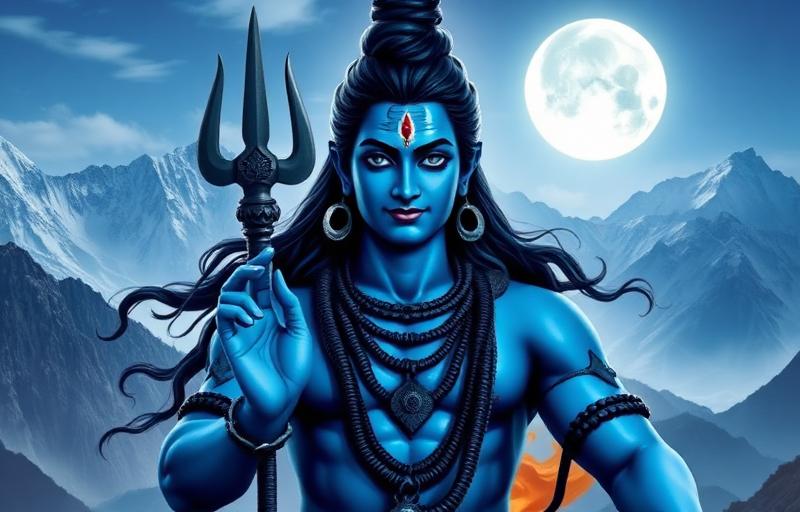
Shiva, without hesitation, consumed the poison. Rather than swallowing it fully, which would have killed even him, he held it deliberately in his throat, and it is this act that turned his throat permanently blue, earning him the name Neelkanth - the blue-throated one. Goddess Parvati, according to tradition, pressed his throat to help contain the poison there, and the devas, to soothe the burning sensation Shiva endured, began pouring water over him continuously.
This single act is why Sawan centres on cooling Shiva:
- Devotees pour water and milk (jalabhishek and dugdhabhishek) over the Shivling throughout the month, reenacting the devas' original cooling gesture
- The Kanwar Yatra tradition of carrying Ganga jal specifically to offer at a Shiva temple continues this same act of cooling on a grand, collective scale
- Even the timing itself is remembered - the event is traditionally placed within Sawan, tying this specific act of cosmic self-sacrifice to this specific month, year after year, ritual after ritual
Parvati's Penance and the Devotion That Followed
The second thread moves from cosmic crisis to personal devotion. After Sati, Shiva's first consort, gave up her life at her father Daksha's yajna, Shiva withdrew into profound meditation, inconsolable and detached from the world. Sati was later reborn as Parvati, daughter of Himavan (the Himalayas personified), and from a young age she resolved that she would have no husband other than Shiva himself.
Winning Shiva, however, proved to be no simple matter. He remained absorbed in meditation, indifferent to the world, and when the gods, desperate for Shiva to father a son capable of defeating the demon Tarakasura, sent Kamadeva to disturb his focus with desire, Shiva opened his third eye and reduced Kamadeva to ash. The lesson embedded here, retold to this day, is that desire alone - even divinely engineered - could never be the path to Shiva's heart.
Parvati chose a different path entirely: austerity matched to his own. She undertook rigorous tapasya in the mountains, enduring extremes of heat and cold, eating minimally and eventually nothing at all, earning the name Aparna (one who does not even eat leaves) in some tellings. Her resolve, sustained across seasons including the demanding monsoon months, is what tradition holds as the reason Sawan carries her energy as much as Shiva's.
This thread is why Sawan is not only about Shiva alone, but about devoted worship more broadly:
- Mangala Gauri Vrat, observed on the Tuesdays of Sawan, is dedicated specifically to Parvati and is kept largely by married and unmarried women for marital happiness and a good life partner, directly echoing her own tapasya
- The pairing of Shiva and Parvati as Shiv Parivar worship, rather than Shiva in isolation, reflects the belief that his month of glory is inseparable from her penance that helped bring it about
- Devotional retellings frame Sawan as a month celebrating not just what Shiva endured, but what devotion itself - embodied by Parvati - is capable of achieving against impossible odds
The Monsoon Connection: Why the Timing Itself Matters

The third thread is easy to overlook precisely because it feels less dramatic than a mythological battle or a goddess's penance, yet it may be the oldest layer of Sawan's sacredness, predating even some of the specific Puranic narratives attached to it. Sawan falls in the heart of the Indian monsoon, when the subcontinent's agricultural cycle depends entirely on the rains that define the season.
In an agrarian society, the arrival and adequacy of rain was, quite literally, a matter of life and death - a good monsoon meant a good harvest and a fed community; a failed one meant famine. It is not difficult to see why a culture whose survival depended so directly on this specific season would come to treat it as spiritually charged, and why Shiva, associated with both destruction and regeneration, with the wild, untamed forces of nature, and with the Himalayas from which India's great rivers descend, became the natural focus of devotion during exactly this period.
Several practical, seasonal customs reinforce this reading:
- Traditional Sawan dietary restrictions on leafy green vegetables are explained by the seasonal abundance of insects within them during monsoon humidity - a practical, ahimsa-rooted precaution that became woven into the month's religious observance
- Fasting itself, concentrated in a month when digestive strength is traditionally considered weaker due to humidity and reduced digestive fire (agni) in Ayurvedic thought, doubles as a seasonally appropriate practice of lighter eating
- The Shravana nakshatra (lunar constellation) that gives the month its Sanskrit name, Shravana, rises to prominence during this period, tying the month's very name to a specific celestial and seasonal marker rather than an arbitrary calendar position
This thread suggests something important: Sawan's sacredness was never purely a retrofit of mythological stories onto an ordinary month. The monsoon's life-or-death importance to an agricultural civilisation likely made this season spiritually significant first, providing fertile ground onto which the Neelkanth story and Parvati's tapasya were then woven, deepening a reverence the season already commanded on its own terms.
Why the Month Is Called Shravan
The name Shravan (from which the more colloquial 'Sawan' derives) comes from the Shravana nakshatra, one of the twenty-seven lunar constellations in the traditional Hindu calendar system, which is at its peak influence during this lunar month, specifically around the full moon (Purnima) that falls within it. This astronomical naming convention is not unique to Shravan - most months in the Hindu lunar calendar are named after the nakshatra prominent during their respective full moons - but the specific nakshatra involved here carries additional layered meaning that devotees find fitting.
The word 'Shravana' itself relates to the Sanskrit root meaning 'to hear' or 'listening', the same root that gives rise to words like shravan (hearing) used in contexts of listening to sacred texts, discourses, and stories - shravana bhakti, the devotional practice of listening to divine stories, is considered one of the nine classical forms of bhakti (navadha bhakti) described in the Bhagavata Purana. Devotees often find a pleasing resonance in the fact that the very month most filled with katha recitations - including the Sawan Somwar Vrat Katha told and retold every Monday - carries a name rooted in the act of listening itself.
Sawan 2026's specific dates anchor these overlapping threads in the calendar:
- The month begins Thursday, 30 July 2026 and ends Friday, 28 August 2026, which also falls on Raksha Bandhan, itself observed on the Shravana Purnima that gives the month its name
- The four Sawan Somwar fall on 3, 10, 17 and 24 August 2026
- Sawan Shivratri, the month's most significant single day for concentrated Shiva worship, falls on Tuesday, 11 August 2026
- Nag Panchami, another observance closely tied to this month, falls on Monday, 17 August 2026
Each of these dates sits within the same window shaped by the three threads already discussed - a cosmic act, a devoted goddess's penance, and a monsoon that made this exact stretch of the year unlike any other.
How These Three Threads Come Together in Practice
Classical Hindu thought rarely insists on a single, exclusive explanation for why something sacred is sacred, and Sawan is a clear example of this comfort with layered meaning. A devotee performing jalabhishek on a Sawan Monday morning is, whether consciously or not, simultaneously participating in all three threads at once.
How the threads visibly overlap in a single Sawan ritual:
- The water itself being poured recalls the devas cooling Neelkanth after Samudra Manthan - but it is also, quite literally, monsoon water in its most immediate seasonal sense, connecting the ritual to the agricultural thread
- The fasting devotee, particularly an unmarried woman observing Mangala Gauri Vrat on a Sawan Tuesday, is directly channelling Parvati's own austerity and endurance, while also following a dietary pattern suited to the monsoon's demands on digestion
- The Kanwar Yatra, walked during peak monsoon rains, combines physical austerity echoing Parvati's tapasya, devotion to the poison-drinking Shiva through the water carried, and a journey undertaken specifically because the season and its rains make the pilgrimage both meaningful and physically demanding
Why this matters for how you approach Sawan this year: Rather than picking a single 'correct' reason Sawan is sacred, the richer and more traditional approach is to hold all three simultaneously - to pour water remembering Shiva's sacrifice, to fast remembering Parvati's resolve, and to notice the rain outside as itself a form of the sacred rather than mere weather. Sawan's month-long observance was built, across centuries of layered tradition, to be experienced this way - as one continuous act of remembrance operating on cosmic, devotional, and natural registers all at once.
🙏 The Vandnaa App brings all three threads together in one place - Sawan 2026 dates, the Somwar Vrat Katha, Mangala Gauri Vrat reminders, and daily Shiv mantras, so your whole month of observance stays connected to the full story.
What People Ask Most
Is Sawan's connection to Shiva based only on the Samudra Manthan story?+
No. While the Samudra Manthan and Neelkanth story is the most commonly cited reason, tradition also credits Goddess Parvati's penance to win Shiva and the month's position within the monsoon season as equally important threads behind Sawan's sanctity.
Did Parvati's tapasya happen in the same mythological period as Samudra Manthan?+
Puranic timelines are not always linear in the way historical dates are, and different Puranas present these episodes in varying sequences. Devotees typically treat both as separate, complete stories that happen to share a devotional and seasonal association with the same month, rather than insisting on a single, strict chronological order.
Why does the monsoon season matter spiritually, beyond just being convenient timing?+
In an agricultural civilisation, the monsoon determined survival itself through the harvest it enabled, which naturally made this season spiritually charged. Traditions around fasting, dietary restrictions, and worship during Sawan are believed to have grown from this deep, practical dependence on the rains, later layered with mythological narrative.
Is Sawan celebrated the same way across all regions of India?+
The core elements - jalabhishek, fasting on Mondays, and reverence for Shiva - are widely shared, but specific customs, the intensity of Kanwar Yatra participation, and accompanying regional festivals vary meaningfully between North India, western states, and southern regions, which often follow their own lunar calendar variations.
What is the literal significance of the name 'Shravan'?+
The name comes from the Shravana nakshatra prominent during this lunar month's full moon, following the standard Hindu calendar convention of naming months after their associated constellation. The word also shares its root with 'shravana,' meaning hearing or listening, which devotees connect to the month's tradition of vrat katha recitation.
Between Sawan Somwar and Sawan Shivratri, which observance is considered more significant?+
Both are significant in different ways rather than being ranked against each other. Sawan Somwar offers four weekly opportunities for sustained devotion throughout the month, while Sawan Shivratri, falling on 11 August 2026, is a single, especially concentrated night of worship considered second in intensity only to Mahashivratri.
About the author
Pandit Mahesh Trivedi · Festival Traditions & Panchang
Pandit Mahesh leads the festival-date and Panchang content on Vandnaa. He cross-references multiple regional panchangs (Drik, Vaishnava, Bengali, Marathi) for every festival date published on the site.
Meet the Vandnaa editorial team →Explore on Vandnaa
Related Articles
Goddess Parvati's Tapasya in Sawan: The Story Behind the Month
7 min read

Har Har Mahadev: Meaning & Origin of Sawan's Most-Chanted Phrase
7 min read
Sawan Somwar 2026: Dates, Vrat Vidhi, Shiv Mantras & Why Mondays in Sawan Are So Powerful
10 min read
Shiv Parivar: The Family of Shiva, Parvati, Ganesha & Kartikeya - Its Meaning
8 min read