What Panchamrit Really Means in Sawan Puja
Panchamrit literally breaks into 'panch' (five) and 'amrit' (the nectar of immortality) - five ingredients combined to recreate, in miniature, the divine nectar that emerged from the Samudra Manthan. That same churning of the cosmic ocean is also where the story of Sawan begins: alongside the Amrit came Halahala, the poison Lord Shiva swallowed to save creation. Offering panchamrit during Sawan is, in a sense, completing that story - giving Shiva a taste of the sweetness the universe was saved for.
Each of the five ingredients carries its own meaning, and knowing this makes the ritual far more than a kitchen task:
- Milk (dudh) - purity and motherly nourishment, linked to Kamadhenu, the wish-fulfilling cow
- Curd (dahi) - prosperity and multiplication; a small amount of curd sets an entire pot of milk
- Honey (madhu) - sweetness of speech and unity, the harmony a devotee seeks with the divine
- Ghee (ghrit) - strength and victory, the fuel of the sacred fire
- Sugar or mishri (sharkara) - joy, the sweetness of a life free of bitterness
Some households add a sixth element - a few drops of Gangajal - though the classical panchamrit stays at five. In Sawan specifically, panchamrit is not just poured on the Shivling; it is also distributed afterward as prasad, meaning your family effectively shares in the abhishek. That is part of why Sawan Somwar households treat the recipe seriously - get the ingredients or ratio wrong, and both the offering and the prasad suffer.
It is worth noting panchamrit is common across Shiva, Vishnu and Devi worship - the five ingredients do not change, though small additions (like tulsi) shift depending on which deity you are preparing it for, something the next sections cover in detail for a Shiva-specific Sawan abhishek.
The Exact Recipe: Ingredients & Proportions for One Sawan Somwar
For a single Sawan Somwar abhishek plus enough prasad for a family of four, this is the proportion most puja vidhi texts and temple priests follow - roughly 4:2:1:1:1 by volume:
- Milk - 1 cup (200 ml), full-fat, raw or boiled-and-cooled, never packaged long-life tetra milk if you can help it
- Curd (dahi) - 1/4 cup (50 g), fresh, made at home or bought same-day
- Pure cow ghee (ghrit) - 1 tablespoon, melted but not hot
- Raw honey (madhu) - 1 tablespoon, never heated (heating honey is considered to destroy both its nutritional and ritual value)
- Sugar or mishri (sharkara) - 1 tablespoon, mishri (crystallised sugar candy) is preferred over refined white sugar in most Shiva households
Optional additions: a teaspoon of Gangajal at the very end, and 2-3 drops of pure water. If you are preparing panchamrit as prasad to also offer to Vishnu or Krishna alongside your Shiva puja, 2-3 tulsi leaves are added - but for a pure Shiva abhishek, tulsi is traditionally left out (more on why in the do's and don'ts section below).
Vessel matters as much as ratio. Use a copper, brass, silver or steel vessel - never plastic or aluminium, which are considered ritually impure and can also react with the acidity of the curd and honey. A small kalash or lota kept aside specifically for panchamrit, used for no other purpose, is ideal if you do this every Sawan Somwar.
Quantity scaling: halve everything for a solo puja, or double it if you are hosting a small satsang - the 4:2:1:1:1 ratio stays constant regardless of the batch size, which is what actually matters more than the absolute quantity.
Step-by-Step Preparation Method
Panchamrit should always be prepared fresh on the same day it will be offered - ideally within an hour or two of the puja, never the night before:
Step 1 - Clean the vessel. Wash your copper or steel vessel with plain water (not soap) and wipe it dry. Many households rinse it once with a few drops of Gangajal first.
Step 2 - Pour the milk first. Milk forms the base. Add it to the vessel and let it settle for a minute.
Step 3 - Add the curd gently. Stir it in with a wooden or steel spoon using a clockwise motion - never vigorously, or the mixture will curdle and look unappetising rather than smooth.
Step 4 - Add the melted ghee. Make sure it has cooled slightly so it does not cook the curd.
Step 5 - Stir in the honey. Add it last among the 'wet' ingredients since honey is dense and blends better into an already-mixed base.
Step 6 - Dissolve the sugar or crushed mishri. Stir until it fully dissolves - undissolved sugar looks careless in an offering meant to be pure and complete.
Step 7 - Chant while stirring. Most households stir the final mixture clockwise 5 or 11 times while softly chanting 'Om Namah Shivaya', treating the preparation itself as part of the puja rather than mere kitchen work.
Step 8 - Divide into two portions immediately. One small portion for tasting or checking consistency (this is for you), and a separate, untouched portion that will actually go to the Shivling. This separation matters more than most people realise - see the do's and don'ts section next.
The finished panchamrit should be pale yellow-white, pourable but not watery, and lightly sweet-tart. If it looks separated or curdled, it was stirred too hard or the milk was too hot when the curd went in.
How to Offer Panchamrit During Sawan Abhishek
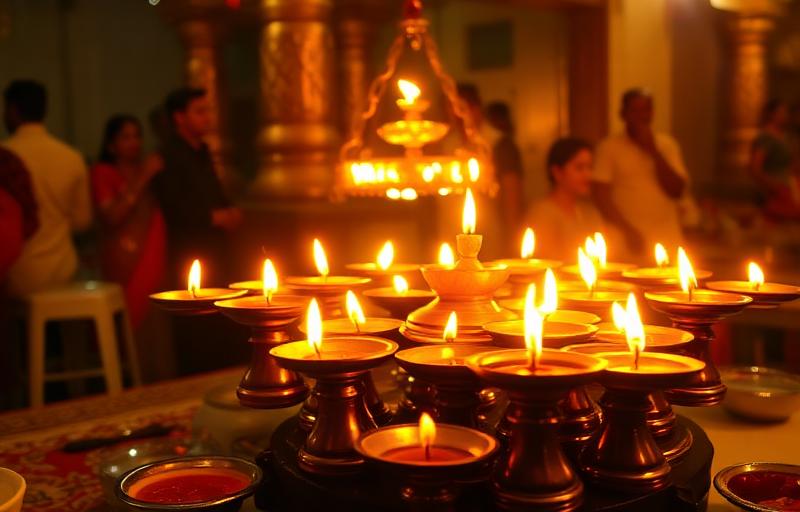
Panchamrit fits into a specific place in the abhishek sequence - offering it at the wrong point is one of the most common mistakes in home Sawan puja.
The traditional shodashopachara (16-step) sequence places panchamrit like this: 1. Plain water abhishek first (jal abhishek) 2. Panchamrit abhishek (either pre-mixed, or each ingredient poured one at a time in order - milk, curd, honey, ghee, sugar) 3. A final plain water rinse to 'close' the panchamrit stage 4. Chandan (sandalwood paste), bilva leaves, flowers and bhasma follow after the Shivling is clean and dry
Two accepted methods exist, and both are valid:
Method A - Pre-mixed pour: Pour the fully prepared panchamrit slowly over the Shivling in one continuous stream from the vessel, chanting 'Om Namah Shivaya' throughout. This is what most home devotees do on a Sawan Somwar - it is simpler and takes 2-3 minutes.
Method B - Sequential abhishek (panch-abhisheka): Pour each of the five ingredients separately, in the order milk, curd, honey, ghee, sugar-water, reciting a line for each. Temples and priests doing a full Rudrabhishek typically use this method since it lines up with the 16-step framework precisely.
The traditional Sanskrit verse recited while offering (either method): 'Payo dadhi ghritam chaiva madhu sharkara-yayutam, panchamritam mayanitam snanartham pratigrihyatam.' (Milk, curd, ghee, honey and sugar together - I have brought this panchamrit; please accept it for your sacred bath.)
After the panchamrit stage, always rinse the Shivling with plain water or Gangajal before moving to chandan and bilva patra - offering flowers or leaves directly onto a sticky, unrinsed Shivling is considered incomplete puja.
🙏 The Vandnaa App's Sawan puja checklist walks you through this exact 16-step abhishek sequence with the correct mantra for each stage, so you never have to guess the order.
Do's and Don'ts While Making Sawan Panchamrit
A few rules separate a panchamrit that is ritually correct from one that technically has the right five ingredients but misses the point:
Do:
- Use fresh, same-day milk and curd - packaged UHT milk is acceptable if fresh options are unavailable, but never use milk close to its expiry
- Use pure cow ghee, not vanaspati or a ghee-flavoured substitute
- Keep raw honey - heating destroys both its enzymes and, per tradition, its purity as an offering
- Prepare in a copper, brass, silver or steel vessel reserved only for puja use
- Make a separate small portion to taste for consistency before the actual offering is poured
Don't:
- Don't add tulsi leaves if this panchamrit is exclusively for Shiva. The belief traces to the Vrinda-Jalandhar legend, where tulsi (as Vrinda) is closely tied to Lord Vishnu; most Shaivite households skip tulsi in a Shiva-only panchamrit, reserving it for Vishnu or Krishna puja instead
- Don't taste the portion meant for offering - once tasted (jhoothan), it is no longer fit to offer; always keep the two portions physically separate from the start
- Don't refrigerate the offering portion - panchamrit should be offered fresh, not chilled
- Don't use a plastic spoon, bowl or funnel at any stage
- Don't prepare it hours in advance - curd continues to ferment and the mixture can separate or turn sour by the time you get to puja
- Don't skip stirring in one direction - clockwise stirring (pradakshina direction) is considered auspicious, counter-clockwise is avoided in most traditions
Getting the ingredients right but the handling wrong - tasting before offering, using a plastic bowl, letting it sit for hours - is the single most common way a well-intentioned panchamrit falls short of what the puja actually calls for.
After the Abhishek: What to Do With the Panchamrit Prasad
The panchamrit that has touched the Shivling does not go to waste - it transforms into charnamrit, one of the most sacred forms of prasad in Shaiva worship, and what happens to it next is itself part of the ritual.
Collecting it: Most home Shivlings sit on a small stand (a peetha) with a channel or plate underneath that catches the abhishek liquid. After the puja, this collected liquid - now mixed with a little of the water rinse too - is your charnamrit.
Distributing it: Every family member present takes a few drops in their right palm and sips it before touching it to their eyes and head. This is not merely symbolic - charnamrit is treated as carrying the Shivling's own blessing outward into the home.
What NOT to do: Never pour leftover charnamrit down an ordinary drain or discard it as waste. If there is more than can be consumed, it is poured at the base of a tulsi plant, a peepal tree, or directly into soil - never into a dustbin.
Using it in the day's food: Many Sawan Somwar households add a spoon of the charnamrit into the evening's phalahar (fasting meal) - a way of literally carrying the day's devotion into the meal that breaks the fast.
A note on quantity: This is exactly why the 4:2:1:1:1 ratio in a modest quantity (roughly 1.5-2 cups total) works better than a large batch - charnamrit is meant to be sipped in drops, not consumed as a beverage. Making too much just means more of it has to be respectfully disposed of later, which is easily avoided by preparing only as much as the puja and prasad genuinely need.
Done this way - fresh ingredients, correct ratio, careful preparation, and a mindful close - Sawan panchamrit stops being a kitchen chore squeezed in before puja and becomes what it was always meant to be: an offering complete from first pour to last drop.
Frequently Asked Questions
Can I use store-bought/packaged milk and curd for panchamrit?+
Yes, if fresh farm milk isn't available. Use full-fat packaged milk and fresh (not sour) curd bought the same day. What matters more than the source is freshness - avoid milk or curd that is even a day away from turning.
I don't have honey at home - can I skip it or substitute it?+
Honey is one of the five core ingredients, so skipping it technically makes it 'chaturamrit' (four nectars), not panchamrit. If you truly have none, jaggery syrup is sometimes used as a last-resort substitute, but try to source real honey before your next Sawan Somwar - it's inexpensive and available everywhere.
Is panchamrit the same as charnamrit?+
Not quite - panchamrit is the mixture before it's offered; charnamrit is what it becomes after touching the deity or Shivling during abhishek. All charnamrit starts as panchamrit, but panchamrit only becomes charnamrit once it has been offered.
Can panchamrit be made without ghee for someone who is lactose intolerant or vegan?+
The classical five ingredients are all dairy-adjacent except honey and sugar, so a fully vegan panchamrit departs from tradition. If lactose is a health concern, plant-based milk and curd alternatives are increasingly used by some households, though most priests would recommend using at least a token amount of real dairy for the ritual portion, with the rest adjusted for what you personally consume.
How much panchamrit should I prepare for one Sawan Somwar puja at home?+
For a single Shivling abhishek plus prasad for a family of four, 1.5-2 cups total (using the 4:2:1:1:1 ratio) is enough. Making significantly more just creates extra charnamrit that needs respectful disposal - it's better to prepare a modest batch fresh each Monday.
Can panchamrit be offered on days other than Sawan Somwar?+
Yes - panchamrit abhishek is not restricted to Mondays. It is offered during any Shiva puja, on Pradosh Vrat, Sawan Shivratri, and even daily by some devotees. Sawan Somwar simply makes it a weekly habit for the month rather than an occasional ritual.
About the author
Dr. Suresh Iyer · Vastu Shastra & Jyotish, 18+ years
Dr. Suresh has practiced traditional Vastu and basic Vedic Jyotish for over 18 years across South India. He contributes the Vastu, direction, and home-puja layout guides on Vandnaa.
Meet the Vandnaa editorial team →Explore on Vandnaa
Related Articles

How to Do Rudrabhishek (Shiva Abhishek) at Home
9 min read
Sawan Somwar 2026: Dates, Vrat Vidhi, Shiv Mantras & Why Mondays in Sawan Are So Powerful
10 min read
Sawan Sattvic Diet: What to Eat and Avoid the Entire Month
7 min read
Bilva Patra (Bel Patra): Significance, Rules & How to Offer to Shiva
9 min read