Why a Couple's First Sawan Is Considered Special
In most Hindu households, the first Sawan a couple spends together after their wedding is quietly treated as a milestone. Families refer to it as Pehla Sawan (the first Sawan), and it is often the first major festival season where the new bride's rituals, her in-laws' customs and her own upbringing all meet in one household for the first time. Sawan 2026 runs from Thursday, 30 July to Friday, 28 August, and for couples married earlier this year or in the months before, this entire stretch becomes a season of shared prayer rather than individual observance.
The reason this month specifically carries such weight for newlyweds is mythological as much as social. Sawan is dedicated to Lord Shiva, and the defining story of the month, Shiva swallowing the Halahala poison during the Samudra Manthan to protect all of creation, is inseparable from the story of Parvati, who performed years of tapasya to be united with him. Devotees see in this pairing not just two deities but a template: a partnership where each person's strength completes the other's, where devotion is expressed through action rather than words alone.
For a new couple, worshipping together during this month is less about elaborate ritual and more about establishing a shared rhythm early in married life.
- Many families gift the couple their first joint puja thali during this Sawan
- The bride's parental home (maayka) often calls her back for a few days during the month, a custom tied closely to Hariyali Teej
- Some communities consider it auspicious for the couple to visit a Shiva temple together at least once during the four Sawan Somwars
- Elders often use this month to formally introduce the daughter-in-law to the family's specific puja customs
What matters most, priests generally emphasise, is not the scale of the ritual but that it is done together, with attention and sincerity.
The Story of Shiva-Parvati as a Marriage Model
The union of Shiva and Parvati is one of the most studied relationships in Hindu tradition, not because it was easy, but because it was earned. Parvati, born as the daughter of Himavan, chose Shiva as her only object of devotion at a young age, against the doubts of her own family. When persuasion and beauty failed to draw the ascetic Shiva out of his meditation, she undertook rigorous tapasya, standing through freezing winters and blazing summers, surviving at times on nothing but fallen leaves, earning her the name Aparna (one who eats not even leaves). It was only after Shiva tested the depth of her resolve, appearing before her disguised as an old Brahmin who mocked his own ascetic ways, that he revealed himself and accepted her.
This story is retold to newlyweds for a specific reason: it reframes marriage not as an instant arrangement but as something built through patience, consistency and mutual respect. Parvati's persistence is not passive waiting; it is active, disciplined devotion. Shiva's eventual acceptance is not indifference giving way, but recognition of equal seriousness.
The couple's union is further symbolised in the form of Ardhanarishvara, the half-Shiva, half-Parvati deity, where the right side is Shiva and the left is Parvati fused into a single body. This image is considered one of the clearest theological statements in Hindu thought about marriage: that a true partnership is not two separate people living side by side, but two energies, consciousness (Purusha) and creative power (Prakriti), functioning as one whole.
For a newly married couple, keeping a small image of Ardhanarishvara or a joint Shiva-Parvati idol at home during Sawan is considered a meaningful way to internalise this teaching, a daily visual reminder that neither partner is complete without honouring the other.
Joint Puja Rituals for Couples During Sawan
A couple does not need a separate ritual system of their own; the standard Sawan Somwar puja works perfectly well when performed together, with a few adjustments that make the shared intention explicit. The core structure remains the same as any Shiv puja, but the following practices are specifically recommended for husband and wife performing it jointly:
- Sit together, facing the Shivling or photo, rather than one person leading while the other watches. Traditionally the husband sits to the right and the wife to the left, mirroring the Ardhanarishvara arrangement.
- Perform the jalabhishek and doodh abhishek jointly - both partners can hold the lota together and pour in a slow, steady stream while reciting Om Namah Shivaya.
- Offer bel patra as a pair, each placing a leaf with the smooth side facing the Shivling, silently naming something they are grateful for in the marriage.
- Tie a kalava (mauli thread) on each other's right wrist at the start of the puja, a small gesture that many priests suggest for newlyweds specifically during this month.
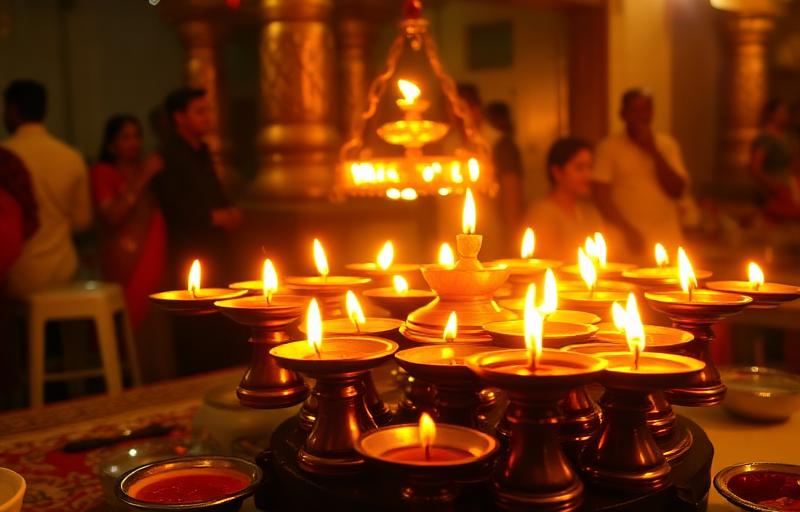
- Light the evening diya together at dusk rather than separately, letting one partner hold the diya while the other lights the wick.
- Wives observing the Mangala Gauri vrat on Sawan Tuesdays (4, 11, 18 and 25 August 2026) can involve the husband in the preparation of the puja thali, even though the fast itself is typically kept by the wife.
None of this requires new mantras or unfamiliar Sanskrit; it simply reframes an individual ritual as a shared one. Priests note that the value lies in the couple showing up for the practice consistently across the month, not in any single elaborate ceremony. Even ten quiet minutes together at the Shivling on a Monday evening, done with attention, is considered more meaningful than a rushed, solitary version of the same puja.
Pehla Sawan: Regional Customs Worth Knowing

Across India, a newly married woman's first Sawan comes wrapped in customs that vary by region but share a common thread: celebrating fertility, renewal and the colour green, which is considered especially auspicious this month because it mirrors the monsoon's new growth and is associated with Parvati and marital good fortune.
- Sawan ka Joda: In many North Indian families, the bride's parents or in-laws gift her a green outfit, often with gold or red detailing, to be worn specifically during Sawan Somwar or Teej. Green bangles (hariyali chuda) are gifted alongside it.
- Sinjara: A custom especially strong in Punjab, Haryana and Rajasthan, where the bride's parents send mehendi, bangles, sweets and clothes to their daughter's marital home shortly before Hariyali Teej, which falls toward the end of Sawan.
- Kajari and folk songs: In Uttar Pradesh and Bihar, women gather to sing Kajari, monsoon folk songs that often reference longing, marriage and the rains, especially relevant to a bride experiencing her first monsoon away from her parental home.
- Vishesh puja gifts: It is common for a newlywed couple to receive their first joint Shiv-Parvati idol, a puja thali set, or a copy of the Shiv Chalisa as a Sawan gift from relatives, meant to start their married life's puja collection.
- Return visits to maayka: Many brides spend a portion of Sawan, particularly around Hariyali Teej, at their parental home, a custom that softens the transition of the first year of marriage.
These customs differ by community and are not obligatory, but they point to a shared cultural instinct: treating a couple's first monsoon together as worth marking with colour, food, song and prayer, not just quiet ritual alone.
Mantras and a Simple Sankalp for Marital Harmony
Certain mantras are particularly associated with marital wellbeing and are worth learning together as a couple, rather than one partner reciting while the other listens passively.
- Om Namah Shivaya - the fundamental five-syllable mantra of Shiva, suitable for daily recitation together during abhishek; it asks for nothing specific but builds a shared discipline.
- Om Sham Shanmukhaya Namah and general invocations to Parvati as Gauri are traditionally chanted by women observing Mangala Gauri vrat, asking for an unbroken, harmonious married life (akhand saubhagya).
- The Maha Mrityunjaya Mantra - Om Tryambakam Yajamahe Sugandhim Pushtivardhanam, Urvarukamiva Bandhanan Mrityor Mukshiya Maamritat - is chanted by couples for each other's health and long life, and is considered appropriate to recite together on Sawan Somwar evenings, ideally 11 or 108 times using a rudraksha mala.
- A short verse invoking Ardhanarishvara, even a simple line such as Namah Shivabhyam Nava Yauvanabhyam, is sometimes taught to newlyweds as a compact daily prayer for balance in the relationship.
Beyond memorised mantras, many priests suggest that a couple take a simple, personal sankalp (vow) together on the first Sawan Somwar of the year, spoken in their own words rather than Sanskrit: a shared intention for the coming year of marriage, whether that is patience during disagreements, financial discipline, or simply showing up for each other's family obligations. This sankalp is renewed silently on each of the four Mondays, treating the month as a check-in point rather than a one-time ceremony.
The idea underlying all of this is straightforward: mantras recited together, even imperfectly, tend to matter more in a marriage than mantras recited perfectly alone.
Frequently Asked Questions
What is 'Pehla Sawan' and why is it significant for newlyweds?+
Pehla Sawan refers to a couple's first Sawan month after marriage. It is treated as a milestone in many families, marked by gifts of green clothing and bangles, joint temple visits, and the bride's introduction to her new family's puja customs.
Can husband and wife perform Shivling abhishek together?+
Yes, joint abhishek is common and considered auspicious. Both partners can hold the lota together while pouring water or milk and reciting Om Namah Shivaya, symbolising shared devotion rather than an individual ritual.
Is Mangala Gauri vrat compulsory for newly married women?+
No, it is not compulsory but is widely observed by newly married women in the first five years of marriage for marital wellbeing. In 2026 the Sawan Tuesdays fall on 4, 11, 18 and 25 August. The husband can support by helping prepare the puja thali.
What should a newly married couple gift each other during Sawan?+
There is no fixed rule, but common meaningful gifts include a joint Shiv-Parvati idol, a puja thali set, a rudraksha mala, or a copy of the Shiv Chalisa, items that can start the couple's shared devotional practice.
Which mantra should couples chant together for a happy married life?+
Om Namah Shivaya during daily abhishek and the Maha Mrityunjaya Mantra on Sawan Somwar evenings are both widely recommended, along with a short personal sankalp the couple sets together for the year ahead.
Does the bride have to visit her parents' home during Sawan?+
It is a common custom in many regions, especially around Hariyali Teej, but it is not a religious requirement. Families arrange it according to their own convenience and circumstances rather than any fixed rule.
About the author
Pandit Mahesh Trivedi · Festival Traditions & Panchang
Pandit Mahesh leads the festival-date and Panchang content on Vandnaa. He cross-references multiple regional panchangs (Drik, Vaishnava, Bengali, Marathi) for every festival date published on the site.
Meet the Vandnaa editorial team →