What Is the Shiva Purana
The Shiva Purana is regarded as the principal scripture of the Shaiva tradition among the eighteen Maha Puranas. It is devoted almost entirely to the glory, nature and stories of Lord Shiva, presenting him as the supreme reality from which the universe emerges and into which it returns.
Traditionally organized into several sections that each explore a different facet of Shiva - his cosmic form, his family life with Parvati and their sons, and his role in creation and dissolution - the text moves between philosophy and story with ease, making profound ideas accessible through narrative.
Origin and Narration
As with the other Puranas, tradition attributes the compilation of the Shiva Purana to sage Ved Vyasa. Much of its content is presented through the sage Suta, who recounts these stories to an assembly of sages performing a long sacrifice in the Naimisha forest, a setting common to several Puranic narrations.
This layered storytelling - a sage recounting what he heard from another sage, who in turn heard it from the divine - reflects how devotional knowledge was traditionally seen as something received and passed on with reverence, rather than authored anew.
What the Purana Contains
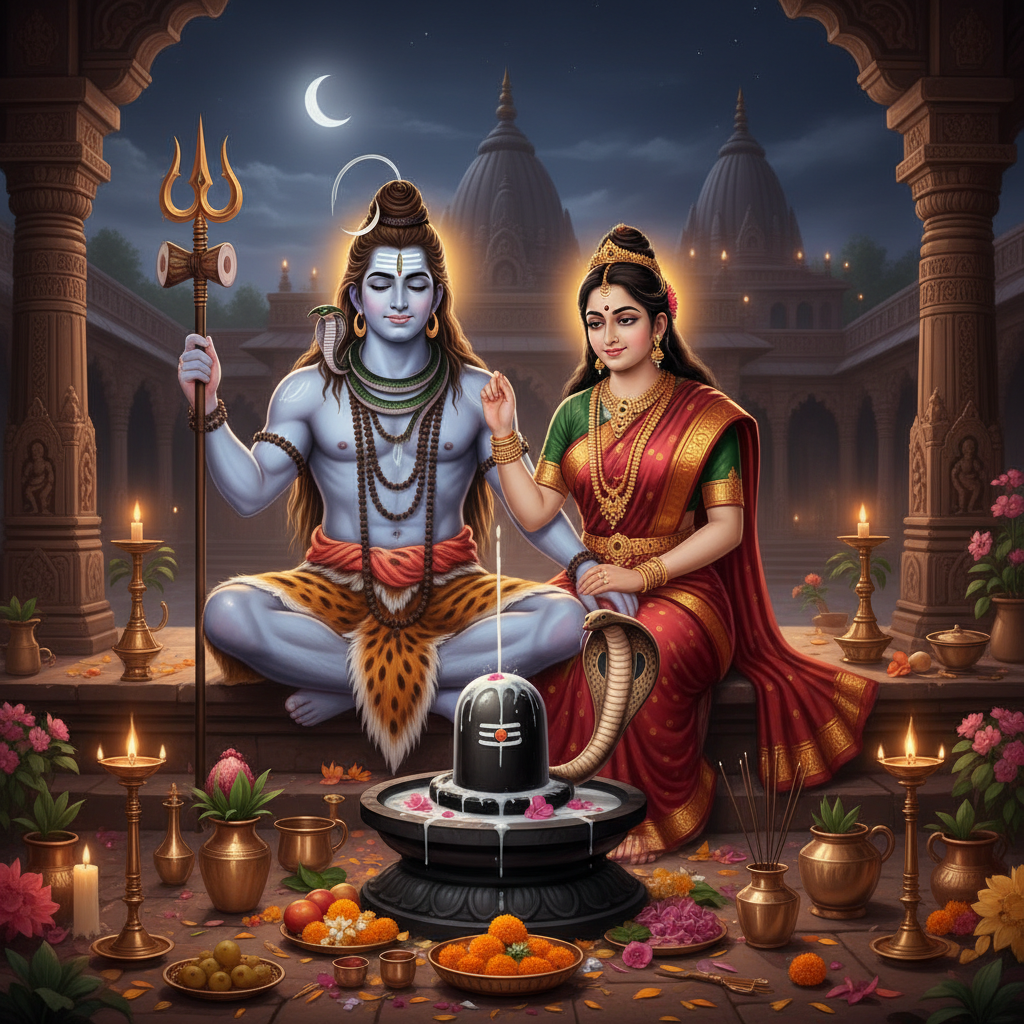
The Shiva Purana weaves together cosmology, philosophy and devotion. It describes the greatness of Shiva Lingam worship, the significance of sacred Shiva kshetras that later traditions came to associate with the twelve Jyotirlingas, and the deep symbolism behind Shiva's form - his third eye, the crescent moon, the serpent and the matted hair.
It also presents Shiva as Ardhanarishvara, the union of masculine and feminine principles, reflecting a worldview in which creation itself depends on this balance.
Key Stories and Highlights

Among its most cherished stories is the account of Shiva and Parvati's wedding, told with warmth across many sections of the text, along with the birth and childhood of Ganesha and Kartikeya. The Purana also contains the story of Shiva drinking the poison that emerged during the churning of the ocean, earning him the name Neelkanth.
Stories of Shiva's fierce forms, such as his destruction of Tripura, sit alongside gentler tales of his family life, showing devotees the full range of his nature.
Significance and Benefits of Reading It
Devotees believe that engaging with the Shiva Purana, whether through reading, listening to a katha, or simple recitation of a favorite section, deepens one's connection with Shiva as both the ascetic and the householder god. As per tradition, its teachings encourage detachment from ego while remaining fully present in one's duties and relationships.
It is often turned to during the month of Shravan and around Maha Shivratri, when devotion to Shiva is at its most fervent across households.
A Simple Takeaway for Devotees
A devotee need not master every section of the Shiva Purana to draw from its wisdom. Even reflecting on the story of Shiva and Parvati's patient devotion to each other, or chanting Om Namah Shivaya while recalling his stories, brings the text's spirit into ordinary days.
As with all scripture, engaging with the Shiva Purana is ultimately an act of faith and love, not a transaction.
Quick Answers
What is the Shiva Purana about?+
The Shiva Purana is one of the eighteen Maha Puranas, devoted to the glory, cosmology and stories of Lord Shiva, including his marriage to Parvati, the birth of Ganesha and Kartikeya, and the symbolism behind his iconic form.
Which sage narrates the Shiva Purana?+
The text is largely narrated by sage Suta to an assembly of sages in the Naimisha forest, following a storytelling tradition common to several Puranas.
When is the Shiva Purana traditionally read or recited?+
Many devotees turn to the Shiva Purana during Shravan month and around Maha Shivratri, though it can be read or listened to at any time as an expression of devotion to Shiva.
About the author
Anjali Mehta · Editor, M.A. Religious Studies
Anjali is the managing editor for Vandnaa and oversees the festival and vrat coverage. She holds an M.A. in Religious Studies and reviews every published article for accuracy, accessibility, and tradition-fidelity.
Meet the Vandnaa editorial team →