Who Was Surdas - The Blind Poet of Braj
Surdas (traditionally 1478 to 1583 CE) is the supreme poet of Krishna bhakti in Braj Bhasha, remembered across India simply as the blind singer who saw Krishna better than the sighted. Tradition places his birth at Sihi near Delhi or at Runakta near Agra, and most accounts hold that he was blind from birth. His early years were marked by neglect; the boy who could not see was treated as a burden, and he left home young. Yet what seemed his curse became his concentration: with no outer world to distract him, Surdas turned his whole inner sky toward Shri Krishna. He settled in the Braj region, the land of Krishna's leela between Mathura and Vrindavan, where his voice and ektara began drawing crowds. Devotees affectionately call him Mahakavi Surdas and the Sur Suraj - the sun among poets - an honorific given, fittingly, to a man who never saw the sun.
Meeting Vallabhacharya - From Lament to Leela
The turning point came at Gau Ghat on the Yamuna, where the young singer met Shri Vallabhacharya, founder of the Pushti Marg (the path of grace). Tradition tells that Surdas sang for him a pada of trembling self-abasement - the cry of a sinner begging mercy. Vallabhacharya listened, then asked gently why one so gifted kept whimpering; instead, he said, sing of the leela of Krishna - his birth, his butter thefts, his flute. He initiated Surdas, taught him the Bhagavata's stories, and turned the poet's face from his own darkness toward Krishna's playfulness. Surdas spent his life thereafter at Govardhan, singing daily kirtan before Shrinathji. He became the foremost of the Ashtachhap, the eight poet-disciples of the Pushti Marg whose songs still structure worship in that tradition. One sentence from a guru redirected a lament into an ocean of joy.
The Sur Sagar - An Ocean of Krishna's Childhood
Surdas's life work is the Sur Sagar, 'the ocean of Sur'. Tradition says he composed a sava lakh (125,000) padas; around five thousand survive in manuscripts, and even that remnant is among the largest and most beloved bodies of devotional song in any Indian language. Written in Braj Bhasha, the mother tongue of Krishna's own homeland, the Sur Sagar follows the Bhagavata Purana's frame but lingers where Surdas's heart lived: the Bal Leela, Krishna's infancy and childhood. Here Krishna crawls on hands and knees, his anklets chiming - 'kilakat Kanha ghuturuvani aavat' - demands the moon as a toy, and is caught with butter on his face. The poems are not narration; they are darshan. Generations of mothers have rocked children to Sur's lullabies, and classical and folk singers alike treat the Sur Sagar as bottomless. Scholars debate what one blind man could compose; devotees simply keep singing.
Vatsalya Bhava - Krishna Through a Mother's Eyes
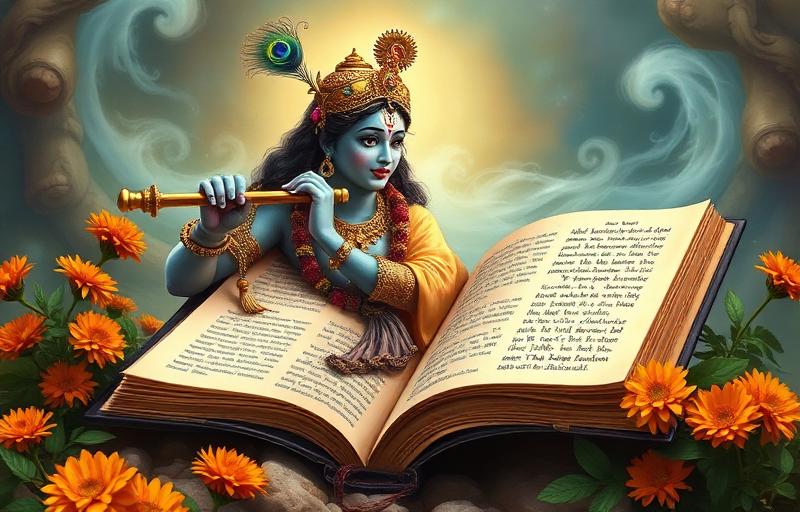
Bhakti tradition describes several bhavas, emotional relationships with God: servant, friend, parent, beloved. Surdas is the unmatched master of vatsalya bhava - loving God as one's own child. In the Sur Sagar it is most often Yashoda Maiya through whom we watch: she churns butter while Krishna tugs her sari, she chases him with a stick she will never use, she ties him to the mortar and then weeps at her own strictness. The theological wonder is deliberate: the Lord of the universe consents to be small, dependent and mischievous so that love can hold him. For Surdas, this is grace itself - God does not only want our awe; he wants our lap. A devotee reciting these padas finds worship turning tender: the deity on the altar becomes the child in the house. It is devotion without distance, and it is why the Sur Sagar makes listeners smile and cry in the same breath.
Maiya Mori Main Nahin Makhan Khayo - The Pada and Its Meaning
The most beloved jewel of the Sur Sagar:
मैया मोरी मैं नहिं माखन खायौ। भोर भयौ गैयन के पाछे, मधुबन मोहि पठायौ॥
Maiya mori main nahin makhan khayo; bhor bhayo gaiyan ke paachhe, madhuban mohi pathayo.
'Mother mine, I did not eat the butter! Since dawn you sent me to Madhuban behind the cows.' Caught red-handed, little Krishna mounts his defense: the cowherd boys smeared butter on his face; how could a small child with little hands even reach the high-hung pot? Then the masterstroke - sulking, he offers to return his stick and blanket and accuses Yashoda of loving him less for being dark. Yashoda laughs and sweeps him into her arms. The meaning beneath the play: the Lord who owns everything pretends innocence so his devotee can enjoy forgiving him. Surdas lets us hold God the way a mother holds a lying, lovable child - and that intimacy is the entire theology of the pada.
Seeing Krishna Without Eyes - The Inner Darshan
How did a man blind from birth describe the curve of Krishna's smile, the peacock feather, the dust of Braj glowing at cow-dust hour? Devotees have always given one answer: Krishna showed himself. Tradition tells that the Lord would come and play before Surdas as he sang, and that the poet's descriptions are eyewitness reports of the only sight he was ever granted. One cherished story: Surdas fell into a well and lay there singing, unafraid; devotees believe Krishna himself pulled him out by the hand. When the Lord asked why he wished for nothing more, Surdas asked only that the hand that held his never let go. His longing lives in the pada 'Akhiyan Hari darshan ki pyasi' - 'these eyes thirst for the sight of Hari.' The blind man taught the seeing world that darshan is not an act of the eyes but of the heart; outer sight merely points at what inner sight embraces.
What Surdas Teaches Today's Devotee

Surdas's first lesson is that limitation is not disqualification. The quality the world called his defect became the doorway of his genius; whatever you believe disqualifies you from devotion may be exactly where grace plans to enter. Second, the Gau Ghat meeting shows the power of one right guide: Vallabhacharya did not give Surdas talent, he gave him direction - from self-pity to leela. Notice what your own practice dwells on. Third, vatsalya bhava is an open invitation: try seeing Krishna as a child for a week - offer food as to a son, speak as to a little one - and watch formality melt into affection. Fourth, sing rather than only read; Surdas's theology lives in melody, and even a tuneless voice offered sincerely is kirtan. Finally, his well-side prayer is the whole path in one line: not for sight, wealth or release - only that the Lord's hand, once taken, never lets go.
Reader Questions Answered
Who was Surdas?+
Surdas (traditionally 1478 to 1583 CE) was the great blind poet-saint of Krishna bhakti, who lived in the Braj region and composed the Sur Sagar in Braj Bhasha. A disciple of Vallabhacharya and foremost of the Ashtachhap poets, he is most loved for his padas on Krishna's childhood seen through Mother Yashoda's eyes.
Was Surdas blind from birth?+
Most traditional accounts hold that Surdas was blind from birth, which makes his vivid, detailed descriptions of Krishna's beauty and Braj's landscapes all the more wondrous to devotees, who believe Krishna revealed himself directly to the poet's inner sight. Some scholars debate this, but the devotional tradition is firm that his vision was the gift of grace.
What is the Sur Sagar?+
The Sur Sagar ('Ocean of Sur') is Surdas's monumental collection of devotional padas in Braj Bhasha. Tradition credits him with 125,000 compositions, of which around five thousand survive. Loosely following the Bhagavata Purana, it dwells most lovingly on Krishna's childhood leela and remains a foundation of devotional music across north India.
What is the meaning of 'Maiya mori main nahin makhan khayo'?+
It means 'Mother mine, I did not eat the butter.' In this most famous pada of the Sur Sagar, little Krishna, caught with butter on his face, argues his innocence before Yashoda with adorable excuses. Beneath the play lies the theology of vatsalya bhava: the Lord of the universe makes himself small so his devotee can love, scold and forgive him like a child.
What is vatsalya bhava in bhakti?+
Vatsalya bhava is the devotional attitude of loving God as one's own child, the way Yashoda loved Krishna. Instead of awe and distance, the devotee feeds, protects, scolds and cherishes the Lord with parental tenderness. Surdas is the greatest poet of this bhava, and his padas let every devotee experience Krishna as the child of their own home.
Who was Surdas's guru?+
Surdas's guru was Shri Vallabhacharya, founder of the Pushti Marg. They met at Gau Ghat on the Yamuna, where Vallabhacharya heard Surdas's plaintive singing and guided him to sing Krishna's leela instead of laments. He initiated Surdas, who then served at the Shrinathji temple at Govardhan and became the leading poet of the Ashtachhap.
About the author
Pandit Ravindra Sharma · Vedic Rituals & Bhakti, 22+ years
Pandit Ravindra is the Vandnaa editorial team's resident specialist on aarti, chalisa, and daily devotion. He has performed home and temple pujas across Varanasi and Delhi for over two decades and contributes the bhakti-focused articles on this site.
Meet the Vandnaa editorial team →