The Temple in Lahaul
Trilokinath stands on a spur above the Chandrabhaga river in the Lahaul valley, in Lahaul and Spiti district, Himachal Pradesh, at about 2,760 metres, near Udaipur.
What is there:
- A white marble image with six arms, standing
- A stone temple in the shikhara form
- Prayer wheels around the temple, turned by visitors
- Prayer flags on the approach
- A setting of high, dry mountain country very different from the rest of Himachal
The two identifications:
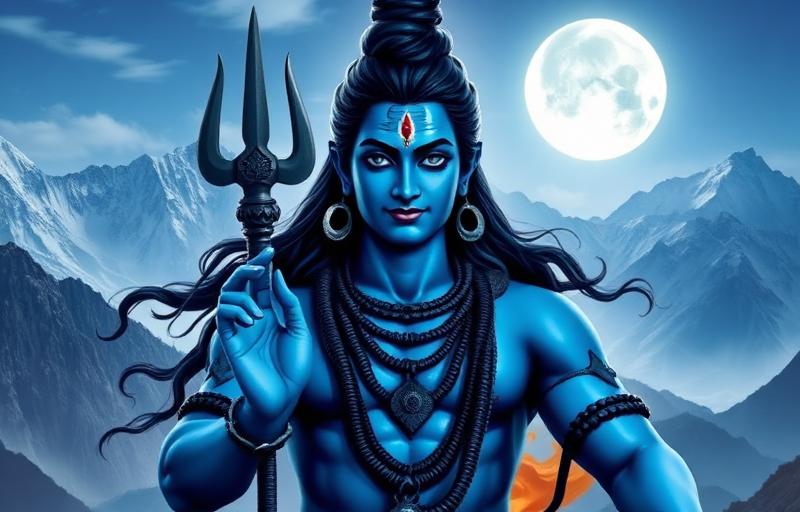
- Hindus worship the image as Shiva, as Trilokinath, lord of the three worlds
- Buddhists worship the same image as Arya Avalokiteshvara, the bodhisattva of compassion, and specifically as Padmapani, the lotus bearer
- Both traditions worship in the same temple, before the same image
- Both are conducted, in practice, side by side
How the arrangement works:
- Hindu and Buddhist devotees come to the same sanctum
- Both make offerings and both circumambulate
- The prayer wheels are used by Buddhist devotees and are part of the structure
- The temple's principal festival, Pauri, is observed by both communities together
- Local families in Lahaul frequently observe both traditions and do not treat the distinction as requiring a choice
Why the image supports both readings. This is the interesting part and it is not a coincidence.
- A six armed standing figure with a lotus and other attributes fits the iconography of Avalokiteshvara in his Padmapani or Shadakshari forms
- The same figure is readable as a form of Shiva, and Shiva is depicted with multiple arms in many forms
- The white marble and the style point to a Kashmiri or western Himalayan workshop of the period, working in a tradition that served both Buddhist and Hindu patrons
That last point is the key. The artistic tradition that produced this image did not draw the line where later observers assume it was drawn.
Avalokiteshvara and Shiva
The overlap between these two figures is a real feature of Indian religious history and it explains the shrine.
Avalokiteshvara:
- The bodhisattva of compassion in Mahayana Buddhism
- A being who has attained enlightenment and remains to help others
- Represented in many forms, including Padmapani with the lotus, the thousand armed and eleven headed forms, and Shadakshari with the six syllable mantra
- Called Chenrezig in Tibetan, Guanyin in Chinese where the figure becomes female, Kannon in Japanese
- The Dalai Lamas are understood as emanations of Avalokiteshvara
- The mantra Om Mani Padme Hum is his
Where he overlaps with Shiva:
- The name contains ishvara, lord, which is a Shaiva term
- He is described in some texts with attributes shared with Shiva, including a deer skin and matted hair
- The Lokeshvara form, lord of the world, is directly comparable to Lokanatha as a name of Shiva
- In Nepal, Matsyendranath is worshipped as both a Nath siddha and as Avalokiteshvara, and the Rato Machhindranath festival at Patan is observed by Hindus and Buddhists together
- Iconographic borrowing runs in both directions across the whole first millennium
Why this happened. Buddhism and Hinduism developed alongside each other in the same societies for well over a thousand years.
- They shared artists, who worked for whoever commissioned them
- They shared patrons, and rulers frequently endowed both
- They shared vocabulary, philosophical and iconographic
- They shared sites, and many were used successively or simultaneously
- Their tantric traditions in particular converged very substantially, with shared deities, practices and texts
What later happened. Buddhism largely disappeared from most of India by around the thirteenth century, for a combination of reasons including loss of patronage, absorption into Hindu traditions, the destruction of monastic centres and the disappearance of the monastic economy that sustained it.
Where it survived, in the Himalaya and in Sri Lanka and beyond, the distinction remained sharp. Where it did not, the boundary blurred and figures like Avalokiteshvara were absorbed or forgotten.
Lahaul's position. The valley sits exactly on the line.
- Below it, the Hindu Himachal of Kangra and Chamba
- Above and beyond it, the Buddhist world of Spiti, Ladakh and Tibet
- Lahaul itself has both, in the same villages and frequently in the same families
That is not a compromise or a confusion. It is what a frontier looks like when the people living on it have decided that the question does not need answering.
Trilokinath is the clearest expression of it in India. A single image, in a single temple, receiving two forms of worship, with prayer wheels on the outside and a shikhara on top.
The Pauri Festival
Pauri is the temple's principal festival and is observed jointly by both communities, which makes it unusual.
When. In Bhadrapada, generally August, over three days.
What happens:
- Devotees come from across Lahaul, and from Chamba, Pangi and Zanskar
- A procession is central to the observance
- A decorated animal, traditionally a yak or a bull, is part of the procession
- Circumambulation of the temple
- Both Hindu and Buddhist rites are performed
- Lamas and Hindu priests both officiate in their own forms
- Local dance, music and feasting
The character of the festival. It is a valley festival rather than a pilgrimage from outside.
Lahaul is small, remote and until recently was cut off for months of the year. Pauri is when the valley's people gather, and it falls in the short window when travel within the region is possible.
That gives it the character of a community reunion with a religious centre, which is what most Himalayan festivals actually are.
The animal in the procession. Worth a note.
A decorated yak or bull leading a procession is a widespread Himalayan and Central Asian pattern. The animal is not sacrificed at Trilokinath; it is decorated, led in procession and released.
That is the same structure as the Kode Mokku at Vemulawada described elsewhere in this series, where a bull is offered, circumambulated and handed on without harm.
Lahaul's calendar. The valley's festivals are worth knowing about because they follow the mountain year rather than the plains one.
- Halda, in winter, generally January or February, a fire festival in which villagers carry burning cedar torches, observed across Lahaul
- Pauri, at Trilokinath, in August
- Losar, the Tibetan new year, observed in Buddhist households
- Fagli, in late winter
- Local devta observances by village
Halda deserves a mention. It is observed on a date fixed by the local lamas, involves villagers carrying lit cedar torches to a common point after dark, and marks a point in the deep winter when the valley is largely cut off.
A winter fire festival in a high valley under snow is exactly the kind of observance that makes sense in its own place and nowhere else, and it is one of the more striking things in the Himachali calendar.
Attending Pauri. If you are in Lahaul in August it is worth attending, with the usual conditions: it is a local observance, not a spectacle, so photograph people only with permission, follow local direction, and understand that the accommodation in the valley is limited and will be full.
The Lahaul Valley
Lahaul is unlike the rest of Himachal and the difference is worth understanding before going.
The geography:
- A high valley on the north side of the Pir Panjal, which means it is in the rain shadow
- Dry, with very little monsoon rain, and largely treeless above the villages
- Bounded by the Pir Panjal to the south and the Zanskar range to the north
- The Chandra and Bhaga rivers meet at Tandi to form the Chandrabhaga, which becomes the Chenab
- Elevations from around 2,500 metres upward
Why it looks like Ladakh and not like Kullu. The Pir Panjal blocks the monsoon.
South of the range, in Kullu and Kangra, you get heavy monsoon rain, dense forest and green valleys. North of it, in Lahaul and Spiti, you get a high desert. The transition happens at the pass, over a distance of a few kilometres, and it is one of the most dramatic climatic boundaries in India.
The Atal Tunnel. This changed everything and it is very recent.
- Opened in 2020, running about 9 km under the Rohtang pass
- Before it, Lahaul was reached over the Rohtang pass at about 3,980 metres, which is closed by snow for roughly six months of the year
- The valley was therefore cut off from November to May, with supplies stocked in advance and air support in emergencies
- The tunnel provides year round road access for the first time
What that has meant:
- Medical access in winter, which is the most important change
- Year round supply and movement
- A very large increase in tourism, including winter tourism, which the valley had never had
- Pressure on a fragile environment and on villages that were not built for visitor numbers
- Economic opportunity, and the usual mixture of benefit and disruption
Lahauli agriculture. Worth knowing because it explains the valley's economy.
- The growing season is very short
- Historically barley, buckwheat and potatoes
- Now substantially seed potato, peas and, importantly, hops for brewing, which Lahaul supplies to breweries
- Cash crops have transformed household incomes since the late twentieth century
The Buddhist monasteries:
- Kardang, above Keylong, the largest gompa in Lahaul
- Shashur, also near Keylong
- Tayul
- Guru Ghantal, above Tandi, one of the oldest in the region, associated with Padmasambhava, with wooden images
Mrikula Devi at Udaipur. This is the reason to build extra time into a Trilokinath visit and it is not well known.
- A wooden temple at Udaipur, a few kilometres from Trilokinath
- Dedicated to Mrikula or Markula Devi, a form of Mahishasuramardini
- Plain outside, and inside a wooden interior carved to an extraordinary standard
- The ceiling and beams carry scenes from the Mahabharata and Ramayana, carved in deodar
- The carving is variously dated between the eleventh and sixteenth centuries and includes work of very high quality
- A silver image of the goddess is attributed to a later period
It is among the finest wooden interiors in India and it is in a small town in Lahaul that almost nobody stops in.
Together with Bharmour, Chhatrari and Trilokinath, it makes the case that the western Himalaya holds a body of early wooden and metal art that is genuinely of the first rank and is almost entirely unvisited.
Shared Shrines in India
Trilokinath is the clearest example of a category that is larger than most people assume, and it is worth setting out.
Sites used by more than one tradition:
- Trilokinath, Hindu and Buddhist, described here
- Matsyendranath at Patan in Nepal, Hindu and Buddhist, where the Rato Machhindranath chariot festival is observed by both
- Muktinath in Nepal, a Vishnu shrine that Buddhists worship as Chumig Gyatsa, with the eternal flame and the 108 water spouts
- Numerous sites in Ladakh, Sikkim and the Himalayan belt where local deities are honoured within both frameworks
- Sabarimala, where the tradition includes a stop at a Muslim shrine on the pilgrimage route
- A great many dargahs across India visited by Hindus, and temples visited by Muslims, in local practice
Why this used to be commoner. The reasons are historical and structural.
- Religious identity in premodern India was frequently less exclusive than modern census categories suggest
- People used the shrine that was nearby and that had a reputation for the thing they needed
- A local deity's power was regarded as a fact about the place, not as a claim about the truth of a system
- Caste, region, occupation and language were frequently more salient identities than religion
What changed. This deserves to be said accurately.
- Colonial census categories required people to be assigned to a single religion, which had real effects on how identity was understood and organised
- Reform movements within each tradition, in the nineteenth and twentieth centuries, worked to define boundaries and to discourage shared practice as impure or syncretic
- Nationalist politics, of several kinds, made religious identity a political category
- Partition hardened everything
- Shared shrines became contested in a way they had frequently not been
What survives, and where. Shared practice survives best where the pressures were weakest.
- In remote regions, particularly the Himalaya
- In local rather than nationally famous shrines
- In practices around healing, where people go wherever they think it will work
- Among communities whose own identity does not fit the categories neatly
Why Lahaul kept it. The valley was cut off for half the year until 2020, its population is small, its Hindu and Buddhist households are frequently related to each other, and the pressures that hardened the boundary elsewhere arrived very late and very weakly.
What to do with this as a visitor. Two things.
First, notice it. Standing in a temple where two traditions worship the same image, without either having conceded anything, is an unusual experience and it is worth taking a moment over.
Second, do not romanticise it. This is not evidence that all religions are the same, which is a claim neither tradition makes. Buddhists and Hindus at Trilokinath disagree substantially about what the universe is and what happens after death, and they know it.
What they have worked out is that they can disagree about that and still use the same room, which is a considerably more useful thing than agreement and is much harder to achieve.
Visiting Trilokinath
Getting there
- Trilokinath, near Udaipur, Lahaul, Lahaul and Spiti district, Himachal Pradesh, at about 2,760 metres
- From Manali through the Atal Tunnel to Keylong and then down the valley to Udaipur, roughly 150 km
- From Chamba via the Pangi valley, which is a long, difficult and seasonal route
- The tunnel makes the Manali approach possible year round in principle, though the road within Lahaul can still close in heavy snow
- Buses run from Manali and Keylong; a vehicle is easier
When to go
- June to October is the practical season for a comfortable visit
- Pauri, in Bhadrapada, generally August
- Winter is now accessible via the tunnel but conditions in the valley are severe and facilities limited
- Check road conditions before travelling in any season
Altitude
- At around 2,760 metres, Trilokinath is not extreme, but you will have crossed higher ground to reach it
- If arriving from Manali via the tunnel, you gain altitude quickly. Take it easy on the first day
- The general altitude guidance in the Manimahesh entry applies in reduced form
At the temple
- Remove footwear
- Circumambulate in the direction others are going
- The prayer wheels are turned clockwise
- Both Hindu and Buddhist devotees are present; follow whichever practice is yours and do not interfere with the other
- Photography inside may be restricted. Ask
- Do not treat the shared worship as a curiosity to be documented. People are praying
Practicalities
- Facilities in Lahaul are limited. Udaipur and Keylong have basic accommodation
- Carry cash. ATMs are few and unreliable
- Mobile coverage is patchy
- Bring warm clothing regardless of season. Nights are cold at any time of year
- Fuel up before entering the valley
Combining the visit
- Mrikula Devi temple at Udaipur, which is the single most important thing to add
- Keylong, the district headquarters
- Kardang, Shashur and Tayul gompas
- Guru Ghantal gompa above Tandi
- Tandi, the confluence of the Chandra and Bhaga
- Jispa and the road toward Baralacha La and Ladakh
- Spiti, via Kunzum La, in season
- Pangi valley, toward Chamba, for the very determined
A route. Manali, through the tunnel, to Keylong. A day for Keylong and the gompas. Down the valley to Udaipur, for Mrikula Devi and Trilokinath. Then either back to Manali, on toward Ladakh, or over Kunzum La into Spiti.
A note on responsible visiting. Lahaul's access changed in 2020 and the valley is receiving visitor numbers it was not built for.
- Take your waste out with you. Waste management in the valley is limited and what you leave stays
- Do not camp on agricultural land or near villages without permission
- Use local accommodation and eat locally, so that the money stays in the valley
- Drive carefully. The roads are single track in places with drops
- Respect that villages are villages, not attractions
A closing thought. There is a marble figure with six arms in a stone temple with prayer wheels around it, on a spur above a river, in a valley that was cut off for half of every year until very recently.
Two religions look at it and see two different beings. Nobody has ever needed to decide which of them is right, and the arrangement has held for a very long time.
That is not a small achievement, and it was managed by a few thousand people in a valley in the Himalaya without any assistance from anybody.
Reader Questions Answered
Where is Trilokinath temple?+
On a spur above the Chandrabhaga in the Lahaul valley, Lahaul and Spiti district, Himachal Pradesh, at about 2,760 metres near Udaipur. It is roughly 150 km from Manali through the Atal Tunnel and via Keylong, or reachable from Chamba through the Pangi valley on a long, difficult seasonal route.
Why do two religions worship the same image?+
Hindus worship the white marble six armed figure as Shiva, as Trilokinath, and Buddhists worship the same image as Arya Avalokiteshvara, the bodhisattva of compassion. The iconography supports both readings, the artistic tradition that produced it served both Hindu and Buddhist patrons, and Lahaul sits exactly on the frontier between the two worlds with families often observing both.
What is the Pauri festival?+
The temple's principal festival, held in Bhadrapada, generally August, over three days, and observed jointly by Hindu and Buddhist communities. Devotees come from across Lahaul and from Chamba, Pangi and Zanskar, a procession with a decorated yak or bull is central, and lamas and Hindu priests both officiate in their own forms.
How has the Atal Tunnel changed Lahaul?+
Before it opened in 2020, Lahaul was reached over the Rohtang pass at about 3,980 metres, which closes with snow for roughly six months, so the valley was cut off from November to May. The tunnel gives year round road access for the first time, transforming winter medical access and supply, and bringing a very large increase in tourism to a valley not built for those numbers.
What is the Mrikula Devi temple?+
A wooden temple at Udaipur a few kilometres from Trilokinath, dedicated to a form of Mahishasuramardini. It is plain outside and holds a wooden interior carved to an extraordinary standard, with the ceiling and beams carrying Mahabharata and Ramayana scenes in deodar, variously dated between the eleventh and sixteenth centuries. It is among the finest wooden interiors in India and almost nobody stops there.
Are there other shared shrines in India?+
Yes. Matsyendranath at Patan in Nepal is worshipped by Hindus and Buddhists together, Muktinath is a Vishnu shrine Buddhists worship as Chumig Gyatsa, numerous Himalayan sites honour local deities within both frameworks, and many dargahs across India are visited by Hindus. Shared practice survives best in remote regions, at local rather than famous shrines, and in practices around healing.
About the author
Pandit Ravindra Sharma · Vedic Rituals & Bhakti, 22+ years
Pandit Ravindra is the Vandnaa editorial team's resident specialist on aarti, chalisa, and daily devotion. He has performed home and temple pujas across Varanasi and Delhi for over two decades and contributes the bhakti-focused articles on this site.
Meet the Vandnaa editorial team →