Matabari
The Tripura Sundari temple, universally called Matabari, stands at Udaipur in Gomati district, Tripura, about 55 km from Agartala.
What is there:
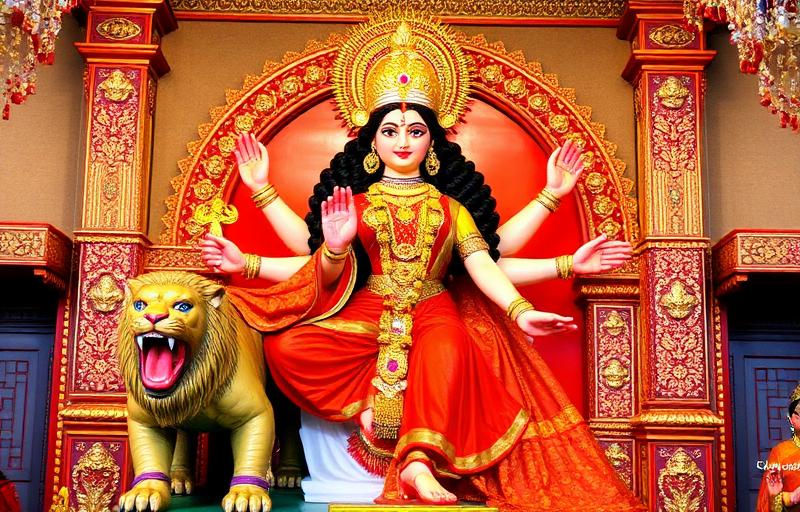
- The goddess Tripura Sundari, the principal deity, in a form called Soroshi
- A second, smaller image of the same goddess, called Chhoto Ma, the little mother
- A temple built on a kurma pitha, a tortoise shaped base, from which its distinctive profile comes
- The Kalyan Sagar, a large tank behind the temple, holding very large tortoises and fish
- A substantial complex serving very large numbers
The founding:
- Built in 1501 by Maharaja Dhanya Manikya of Tripura
- One of the oldest continuously functioning temples in the northeast with a firm date
- A Shakti Peetha, where the right foot of Sati is said to have fallen
The tortoise shape. This is the temple's architectural distinction.
- The base is a kurma pitha, in the shape of a tortoise
- The temple rises from it and the profile, seen from a distance, is that of a tortoise's shell
- The form is derived from the Kurma, the tortoise avatar of Vishnu, described in the Srikurmam entry in the Andhra batch
- It is an unusual plan and there are few comparable temples
Why a tortoise:
- The Kurma chakra, a tortoise diagram, is used in some Agamic traditions to lay out the ground plan of a temple or a settlement, with the parts of the tortoise mapped onto the site
- The tortoise supports Mount Mandara during the churning, and by extension supports the world
- A temple on a tortoise base is a temple on the thing that holds everything up
- The tortoise is also, as set out at Srikurmam, the image of pratyahara, the withdrawal of the senses, in the Bhagavad Gita
And the tank behind it. The Kalyan Sagar holds real tortoises, in numbers and of considerable size, which are fed by visitors and are protected.
So the temple is tortoise shaped and the lake behind it is full of tortoises. Whether one caused the other, or the correspondence was noticed and elaborated, is not something anybody can settle, and the effect is the same either way.
The Kalyan Sagar and Its Tortoises
The tank behind the temple is a substantial part of the visit and it is worth taking seriously as more than a curiosity.
What is in it:
- Very large softshell turtles, some of them extremely large and evidently old
- Large fish
- Both are fed by visitors, with feed sold at the temple
- Neither is caught, by long standing prohibition
The protection mechanism. Exactly as set out at Baijnath in the Uttarakhand batch.
- The water body belongs to the deity
- Killing there is prohibited
- The prohibition is enforced by the community
- Over a long period this produces an unfished, unafraid population
Why this matters more than it might seem. Indian freshwater turtles are in serious trouble.
- Several Indian softshell and hardshell freshwater turtle species are threatened or endangered
- The principal threats are habitat loss, pollution, sand mining in nesting areas, incidental capture in fishing, and the illegal trade in turtles for meat and for the pet trade
- India has been a significant source in the international illegal turtle trade, with very large seizures made periodically
- The Indian softshell turtle and the black softshell turtle are among the species affected
The black softshell turtle. This is the striking case and it belongs in this entry.
- Nilssonia nigricans, the black softshell turtle
- Was declared extinct in the wild by the IUCN, with the only known surviving population being in a temple pond
- That pond was at Bayazid Bastami shrine in Chittagong, Bangladesh
- Populations have subsequently been identified in temple ponds in Assam, including at Hayagriva Madhava temple at Hajo and at other Assamese temple tanks
- Conservation programmes have worked with those temples to breed and release the species
- Its status has since been revised as populations were located
So a species that was believed to survive only in temple ponds is being brought back through work with temple managements.
Why temple ponds ended up holding the last populations:
- They were protected when nothing else was
- The animals were fed, so populations persisted at higher densities than the pond would naturally support
- Nobody caught them
- The prohibition held for centuries and did not depend on any law
And the limitations:
- A temple pond population is genetically isolated and small
- Overcrowding and feeding produce health problems
- The habitat is not natural and does not include nesting conditions in many cases
- Conservation requires breeding and release, which requires cooperation between temple managements and biologists
That cooperation has happened at several Assamese temples and it is one of the better conservation stories in India.
At the Kalyan Sagar:
- Feed the animals with the feed sold at the temple, not with packaged human food
- Do not feed them bread, biscuits or anything processed
- Do not put plastic in the water
- Do not attempt to touch or handle them
- Do not stand on the steps in a way that blocks them
A general point about temple tanks and animals. As set out at Baijnath and Karni Mata and elsewhere in this series, sacred prohibition has protected a considerable amount of Indian biodiversity by accident.
That is not a conservation strategy and it should not be romanticised. It is, however, a real mechanism that has produced real results, and conservation work that builds on it rather than ignoring it has a much better record.
The Manikya Kings
The temple was built by a Manikya ruler and the dynasty is worth setting out, because Tripura's history is not well known outside the state.
The Manikya dynasty:
- Ruled Tripura from around the fifteenth century, with a claimed lineage running much further back
- Of Tripuri origin, one of the indigenous communities of the region, who adopted Sanskritic titles and Hindu practice while remaining a tribal ruling house
- Their chronicle is the Rajmala, a court history in Bengali verse, compiled from the fifteenth century onward
- Ruled from Udaipur and later from Agartala
- Continued as a princely state under British paramountcy until integration with India in 1949
Dhanya Manikya:
- Ruled in the late fifteenth and early sixteenth centuries
- Built the Tripura Sundari temple in 1501
- One of the more significant rulers of the dynasty, who extended the kingdom's power
The Rajmala. Worth a note because it is unusual.
- A chronicle of the Tripura kings, in Bengali verse
- Compiled and extended over centuries by court poets
- One of relatively few sustained dynastic chronicles from any Indian region
- Combines mythological genealogy with historical record, as such chronicles do
The wider point about Tripura. The state's history is one of an indigenous ruling house that adopted Hindu practice and Bengali as a court language while ruling over a population that was substantially tribal.
That produced:
- A Hindu royal establishment, of which this temple is the principal monument
- Continuing tribal religious traditions among the Tripuri, Reang, Jamatia, Chakma and other communities
- A court culture in Bengali, which brought in Bengali literary and religious traditions
- The Manikya rulers' patronage of Bengali literature, including of Rabindranath Tagore, with whom the Tripura house had a long relationship
Tagore and Tripura. Worth setting out because it is genuinely notable.
- Maharaja Bir Chandra Manikya recognised Tagore's poetry very early, sending an emissary to congratulate him after reading his early work
- Successive Manikya rulers maintained the relationship
- Tagore visited Tripura several times
- His plays Visarjan and Rajarshi are set in Tripura and draw on its history, specifically on the subject of animal sacrifice at this temple
Visarjan deserves a paragraph because it bears directly on this site.
- Tagore's play, based on his novel Rajarshi
- Set at a temple in Tripura, and drawing on the tradition of animal sacrifice there
- The plot concerns a king who, moved by the sight of a child distressed at the blood, forbids sacrifice at the temple, and the conflict with the priesthood that follows
- It is one of Tagore's most direct treatments of religious violence and of the relationship between ritual and cruelty
The demographic change. Tripura's population changed very substantially in the twentieth century.
- Large scale migration from East Bengal, and then from East Pakistan after 1947 and after 1971
- The indigenous tribal communities went from a majority to a minority of the state's population
- That change is the central fact of Tripura's modern politics and produced insurgency, violence and a long period of conflict from the 1970s onward
- The situation has substantially stabilised but the underlying questions about land, language and representation have not gone away
Why a temple guide should mention this. Because a visitor to Tripura should understand that the state's history is not the same as the state's temple history, and that the tribal communities of Tripura have their own religious traditions which are not adequately represented by the Manikya court's Hinduism.
Both are Tripura, and this temple is one of them.
Tripura Sundari, and What Tripura Means
The goddess's name and the state's name are connected, and the theology behind the name is substantial.
Tripura Sundari:
- Tripura means three cities, or the three worlds
- Sundari means the beautiful one
- Tripura Sundari is therefore the beauty of the three worlds, or she who is beautiful in the three cities
- Also called Lalita, Rajarajeshwari, Shodashi and Kamakshi
Her place in the tradition. She is a major figure and is not a local deity given a Sanskrit name.
- One of the Dasha Mahavidyas, the ten great wisdom goddesses of the tantric tradition
- The principal deity of the Srividya tradition, which is among the most developed and most philosophically elaborated schools of Shakta practice
- Worshipped through the Sri Yantra or Sri Chakra, the geometric diagram of nine interlocking triangles which is the most complex and most studied yantra in the tradition
- The subject of the Lalita Sahasranama, the thousand names, which is among the most widely recited stotras in India
- And of the Saundarya Lahari, attributed to Shankaracharya, one of the great works of Sanskrit devotional poetry
Srividya. Worth a paragraph because it is a serious philosophical tradition and is frequently misrepresented.
- A tantric tradition centred on Tripura Sundari and the Sri Chakra
- Highly philosophical, engaging closely with Advaita Vedanta and with Kashmir Shaivism
- Practised through mantra, particularly the fifteen or sixteen syllable Panchadashi and Shodashi mantras, through yantra and through meditation
- Requires initiation from a qualified teacher and is not a self study tradition
- Strong in the south, particularly in Tamil Nadu and Kerala, and associated with the Shankaracharya mathas
- Also strong in Kashmir historically and in Bengal and the northeast
The Sri Chakra:
- Nine interlocking triangles, four pointing up and five down, producing forty three smaller triangles
- Surrounded by lotus petals and enclosing squares
- Representing the cosmos and the body simultaneously, and the process by which the one becomes the many and returns
- Worshipped in a defined sequence, from the outside inward or the inside outward
- Constructed in two dimensions or as a three dimensional Meru
The Lalita Sahasranama. A thousand names of the goddess, recited very widely, particularly on Fridays and during Navratri.
It is a substantial text and reciting it is one of the standard Devi practices across India, including by people who have no connection to Srividya as an initiatory tradition.
The Tripura in the state's name. Various derivations are offered.
- From Tripura Sundari, the goddess of the temple
- From Twipra or Tuipra in the Kokborok language, the language of the Tripuri people, meaning near water
- From a king named Tripur in the Rajmala's genealogy
The Kokborok derivation is the one linguists generally prefer, and the Sanskritic ones are the court's.
That is itself a good illustration of the state's history: an indigenous name, a Sanskritic reinterpretation, and a temple to the goddess of the reinterpretation, all in one place name.
Kokborok. Worth naming. It is a Tibeto Burman language, the language of the Tripuri people, one of the official languages of Tripura, and it is not related to Bengali, which is the other official language.
The question of Kokborok's script, whether Bengali or Roman, has been a live political issue in the state for decades, and it is one of the ways the demographic question described above is expressed.
The Diwali Mela
The temple's principal occasion is the Diwali mela, and it is the largest gathering in Tripura.
When: at Diwali, in Kartika, generally October or November, over several days.
Scale: attendance runs into the lakhs over the mela period, drawn from across Tripura, from Assam, from Bengal and from Bangladesh where visa arrangements permit.
What happens:
- Kali Puja is observed, since Diwali at a Devi temple in the eastern tradition is Kali Puja
- Darshan of Tripura Sundari and Chhoto Ma
- Feeding the tortoises and fish at the Kalyan Sagar
- A very large fair, with trade, food, entertainment and the usual mela economy
- Special arrangements for crowd management
Why Diwali at a Devi temple. It is worth explaining because it differs by region.
- In north and west India, Diwali is principally Lakshmi Puja, with the return of Rama to Ayodhya as the founding narrative
- In Bengal, Assam, Odisha and Tripura, the night of Diwali is Kali Puja
- In Sikh tradition it is Bandi Chhor Divas, described in the Durgiana entry
- In Jain tradition it marks Mahavira's attainment of nirvana
- In the south, Naraka Chaturdashi is the principal observance, marking Krishna's killing of Narakasura
That is five different observances on the same nights, all called Diwali, and all correct.
Kali Puja in the eastern tradition:
- Held on the amavasya, the new moon, of Kartika
- Images of Kali are made, worshipped through the night and immersed
- The observance is nocturnal, running through the night
- Tantric elements are more prominent than in most public Hindu observance
- At Tripura Sundari, the temple's own goddess is the focus rather than a made image
On animal sacrifice at this temple. It should be addressed, as at Patiala.
- The temple historically practised animal sacrifice, principally of goats, and this is well documented
- It is the subject of Tagore's Visarjan, described above, which was written specifically about it
- The practice has been the subject of litigation and of court orders in Tripura
- The Tripura High Court ruled on animal sacrifice at temples in the state in 2019, and the matter went to the Supreme Court
- Practice at the temple has been affected by those proceedings
How to hold it. The position set out at Patiala applies.
- The practice is genuine and embedded in the tradition, not an aberration
- It has declined substantially and is legally restricted in many states
- Substitution is well founded within the tradition
- Communities that practised it should not be spoken about with contempt
- This publication does not encourage or recommend it
What a visitor will see now. A very large temple fair, enormous crowds, the tank and its animals, and the ordinary apparatus of eastern Indian Devi worship.
Going during the mela:
- Extremely crowded
- Go early or accept a long wait
- Transport from Agartala is heavily loaded; book or start early
- Accommodation at Udaipur is limited; Agartala is the base
- Keep valuables secure and agree a meeting point if you are in a group
Visiting Matabari
Getting there
- Tripura Sundari temple, Udaipur, Gomati district, Tripura
- About 55 km from Agartala
- Udaipur has a railway station on the Agartala line
- Agartala has an airport with connections to Kolkata, Guwahati and Delhi
- Buses and shared vehicles run from Agartala
Timings
- The temple opens early and runs through the day. Check current timings, which extend during the mela
When to go
- Diwali mela, in October or November, which is the principal occasion and is extremely crowded
- Navratri
- October to March for weather. Tripura from April to September is hot and very wet
- Ordinary days for a quiet visit, which is better for actually seeing the temple
At the temple
- Traditional dress is appropriate
- Footwear is left outside
- Look at the kurma pitha, the tortoise shaped base, from a distance to see the profile
- Visit the Kalyan Sagar and feed the animals with temple feed only
- Photography may be restricted in the sanctum
Combining the visit
- Udaipur town, the old Manikya capital, with several other temples and tanks including the Bhubaneswari temple
- Agartala, 55 km, with the Ujjayanta Palace, now the state museum, which is very large and worth several hours
- Neermahal, at Melaghar about 55 km from Agartala, a water palace built in the 1930s by Maharaja Bir Bikram Kishore Manikya in the middle of Rudrasagar lake, reached by boat, which is among the most striking buildings in the northeast
- Unakoti, described in this batch, in the far north of the state
- Sepahijala wildlife sanctuary, with spectacled langurs
- Jampui hills, in the north, for the views and the orange orchards
- Pilak, in South Tripura, with Buddhist and Hindu sculptural remains of around the eighth to twelfth centuries
Neermahal deserves a paragraph. A palace in the middle of a lake, built in the 1930s, combining Mughal and European elements, reached by boat.
It is the only water palace in eastern India, it is astonishing, and almost nobody outside the northeast has heard of it.
Pilak deserves one too. In South Tripura district, an archaeological site with Buddhist and Hindu sculpture and terracotta of around the eighth to twelfth centuries, indicating a substantial settlement with both traditions.
It is unexcavated in large part, under the Archaeological Survey, and it establishes that Tripura was on the routes between Bengal, Burma and Southeast Asia in that period.
Travelling in Tripura:
- Agartala is the base and has flights and a rail connection
- The state is small and distances are manageable
- October to March is the season
- The state is safe and travel is straightforward, which is not what many people assume about the northeast
- Bengali and Kokborok are the languages; Hindi is understood in towns
- Tripura shares a very long border with Bangladesh, and Agartala is close to it
A note on the northeast generally. The assumption that the northeastern states are difficult or unsafe to travel in is largely outdated.
- Permits are required for Arunachal Pradesh, Nagaland in some cases, Mizoram and Manipur for foreign nationals, and the requirements change; check current rules
- Tripura, Assam and Meghalaya require no permits for Indian citizens
- Infrastructure is better than most people expect
- The region holds some of the most interesting cultural material in India and receives a fraction of the visitors it should
A closing thought. There is a temple shaped like a tortoise, built in 1501, behind which is a lake full of tortoises so old and so large that people come specifically to look at them.
It was built by a tribal ruling house that had adopted Sanskritic Hinduism, in a state whose name may come from the goddess or may come from the indigenous language, and Tagore wrote a play about what used to happen there.
All of that is in one compound, fifty five kilometres from Agartala, and almost nobody from outside the region has been.
Quick Answers
Where is the Tripura Sundari temple?+
At Udaipur in Gomati district, Tripura, universally called Matabari, about 55 km from Agartala. Udaipur has a railway station on the Agartala line, Agartala has an airport with connections to Kolkata, Guwahati and Delhi, and buses and shared vehicles run from Agartala.
Why is the temple tortoise shaped?+
It is built on a kurma pitha, a tortoise shaped base, and the profile seen from a distance is that of a tortoise's shell. The form derives from Kurma, the tortoise avatar who supported Mount Mandara during the churning and by extension supports the world, and the Kurma chakra is used in some Agamic traditions to lay out a temple's ground plan.
What is in the Kalyan Sagar?+
Very large softshell turtles, some extremely large and evidently old, and large fish, both fed by visitors with feed sold at the temple and neither caught by long standing prohibition. Indian freshwater turtles are seriously threatened, and temple ponds have held the last surviving populations of some species, including the black softshell turtle which was declared extinct in the wild.
Who built the temple?+
Maharaja Dhanya Manikya of Tripura in 1501. The Manikya dynasty was of Tripuri origin, an indigenous community of the region, who adopted Sanskritic titles and Hindu practice while remaining a tribal ruling house, ruled from Udaipur and later Agartala, and continued as a princely state until integration with India in 1949.
Who is Tripura Sundari?+
One of the Dasha Mahavidyas and the principal deity of the Srividya tradition, one of the most philosophically developed schools of Shakta practice, worshipped through the Sri Chakra of nine interlocking triangles. Her name means the beauty of the three worlds, and she is also called Lalita, Rajarajeshwari and Shodashi. The Lalita Sahasranama and the Saundarya Lahari are addressed to her.
Why is Diwali a Kali Puja here?+
In Bengal, Assam, Odisha and Tripura the night of Diwali is Kali Puja, held on the amavasya of Kartika and observed through the night. In north and west India Diwali is principally Lakshmi Puja, in Sikh tradition it is Bandi Chhor Divas, in Jain tradition it marks Mahavira's nirvana, and in the south Naraka Chaturdashi is the principal observance. All five are correct.
About the author
Anjali Mehta · Editor, M.A. Religious Studies
Anjali is the managing editor for Vandnaa and oversees the festival and vrat coverage. She holds an M.A. in Religious Studies and reviews every published article for accuracy, accessibility, and tradition-fidelity.
Meet the Vandnaa editorial team →