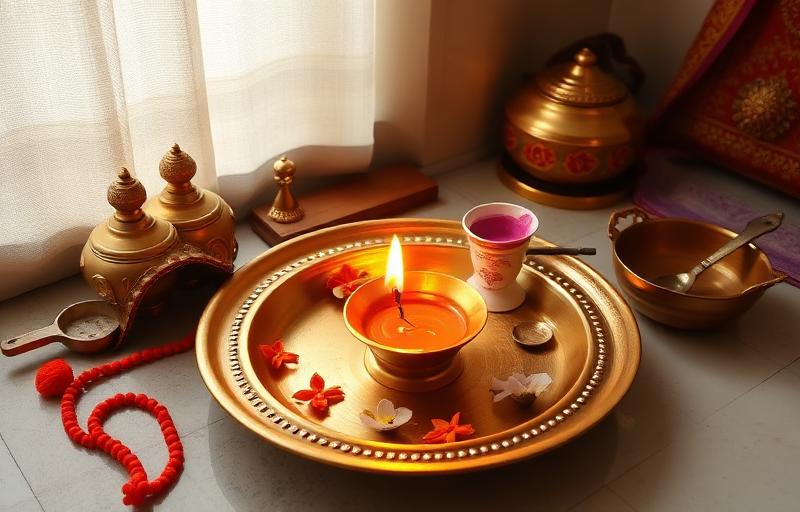
Vishwakarma and the Aarti Sung in His Honour
Vishwakarma, the divine architect and engineer of the gods, is worshipped by craftspeople, engineers and factory workers as the source of all skilled creation. His aarti is sung most prominently during Vishwakarma Puja, observed around mid-September, when tools, machines and workshops are cleaned and formally worshipped.
Unlike aartis sung purely for personal blessing, the Vishwakarma Aarti carries a strong note of gratitude for one's craft and workplace, and a prayer for safety in one's daily work.
Factories, garages, construction sites and design studios across India pause on this day for a shared, simple ceremony that closes with this aarti.
Vishwakarma Aarti - Representative Verses (Hindi)
Here are representative verses of the Vishwakarma Aarti in the traditional aarti style, offered as a devotional excerpt:
जय जय विश्वकर्मा देवा, जय शिल्पी भगवाना। सृष्टि रचना के स्वामी, तुमको शीश नवाना॥ जय जय विश्वकर्मा देवा...
यंत्र औज़ार तुम्हारे, कारीगर के साथी। भक्तन के कारज सारे, सिद्ध करो हे दाता॥ जय जय विश्वकर्मा देवा...
द्वारका इंद्रपुरी रचना, तुमसे ही जग जाना। शिल्प कला के दाता, तुमको शत शत प्रणामा॥ जय जय विश्वकर्मा देवा...
सुरक्षा दो कार्यस्थल में, दुर्घटना से बचाना। श्रम में सफलता दे दो, यही भक्त का चाहना॥ जय जय विश्वकर्मा देवा...
Meaning and Devotional Significance
The line 'yantra auzaar tumhare, kaarigar ke saathi' (your tools and instruments, the craftsman's companions) reflects a distinctive feature of this aarti: it treats ordinary tools, a hammer, a machine, a laptop, as extensions of devotion rather than merely objects. Cleaning and worshipping them is a way of honouring the dignity of one's daily labour.
The request for safety, 'suraksha do karyasthal mein, durghatna se bachana' (protect the workplace, save us from accidents), grounds the aarti in a very practical, everyday concern, showing that devotion here is closely tied to the wellbeing of workers, not only abstract blessing.
Benefits of Singing Vishwakarma Aarti
As per tradition, devotees who sing the Vishwakarma Aarti with sincerity believe it brings:
- Safety and reduced accidents at the workplace
- Smoother functioning of tools, machines and equipment
- Recognition and growth for one's craft or business
- A sense of pride and dignity in one's daily work
- Support for new projects, workshops or factory launches
- A steady, grateful mindset toward one's livelihood
These benefits are held as matters of faith and gratitude, not a substitute for proper safety practices and honest effort.
When and How to Sing This Aarti
The principal occasion is Vishwakarma Puja, when tools and machines are cleaned, arranged before his image, and worshipped with flowers, akshat and a lit diya, closing with this aarti sung together by everyone present at the workplace.
Some workplaces also sing it briefly before starting a major new project or inaugurating new equipment through the year. As with all devotional practice, it is offered as an act of faith and love, not a transaction, a moment of collective gratitude before returning to the work itself.
Common Questions From Devotees
When is Vishwakarma Aarti traditionally sung?+
Most prominently during Vishwakarma Puja in mid-September, when tools and machines are worshipped, and sometimes before launching a major new project or workshop during the year.
Why does the aarti mention safety at the workplace?+
Vishwakarma's devotion is closely tied to daily, practical work, so the aarti includes a sincere prayer for protection from workplace accidents alongside its praise of his creative skill.
Can students of engineering or design sing this aarti?+
Yes, many students recite it during Vishwakarma Puja or before exams and project submissions, inviting clarity and diligence in their creative and technical work.
About the author
Acharya Vinaya Kapoor · M.A. Sanskrit, Mantra & Stotra Studies
Acharya Vinaya holds an M.A. in Sanskrit from Banaras Hindu University and writes the mantra and stotra commentary on Vandnaa. Her focus is on accurate pronunciation, traditional context, and helping modern readers connect with classical texts.
Meet the Vandnaa editorial team →