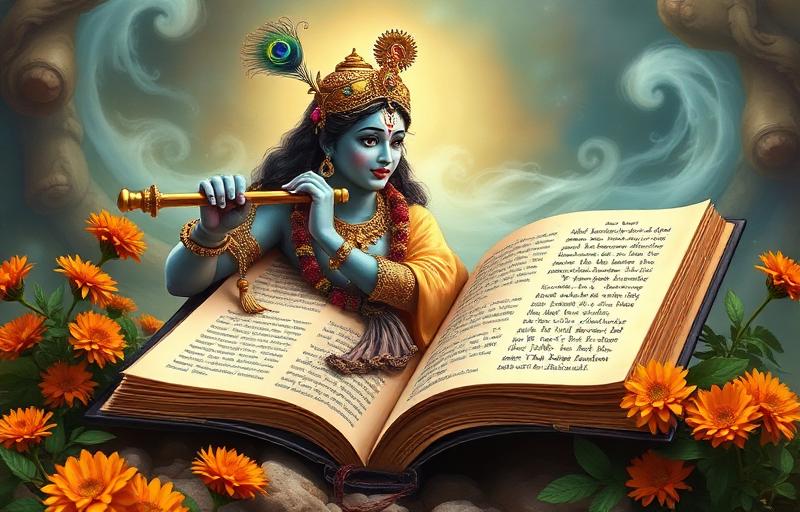
The Player Who Never Lost
Vyomasura, identified in the Bhagavata Purana as a son of the great asura architect Maya, disguised himself as one more cowherd boy and joined Krishna's circle of friends during a round of games in the forest - among them a version of hide-and-seek, where the children took turns as goatherds and thieves, some hiding, one seeking, calves scattered around them.
What made Vyomasura's approach different from a demon who simply attacks is patience: he played along, apparently fairly, for long enough to be trusted as one of the group. Then, taking his turn as the seeker, he began actually capturing the children he found - not tagging them out of the game the ordinary way, but seizing them and, one at a time, carrying them off and sealing them inside a mountain cave, using his own asura ability to move rock as though it were nothing.
The game continued around Krishna, who initially had no reason to suspect anything - children drop out of games, wander home, lose interest. What eventually gave it away was the pattern: too many of his friends, one after another, simply weren't coming back, and the common factor each time was that Vyomasura had been the one to find them last. Krishna confronted him directly, and when Vyomasura reverted to his true asura form and tried to fight rather than explain, Krishna overpowered him the way he handles most of these physically direct confrontations - subduing him by force before finally killing him, the way one would deal with a wild animal rather than a person, which the text notes explicitly as the correct register for a being who had already shown what he actually was.
With Vyomasura dead, Krishna went to the cave, moved the boulder sealing it, and brought his friends back out into the forest, apparently none the worse for the ordeal beyond having been badly frightened.
Maya's Son, Not Maya Himself
Vyomasura's parentage is worth dwelling on because it connects this small childhood episode to a much larger figure in the Puranic world: Maya Danava, the asura architect responsible for building the illusory assembly hall (mayasabha) that Duryodhana later humiliates himself inside during the Mahabharata, and who also constructed the three flying cities destroyed by Shiva as Tripurasura's stronghold.
Maya is a recurring figure across multiple, sometimes only loosely connected episodes in the Puranas and epics, generally depicted less as a straightforwardly evil demon and more as an immensely skilled craftsman whose talents get used by whoever he's currently allied with or bound to serve. Vyomasura inheriting his father's capacity for illusion and concealment - the ability to hide things inside solid rock, to disguise himself convincingly enough to join a children's game undetected - fits that inherited-craft pattern even in a minor episode like this one.
Some later commentarial traditions read Vyomasura's method - infiltration through patient participation rather than open attack - as a deliberate contrast with his father's grander, more visible architectural deceptions, suggesting the family's skill scales down as easily as it scales up: the same instinct for hidden structure and concealment that builds a mayasabha can, in a smaller and crueler application, seal children inside a mountain one at a time.
The Danger That Doesn't Look Like Danger
Among the Vraja demon episodes, Vyomasura's stands out for how ordinary the setting stays right up until the reveal - no storm, no giant animal, no dramatic entrance. It's a game the children were already playing, with a participant they had every reason to trust because he'd apparently been playing fairly for some time before he wasn't.
That slow-burn structure is unusual enough in this cycle to be worth flagging on its own terms, distinct from Putana's immediate poison or Trinavarta's sudden storm. The threat here works precisely because it takes time to notice - each individual disappearance is explainable on its own, and it's only the accumulated pattern across several friends that eventually makes it visible. Krishna's response accordingly isn't a single dramatic act of strength so much as attentiveness sustained over the length of a game, noticing what nobody else in the group had noticed yet.
The episode doesn't carry the widespread festival or naming legacy that some of the other Vraja demons do - there's no Vyomasura-linked observance or epithet the way Kesi gives Keshava - but it remains a regularly retold episode in Krishna-katha recitation specifically for this structural lesson: not every threat to a community announces itself, and the ones that don't are often the ones hiding inside an activity everyone already trusts.
Common Questions From Devotees
Who was Vyomasura's father?+
The Bhagavata Purana identifies him as a son of Maya Danava, the great asura architect who built Duryodhana's illusory assembly hall in the Mahabharata and the three flying cities destroyed by Shiva as Tripurasura's stronghold.
How did Vyomasura kidnap the cowherd boys?+
Disguised as a cowherd boy himself, he joined a game of hide-and-seek and, taking his turn as the seeker, actually seized the children he found one by one and sealed them inside a mountain cave using his asura ability to move rock.
How did Krishna eventually notice something was wrong?+
Not through any special vision but through an observable pattern - too many of his friends were failing to return to the game, and in every case Vyomasura had been the one to find them last.
About the author
Anjali Mehta · Editor, M.A. Religious Studies
Anjali is the managing editor for Vandnaa and oversees the festival and vrat coverage. She holds an M.A. in Religious Studies and reviews every published article for accuracy, accessibility, and tradition-fidelity.
Meet the Vandnaa editorial team →