The Question Everyone Asks
Almost every Hindu has fielded some version of this question, often from a confused coworker or friend checking a calendar: why isn't Diwali just always on, say, November 1st, the way a fixed holiday would be? The frustration is understandable. Most globally familiar holidays anchored to the Gregorian calendar land on the same date every single year without exception, making a shifting date feel unusual or even like an inconsistency in how festivals are decided, rather than what it actually is: a completely different, and in some ways more precise, method of dating something meaningful.
The short answer is that Hindu festivals are not dated against the Gregorian solar calendar at all. They are dated against specific tithis, lunar days tied to the moon's actual position relative to the sun, within a lunisolar calendar system that has been refined over roughly two thousand years of continuous use. Once that single fact is understood, the apparent randomness of festival dates disappears entirely, replaced by a system that is, in fact, extremely consistent and predictable, just not predictable using Gregorian-calendar logic.
This piece works through that logic concretely, using three familiar festivals, Diwali, Holi and Raksha Bandhan, as worked examples rather than staying purely abstract. Readers wanting the fuller mechanics of the lunisolar system itself, including what exactly a tithi is and how Purnimant and Amanta month-counting differ, will find that covered in more depth elsewhere on Vandnaa. Here, the focus stays squarely on answering the everyday version of the question: why does this specific familiar festival land on a different date this year than it did last year, and where, roughly, will it land next year.
Festivals Follow a Tithi, Not a Fixed Date
To understand why any specific festival moves, it helps to hold one core fact firmly in mind: a Hindu festival's real "address" is a tithi and a lunar month, such as Kartik Amavasya or Phalguna Purnima, never a Gregorian date like November 1st. The Gregorian date is simply wherever that tithi happens to fall in a given year, a downstream result rather than the actual defining rule.
The drift happens because a lunar year, twelve lunar months of roughly 29.5 days each, adds up to about 354 days, while the Gregorian solar year runs about 365.25 days, a gap of roughly 11 days annually. Because of this gap, a given tithi's position relative to the Gregorian calendar shifts backward by about 11 days each successive year, which is why a festival that fell in mid-October one year might fall in early October the following year, then late September the year after that, continuing to creep earlier and earlier.
This drift does not continue forever in one direction, which is the detail that resolves most people's remaining confusion. Roughly every two to three years, an extra lunar month, adhik maas, is inserted into the calendar specifically to correct this accumulated gap, pulling the lunar calendar back into alignment with the solar year in one larger correction rather than many small ones. This single mechanism is why Hindu festivals shift noticeably year to year within a bounded window, yet reliably return to roughly the same season across any longer stretch of years, rather than sliding endlessly through the calendar the way an uncorrected lunar-only system would.
Worked Example: Diwali's Kartik Amavasya
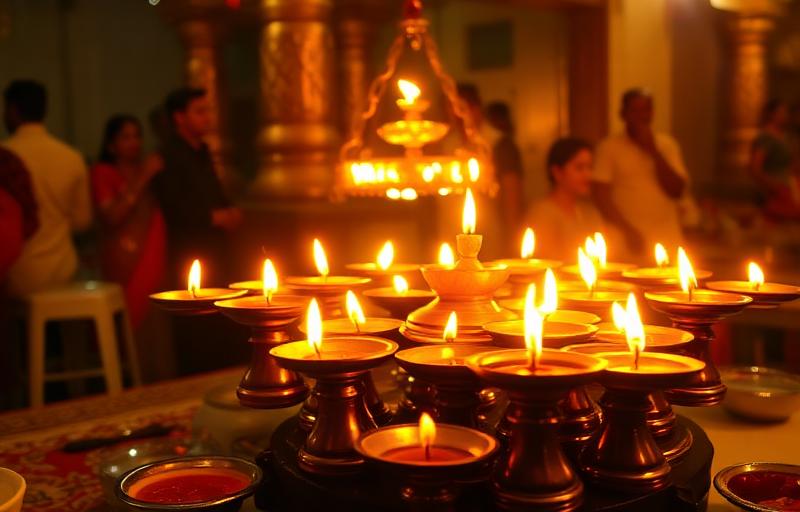
Diwali always falls on Kartik Amavasya, the no-moon night of the lunar month of Kartik, regardless of what Gregorian date that turns out to be in a given year. This single rule, not a committee decision or a regional custom, is the entire explanation for Diwali's shifting date. Because Amavasya is defined by the moon's exact position relative to the sun, and because the lunar calendar drifts against the Gregorian one by about 11 days annually before an adhik maas resets it, Diwali's Gregorian date moves within a window that generally spans mid-October to mid-November across different years.
This is also why Diwali sometimes appears to fall unusually early or unusually late compared to recent memory, readers comparing this year's date to what they remember from five or six years ago are often comparing across an adhik maas correction, not noticing any error in either year's calculation. Both dates are entirely correct, they simply reflect where Kartik Amavasya happened to land in each respective year's lunar cycle.
Devotees who want to know next year's Diwali date well in advance do not need to guess or wait for an announcement, panchang calculations are astronomical and can be computed years ahead with confidence, which is exactly how apps and printed panchangs list multiple years of festival dates at once. The date is never arbitrary or decided late, it is simply the product of a different, moon-based dating logic than the one most global holidays use, calculated with the same precision, just against a different celestial reference point.
Worked Example: Holi's Phalguna Purnima

Holi follows the same tithi-based logic anchored to a different point in the lunar calendar: Phalguna Purnima, the full moon night of the lunar month of Phalgun. Holika Dahan, the bonfire ritual, takes place on the evening of this purnima, and Rangwali Holi, the color-throwing celebration most people picture when they hear the festival's name, follows the next day, on Phalgun's first krishna paksha tithi.
Because Phalgun typically corresponds to a period spanning late February through March on the Gregorian calendar, and because purnima's exact date within that window shifts with the same roughly 11-day annual drift described earlier, Holi generally lands somewhere between late February and late March depending on the specific year, with the same adhik maas correction keeping that window from expanding further over time.
Working through Holi as a second example alongside Diwali is useful precisely because it shows the same underlying rule, tithi plus lunar month equals festival date, applying consistently across a completely different point in the yearly cycle. Diwali is anchored to an amavasya in autumn, Holi to a purnima in late winter or early spring, but the calculation logic connecting each festival to its Gregorian date in any given year is identical. Once a reader has worked through both examples, applying the same reasoning to any other tithi-based festival, from Janmashtami to Navratri, becomes a matter of locating the right tithi and month on that year's panchang rather than learning an entirely new rule each and every single time a new festival comes up.
Worked Example: Raksha Bandhan's Shravan Purnima
Raksha Bandhan provides a third worked example, anchored to Shravan Purnima, the full moon of the lunar month of Shravan, which generally corresponds to a period across July and August on the Gregorian calendar. The same mechanics apply once more: the exact date of that purnima drifts by roughly 11 days each year relative to the Gregorian calendar, then gets pulled back into its usual seasonal window whenever an adhik maas falls due.
What makes Raksha Bandhan a useful third example is that it falls in a different lunar month entirely from both Diwali and Holi, yet families never need three separate explanations for why each festival's date moves the way it does. A single rule, tithi plus lunar month determines the festival, and the 11-day lunar-solar gap corrected periodically by adhik maas, accounts for the shifting date of every tithi-based festival on the Hindu calendar, not just these three. Ekadashi fasting days, Navratri's start date, Janmashtami, and dozens of other observances all move for exactly this same reason, year after year, without needing any separate explanation specific to each one.
Once a reader has traced this same logic through three genuinely different festivals spread across three different seasons, autumn's Diwali, late winter's Holi, and monsoon-season Raksha Bandhan, the earlier abstract explanation of tithis and lunar drift stops being an abstraction and becomes something closer to a tool: given any festival's tithi and month, its rough Gregorian window for any given year becomes reasonably predictable, even without consulting a panchang for the exact day.
The Adjustment Mechanism: Adhik Maas
The single mechanism preventing Hindu festivals from drifting endlessly through the entire year, the way an uncorrected purely lunar count eventually would, is adhik maas, the intercalary or "extra" lunar month. An adhik maas is inserted whenever a lunar month fails to contain a solar sankranti, the sun's transition into a new zodiac sign, within its boundaries, a specific, calculable astronomical condition rather than an arbitrary decision made by any single authority.
When this extra month is inserted, that particular month essentially does not count toward the year's usual festival calculations, its named festivals wait for the following, "real" occurrence of that lunar month instead. This effectively pauses the accumulated 11-day-per-year drift for one extra month, giving the solar calendar time to catch back up before the lunar count resumes its normal pace. The practical result, felt by every household following the panchang, is that a festival's Gregorian date might occasionally jump later rather than continuing its usual earlier drift, precisely in years affected by an adhik maas.
This is the detail that ultimately answers the deeper version of the original question. Hindu festivals shift date to date each year because they follow the moon, but they do not drift through every season over time the way a purely lunar system without this correction would, because the solar-based adhik maas mechanism actively prevents that from happening. Diwali will keep landing somewhere in autumn, Holi somewhere in late winter to early spring, and Raksha Bandhan somewhere in monsoon season, indefinitely, precisely because this correction has been running, reliably, for roughly two thousand years.
📿 Vandnaa's festival calendar already accounts for every tithi and adhik maas calculation, so you always see the correct upcoming date without doing any of this math yourself.
Reader Questions Answered
Why doesn't Diwali fall on the same date every year?+
Diwali is dated to Kartik Amavasya, a lunar tithi, not a fixed Gregorian date. Because the lunar year runs about 11 days shorter than the solar year, this tithi's Gregorian date shifts earlier each year until an adhik maas resets it.
Will Hindu festivals ever drift into a completely different season?+
No. The adhik maas mechanism, which inserts an extra lunar month roughly every two to three years, specifically prevents this by periodically resetting the lunar calendar against the solar year, keeping every festival within a consistent seasonal window indefinitely.
What exactly is adhik maas and how often does it happen?+
Adhik maas is an extra lunar month inserted whenever a lunar month does not contain a solar sankranti. It occurs roughly once every two to three years and is the primary mechanism keeping the lunar and solar calendars aligned over time.
Is there any Hindu festival with a fixed Gregorian date?+
Yes, Makar Sankranti and other sankranti days follow the solar calendar rather than the lunar tithi system, so they fall on nearly the same Gregorian date, typically January 14th for Makar Sankranti, every single year.
How far in advance can festival dates actually be predicted?+
Quite far. Panchang calculations are based on precise astronomical positions of the sun and moon, which can be computed years or even decades in advance, which is exactly how apps and printed calendars list multiple future years of festival dates confidently.
Why do different panchang sources sometimes disagree by a day on a festival date?+
This usually happens because of kshaya or vriddhi tithi situations, where a tithi begins and ends within one sunrise cycle or spans two, combined with slightly different regional conventions for which moment relative to sunrise determines a day's ruling tithi.
About the author
Pandit Mahesh Trivedi · Festival Traditions & Panchang
Pandit Mahesh leads the festival-date and Panchang content on Vandnaa. He cross-references multiple regional panchangs (Drik, Vaishnava, Bengali, Marathi) for every festival date published on the site.
Meet the Vandnaa editorial team →