Sunday (Surya) and Monday (Shiva)
Ravivar, Sunday, belongs to Surya, the sun god, and is considered an auspicious day for prayers related to health, vitality and clarity, qualities directly associated with sunlight's life-sustaining role. Many devotees offer water to the rising sun on this day, a practice called Surya Arghya, and some observe a Sunday fast focused on Surya specifically, often avoiding salt, as part of the day's devotional discipline.
Somvar, Monday, is dedicated to Shiva, and the reasoning here runs through the moon rather than through Shiva directly at first glance. "Som" is itself a name for the moon, and Chandra, the moon god, is traditionally depicted adorning Shiva's matted hair, having been given a place there after a humbling episode involving the moon's waning curse. Because the moon and Shiva are linked this closely in iconography and legend, the day named for the moon naturally became associated with Shiva worship over time.
Monday fasting for Shiva, known as Somwar Vrat, is among the most widely observed weekly fasts in Hindu households, particularly popular among unmarried women praying for a good match and married women praying for their spouse's wellbeing, though the observance is by no means limited to these groups. The fast typically involves worshipping a Shivling with water, bel leaves and milk, and many devotees specifically choose Mondays in the auspicious month of Sawan to intensify this practice, treating the day's existing association with Shiva as an opportunity for deeper seasonal devotion rather than a coincidence to work around. Both days, taken together, show the same pattern that recurs through the rest of the week: the graha's traditional character, the sun's vitality, the moon's link to Shiva, sets the tone, and the deity worshipped follows naturally from it rather than the pairing being decided in reverse.
Tuesday (Hanuman) and Wednesday (Ganesha)
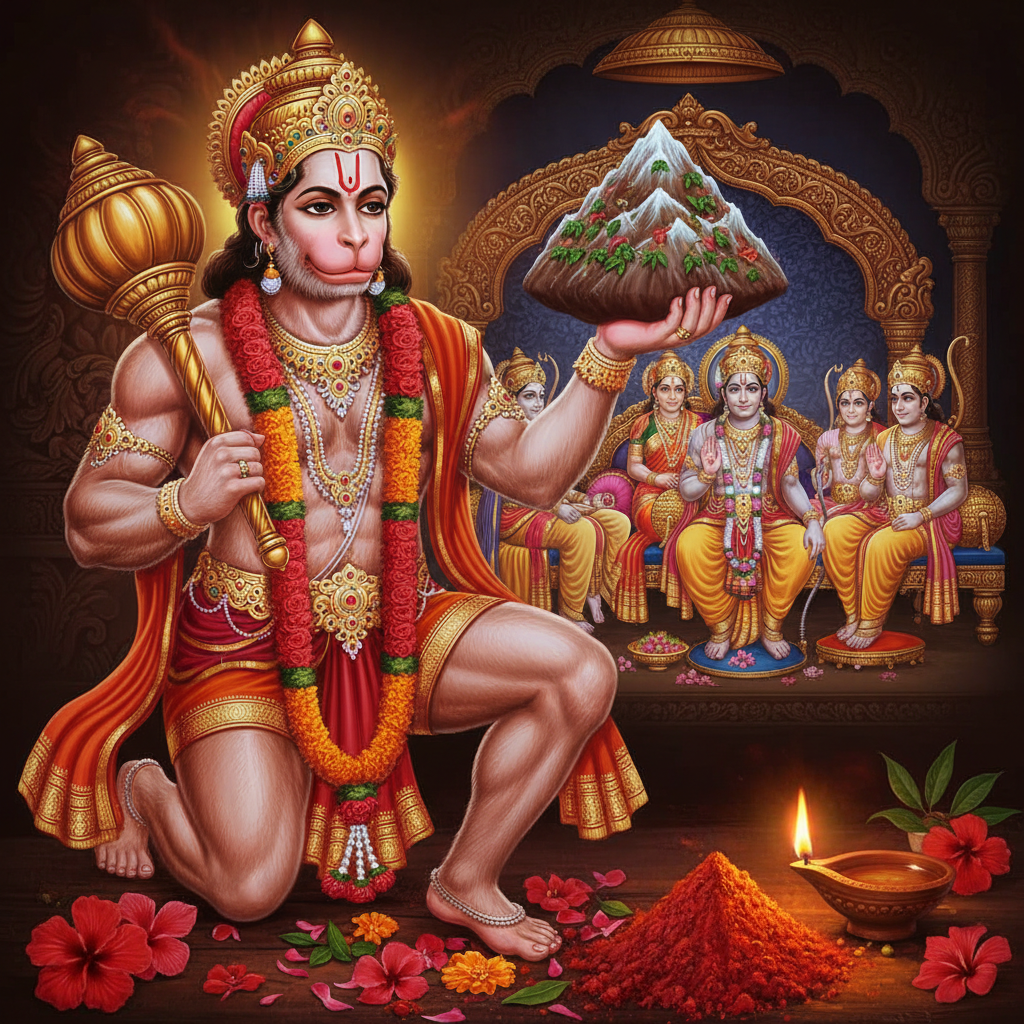
Mangalvar, Tuesday, is ruled by Mangal, Mars, and is dedicated primarily to Hanuman, whose association with strength, courage and protection fits naturally with Mars's traditional character as a planet of energy, boldness and battle. Devotees troubled by what tradition calls Mangal dosha, an unfavorable placement believed to affect certain life matters, often specifically turn to Hanuman worship on Tuesdays, seeking his protection as a remedy woven into devotional practice rather than treated as a separate predictive service. Tuesday fasting for Hanuman, involving reciting the Hanuman Chalisa and offering sindoor or til oil at his murti, is common across North Indian households in particular.
Budhvar, Wednesday, is ruled by Budh, Mercury, associated with intellect, communication and business acumen, and the day is most closely tied to Ganesha, remover of obstacles and patron of new beginnings and sound decision-making, a natural pairing with Mercury's association with sharp thinking. In parts of Maharashtra and among Vaishnav communities, Wednesday is also connected to Vithoba or Krishna in certain regional traditions, showing how the core planetary logic can carry slightly different regional deity associations while keeping the same underlying reasoning about the day's character.
Businesses and students in particular often treat Wednesday as a favorable day to begin new ventures or important study sessions, drawing on Ganesha's association with auspicious beginnings and Budh's association with clear thinking working together rather than as two unrelated ideas layered onto the same day by coincidence. Together, these two days illustrate how the week's early rhythm moves from Surya's vitality and Shiva's introspection into more outward, action-oriented energy, courage on Tuesday, clear-headed planning on Wednesday, before the week turns toward Thursday and Friday's focus on stability and abundance.
Thursday (Vishnu) and Friday (Lakshmi)

Guruvar, Thursday, is ruled by Brihaspati, Jupiter, who holds the specific title of guru, teacher, to the devas themselves in Puranic tradition, making Thursday naturally associated with wisdom, learning and guidance. The day is dedicated primarily to Vishnu, the preserver, since Brihaspati's role as a wise, stabilizing counselor to the gods pairs naturally with Vishnu's own role in maintaining cosmic order and balance. Devotees observing a Thursday fast commonly wear yellow, Brihaspati and Vishnu's associated color, and offer chana dal, turmeric or yellow sweets, avoiding salt in many household traditions as part of the day's discipline.
Shukravar, Friday, is ruled by Shukra, Venus, associated with beauty, prosperity, comfort and material wellbeing, qualities that pair directly with Lakshmi, goddess of wealth and abundance. Friday is also, in many regional and community traditions, connected to Durga or specifically to Santoshi Maa, goddess of contentment, whose sixteen-Friday vrat remains a widely observed household devotional practice, particularly in North India.
Both of these days carry a strong household and prosperity focus rather than the more protective or disciplinary character of days like Tuesday or Saturday. Many families specifically schedule griha pravesh ceremonies, new business openings, or major purchases with an eye toward these two days, drawing on the traditional association between Thursday's wisdom-linked stability and Friday's prosperity-linked abundance to frame the timing of significant household decisions, alongside broader muhurat considerations from the full panchang. Some households also keep a modest Thursday routine of donating yellow items, turmeric, or bananas to the needy, extending Brihaspati's association with wisdom into an act of generosity rather than keeping the observance limited to prayer alone.
Saturday (Shani)
Shanivar, Saturday, is ruled by Shani, Saturn, and is treated with a noticeably different tone than the other six days. Shani is associated with discipline, karma, justice and consequence, the graha traditionally understood to deliver the results of one's past actions in a strict, impartial way rather than granting favors freely. This is not viewed as malevolent within tradition, but it is viewed as demanding, which shapes how devotees approach the day.
Worship on Saturday typically centers on Shani Dev directly, with devotees offering mustard oil, black sesame seeds or iron items at Shani temples, practices believed to ease the more difficult effects associated with this graha. Many devotees also specifically worship Hanuman on Saturdays, drawing on a popular tradition holding that Hanuman's protection helps devotees navigate Shani's stricter influence, making Saturday one of the few days where two different deities receive strong, overlapping devotional attention rather than one clear primary figure.
Saturday fasting tends to be less common as a strict food-avoidance practice compared to Monday or Thursday, with many households instead focusing on temple visits, charity, and specific offerings rather than fasting itself. Feeding crows, donating black items like sesame or iron, and helping those in need are all traditionally associated with Saturday observance, framed less as personal devotion in isolation and more as karma-conscious action, a fitting emphasis for a day whose ruling graha is himself so closely tied to the consequences of one's deeds. This closes the week on a reflective note, after Sunday's vitality, Monday's introspection, Tuesday and Wednesday's action, and Thursday and Friday's focus on stability and abundance, Saturday asks devotees to pause and consider the results of the choices made across the days before it.
Why the Mapping Isn't Arbitrary
Looking at the full week together, a consistent pattern emerges: each day's deity association grew out of a genuine, traceable link between that day's graha and a specific quality, whether the sun's vitality, the moon's connection to Shiva, Mars's energy fitting Hanuman, or Saturn's discipline fitting Shani himself directly. This is not a system where deities were assigned to days by arbitrary preference, it developed over centuries as astronomical tracking and devotional practice grew up together within the same tradition.
It is worth being clear about what this system is, and isn't, meant for. It is a framework for structuring devotional practice, giving households and individuals a rhythm for weekly prayer, fasting and focus. It is not a personalized predictive tool, and this explainer has deliberately stayed with the traditional, devotional reasoning behind each pairing rather than veering into individual chart-reading or forecasting, which is a separate practice outside what this system is meant to offer here.
For most practicing Hindus, the real value of this weekly structure is practical and personal rather than theoretical. It offers a natural way to structure devotion across seven days without needing to decide fresh each morning who to pray to or why, and it connects an ordinary Tuesday or Thursday to a much larger, centuries-old rhythm simply by choosing to observe it. Nothing prevents anyone from praying to any god on any day, the mapping is an invitation to structure, not a restriction on devotion.
🪔 Vandnaa's daily reminders can nudge you toward the right day's puja or vrat automatically, so you never lose track of the week's rhythm.
What People Ask Most
Why is Monday considered Shiva's day specifically?+
Monday, Somvar, is named after Som, the moon, and Chandra the moon god is traditionally shown adorning Shiva's hair. This close iconographic link between the moon and Shiva is why the moon's day became associated with Shiva worship.
Is it necessary to worship only that day's specific god?+
No, there is no rule requiring this. The day-deity system offers a helpful, traditional structure for weekly devotion, but devotees are free to pray to any deity on any day according to personal faith and family custom.
Why is Saturday associated with Shani Dev?+
Saturday, Shanivar, is named directly after Shani, the planet Saturn, who is worshipped as Shani Dev on his own day. He is associated with discipline, karma and the consequences of past actions.
Can I do puja for any god on any day, not just their assigned day?+
Yes, absolutely. The weekly mapping is a devotional convenience and tradition, not a restriction. Daily puja to your chosen deity, or Ishta Devata, is entirely appropriate regardless of which graha rules that particular day.
Why are both Tuesday and Saturday connected to Hanuman in some traditions?+
Tuesday connects to Hanuman through Mars's association with strength and courage. Saturday's connection comes from a separate popular belief that Hanuman's protection helps devotees navigate Shani's stricter effects, giving him devotional relevance on both days for different reasons.
Where does the tradition of linking days to grahas and deities come from?+
It developed from ancient Vedic and Puranic astronomical observation of the seven classical grahas visible to the naked eye, combined over centuries with devotional tradition that associated each graha's character with a fitting deity.
About the author
Anjali Mehta · Editor, M.A. Religious Studies
Anjali is the managing editor for Vandnaa and oversees the festival and vrat coverage. She holds an M.A. in Religious Studies and reviews every published article for accuracy, accessibility, and tradition-fidelity.
Meet the Vandnaa editorial team →Explore on Vandnaa
Related Articles
The Hindu Pantheon's Family Tree: How the Major Gods Are Related
7 min read
Lunar vs Solar: How the Hindu Calendar Actually Works
7 min read

Dincharya: Structuring a Hindu Daily Spiritual Routine From Sunrise to Sleep
7 min read
Why Hindu Festival Dates Change Every Year: The Lunar Calendar Explained
7 min read