The Image of Anant Shayan
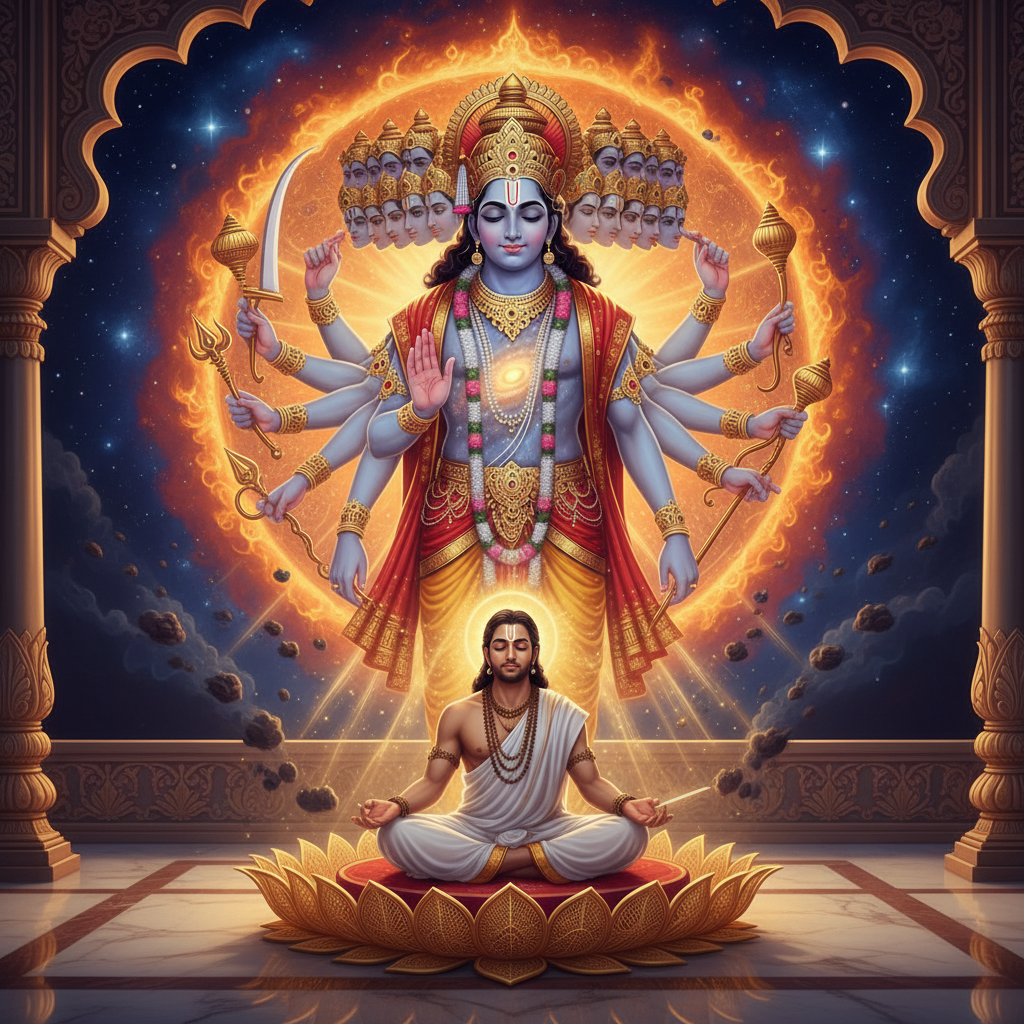
One of the most beautiful images in all of Hindu art is Lord Vishnu reclining (Shayan) on Shesha Naga - the great serpent - floating upon Kshira Sagara, the cosmic ocean of milk. Goddess Lakshmi presses his feet, the serpent's many hoods spread like a canopy over his head, and a lotus bearing Brahma rises from Vishnu's navel.
This form is called Anant Shayan or Sheshashayi Vishnu. At first it may look like the Lord is simply asleep, but every detail is a profound symbol. Far from idleness, this is the divine rest from which the whole universe is born.
Who Is Shesha Naga?
Shesha (also called Ananta, 'the endless one') is the king of serpents, depicted with a thousand hoods. His very names hold the meaning of the image:
- Shesha means 'that which remains'. When the whole universe is dissolved at the end of a cosmic age, Shesha is what is left over - the eternal remainder on which the Lord rests. He represents the timeless ground that endures beyond every creation and dissolution.
- Ananta means 'endless, infinite'. The serpent symbolises eternity and the cycles of time that have no beginning and no end, coiling endlessly.
The coiled serpent is also linked to cosmic energy and the cycles of the cosmos. That Vishnu rests upon it shows the Lord as the master of time and eternity itself, reposing on the very fabric of endless existence.
Yoga Nidra - The Rest That Is Not Sleep
Vishnu's reclining is not ordinary sleep but Yoga Nidra - a state of conscious, meditative rest. Though his eyes are closed and his body is at ease, his awareness is fully awake. He rests between cosmic cycles, holding the seed of the next creation within.
From this restful state, a lotus rises from his navel bearing Brahma, who then begins to create the world. This single detail is the heart of the image: creation arises out of stillness, not agitation. The supreme Lord does not need to strain or struggle to make the universe; it unfolds effortlessly from his calm.
The deepest teaching here is for us. It shows that the highest power lies in deep, peaceful awareness - and that true action flows best from a still and centred mind, not from restlessness.
Calm Amid Chaos - The Deeper Meaning
Look again at the whole picture and its message becomes clear. The Lord lies utterly serene on the soft coils of an endless serpent, in the middle of a vast ocean. There is no fear of the deep waters, no disturbance from the serpent that elsewhere might frighten. This is the supreme image of perfect peace at the centre of infinity.
For the devotee, the lessons are many:
- The serpent's hood as protection: Shesha's many hoods shelter the Lord like a canopy, showing the divine ever-protected and at home within eternity.
- Lakshmi at his feet: Even abundance and fortune serve the calm, centred Lord, reminding us that prosperity follows inner peace, not the reverse.
- Stillness as strength: The mightiest preserver of the universe is shown not battling but resting - teaching that quiet, conscious calm is the source of all real power.
When we meditate on Sheshashayi Vishnu, we are invited to find that same still centre within ourselves - to rest in awareness, remain calm amid life's churning ocean, and let our actions flow from peace rather than panic.
What People Ask Most
Why does Vishnu recline on Shesha Naga?+
Vishnu reclines on Shesha Naga to show his mastery over time and eternity. Shesha means 'that which remains' after every cosmic dissolution, and Ananta means 'endless'. Resting on the serpent shows the Lord at perfect peace on the eternal, timeless ground of existence, between cycles of creation.
What is Yoga Nidra in the context of Vishnu's sleep?+
Yoga Nidra is conscious, meditative rest - not ordinary sleep. Though Vishnu's eyes are closed, his awareness is fully awake. From this state of restful awareness, creation unfolds effortlessly, teaching that true power flows from a still, centred mind rather than from agitation.
What is Kshira Sagara, the ocean Vishnu floats on?+
Kshira Sagara is the cosmic ocean of milk on which Vishnu reclines. It represents the vast, formless potential of existence. The Lord resting calmly upon it, with Lakshmi at his feet, is the supreme image of perfect peace at the centre of infinity.
Why does a lotus with Brahma rise from Vishnu's navel?+
From Vishnu's navel rises a lotus bearing Brahma, the creator, who then begins to fashion the world. This shows that creation arises out of stillness - the universe unfolds effortlessly from Vishnu's calm, meditative rest rather than from struggle or agitation.
About the author
Dr. Suresh Iyer · Vastu Shastra & Jyotish, 18+ years
Dr. Suresh has practiced traditional Vastu and basic Vedic Jyotish for over 18 years across South India. He contributes the Vastu, direction, and home-puja layout guides on Vandnaa.
Meet the Vandnaa editorial team →