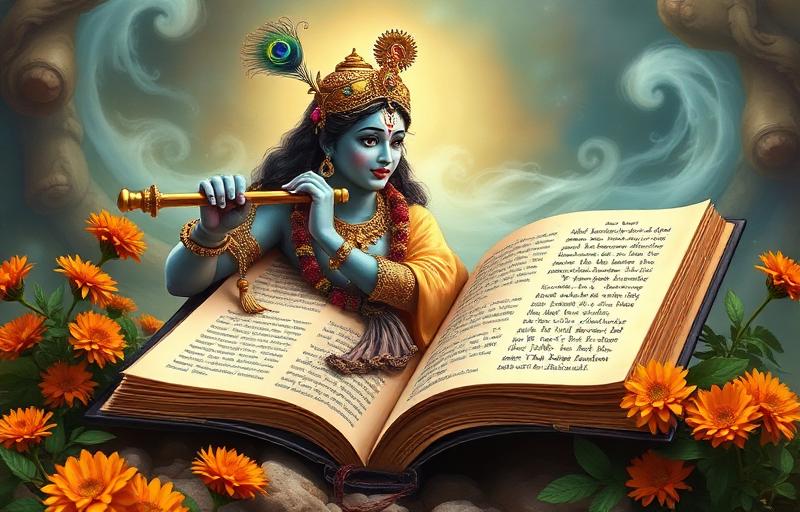
The First of Kunti's Five Invocations
After Pandu was cursed by the sage Kindama and told he could never father a child without dying from the act, Kunti revealed to him the mantra Durvasa had given her years earlier, capable of summoning any god to grant her a child by him. Pandu, in consultation with her, chose the order and the deities carefully, wanting sons who could restore and defend the Kuru line he could not otherwise continue.
For the first child, the choice was Dharma, sometimes identified in this specific role with Yama in his aspect as the god who personally embodies righteous conduct and moral law rather than only death and judgment. The Mahabharata is explicit that this was a deliberate first choice, meant to secure for the eldest Pandava, the one who would eventually claim the throne, a nature incapable of the kind of deception and cruelty that had already begun corrupting Hastinapura's politics through Dhritarashtra's sons.
Yudhishthira was raised with the epithet Dharmaraja built into how the text refers to him almost from birth, and unlike his brothers, whose defining traits (strength, archery, beauty, horsemanship) are demonstrated through action, his is treated as a matter of settled fact from the moment of his conception.
Where the Guarantee Was Actually Tested
The text does not let Yudhishthira's parentage function as an easy shield against real moral difficulty. His two hardest tests are placed at the exact points where the reader would expect Dharma's son to be flawless, and in both the epic shows him falling short in a specific, deliberate way, rather than sailing through untouched.
At the dice game, it is specifically Yudhishthira, son of Dharma, who is manipulated into staking his brothers, himself, and finally Draupadi, a catastrophic failure of judgment that the text does not excuse on the grounds of his birth. And at Kurukshetra, in the episode covered elsewhere in this series concerning Drona's death, it is Yudhishthira, again, who speaks the half-truth about Ashwatthama's death that breaks Drona's will to fight, the single documented lie of a man otherwise defined by truthfulness.
Both incidents matter more, not less, because of who his father is. They are read by most commentators not as contradictions of his nature but as the text's way of insisting that dharma itself is not a simple, static rulebook applied automatically. Even the son of Dharma has to work out, under real pressure, what righteous action actually requires in a given moment, and sometimes gets it wrong or bends it, which is closer to what dharma means in the epic's own usage than a guarantee of moral perfection would have been.
The Test at the Very End
The clearest confirmation the text offers of Yudhishthira's parentage comes only at the close of the epic, in the Mahaprasthanika and Svargarohana Parvas, when he alone among the Pandavas reaches the gates of heaven still accompanied by a dog that had followed him faithfully through their final journey. Asked to abandon the dog to enter heaven, Yudhishthira refuses outright, saying he will not abandon a devoted companion for his own comfort even at the threshold of paradise.
The dog then reveals itself to be Dharma, his own father, who had taken this final form specifically to test whether his son's righteousness was genuine when there was no longer any earthly reward left to gain from it, no kingdom, no reputation, nothing but the choice itself. Only after Yudhishthira passes this last, unwitnessed test does the text treat his identity as Dharma's son as something fully and finally proven, closing the frame it opened at his birth.
What People Ask Most
Is Dharma the same as Yama in this context?+
The texts often use Dharma and Yama interchangeably for Yudhishthira's father, since Yama is understood as the deity who personally embodies and enforces dharma, righteous law, alongside his more familiar role as god of death.
Why is the dog episode considered so important?+
It is one of the Mahabharata's most cited moments of moral testing because it removes every possible worldly incentive, showing whether Yudhishthira's ethics were performed for reward or genuinely held.
Did Yudhishthira feel guilty about the dice game his whole life?+
The text repeatedly shows him referencing it as his own greatest failure, including during the war and afterward, treating it as the clearest exception to the righteousness his birth was meant to guarantee.
About the author
Anjali Mehta · Editor, M.A. Religious Studies
Anjali is the managing editor for Vandnaa and oversees the festival and vrat coverage. She holds an M.A. in Religious Studies and reviews every published article for accuracy, accessibility, and tradition-fidelity.
Meet the Vandnaa editorial team →