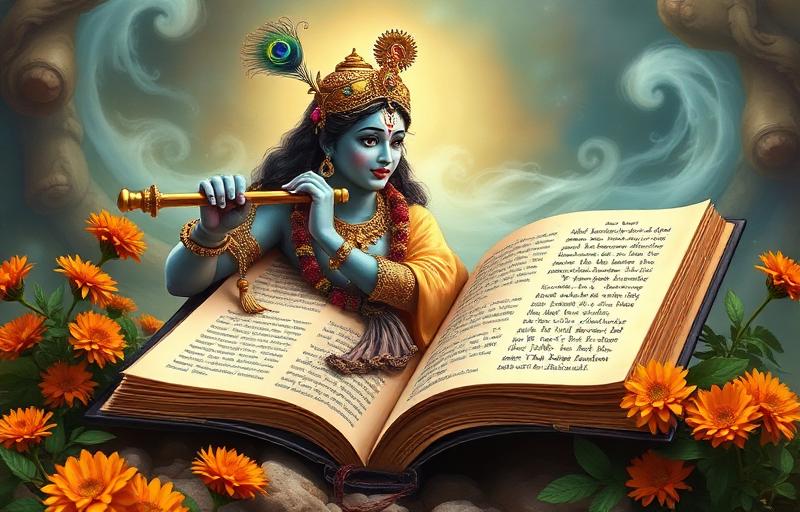
यात्री ऋषियों के बीच एक दासी का पुत्र
The Bhagavata Purana has Narada himself narrate his own earlier birth to Vyasa, which is a striking choice for a text to make: the great wandering sage of a hundred other stories in this series pausing to explain that he was not always what he became, and that nothing about his own origin was remarkable.
In that earlier birth, Narada says, he was the son of a maidservant working for a group of learned brahmins during the four months of the rainy season retreat, Chaturmasya, when wandering sages traditionally stopped travelling and settled in one place.
He had no father to speak of in the account, no lineage worth naming, no formal education arranged for him. He was simply a boy of about five, present in the household because his mother was, doing whatever small service a child could do for the guests: fetching, cleaning, waiting.
The sages who had gathered there were, by his own description, devoted entirely to discussing Krishna's stories, chanting his glories, singing and describing his deeds through the length of every evening, with nothing else on their agenda for the whole four months.
Narada, still a child, was permitted to sit and listen, and occasionally to eat the remnants of food left over from what the sages themselves had eaten, which in this tradition is treated as no small thing: prasad, blessed leftovers, carrying something of the sanctity of those who ate first.
चार माह के श्रवण ने क्या किया
The boy's own account is specific about what changed in him: not sudden enlightenment, but a gradually accumulating taste for what he was hearing, until the stories of Krishna became more real and more compelling to him than anything in his own small life.
When the four months ended and the sages prepared to resume their wandering, they blessed the boy before leaving, transmitting to him some of what he had absorbed by simply being present, though the text is careful that his own longing did the greater part of the work.
Soon after, his mother died, bitten by a snake while doing her ordinary work. Narada reads this, in his own retelling, not as tragedy so much as release: with no mother left to care for, and having already tasted something he could not unlearn, he set out alone into the world to look for Krishna directly, rather than staying to build a household of his own the way his birth would ordinarily have obliged him to.
He wandered, meditated, and eventually is said to have had a vision of Krishna that vanished as quickly as it came, leaving him with a longing that never again fully resolved, which the text presents as the emotional engine behind everything Narada does in every later story: he is chasing something he was shown once and has not stopped looking for since.
परंपरा इसे इस प्रकार क्यों कहती है
The deliberate detail in this account is the absence of any advantage. Narada in this birth has no caste privilege of any weight, no education arranged for him, no family connection to sages beyond his mother's employment. What he has is proximity, four months of it, and a willingness to actually listen rather than merely be present.
This is the story the Bhagavata tradition tells whenever it wants to make its most democratic claim about bhakti: that satsang, the simple company of those absorbed in devotion, can do for an ordinary child in one season what birth and scripture and formal training cannot guarantee for anyone.
It is also, structurally, the origin point for the sage who later curses Daksha's sons for choosing renunciation over marriage, teaches the Sanaka Kumaras' own students, and appears at the edge of nearly every major story in this corpus as a kind of divine correspondent, moving information, provoking events, occasionally causing real damage through good intentions badly aimed.
A reader who has met that older, more mischievous Narada elsewhere in this series now has the version of him that came first: a servant's son who listened for four months and never really stopped.
भक्तों के सामान्य प्रश्न
क्या नारद सदा से महान ऋषि थे, या बने?+
भागवत पुराण में नारद के अपने वर्णन के अनुसार, एक पूर्व जन्म में वे एक साधारण दासी पुत्र थे, जो वर्षा ऋतु के चातुर्मास में ऋषियों से कृष्ण कथा सुनकर बदल गए।
What is Chaturmasya?+
The four-month rainy season period during which wandering sages and ascetics traditionally halted their travels and settled in one place, often devoting the time to continuous scriptural discussion and devotional practice.
यह कथा भक्ति के विषय में क्या सिखाती है?+
कि सत्संग द्वारा भक्ति जन्म, जाति अथवा औपचारिक शिक्षा से परे सबके लिए सुलभ है - बिना किसी सुविधा वाला बालक केवल निकटता और सच्चे श्रवण से बदल गया।
About the author
Pandit Ravindra Sharma · Vedic Rituals & Bhakti, 22+ years
Pandit Ravindra is the Vandnaa editorial team's resident specialist on aarti, chalisa, and daily devotion. He has performed home and temple pujas across Varanasi and Delhi for over two decades and contributes the bhakti-focused articles on this site.
Meet the Vandnaa editorial team →