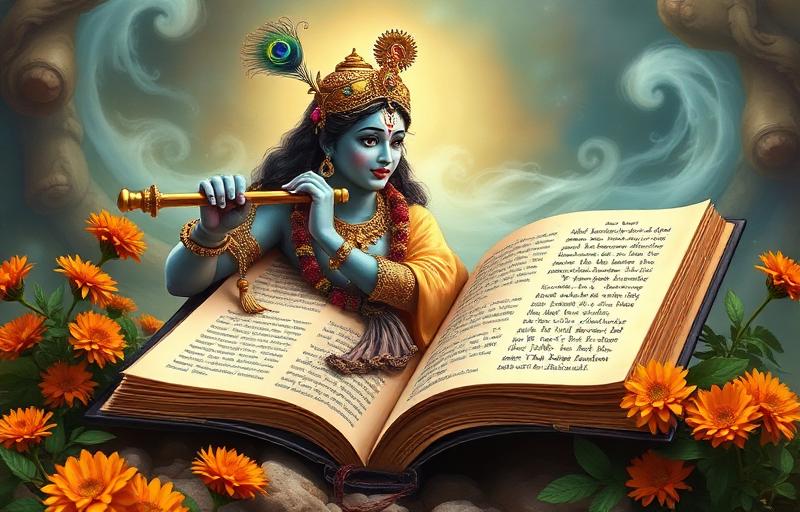
जगत बसाने को जन्मे, और मना करते
Sanaka, Sanandana, Sanatana and Sanatkumara are named across different Puranas as the first sons Brahma produced from his own mind, before any of the better-known Prajapatis, when creation was still short of hands to carry it forward.
Brahma's instruction to them was the same instruction given to every mind-born son afterward: go, marry, have children, fill the worlds.
They refused. Each of the four had, in the course of being born already possessed of full knowledge, taken one look at the world Brahma wanted populated and chosen renunciation instead, remaining perpetually five years old, uninterested in either growing older or fathering the next generation.
Brahma is said to have been furious, and that fury itself became a fifth being, Rudra in one telling, though the texts vary on exactly what emerged and how it relates to Shiva's own presence elsewhere in the same cosmology.
The four boys, meanwhile, simply left. They spent the rest of their existence wandering the worlds as eternal children, teaching Vedanta to whoever could keep up, appearing in the Bhagavata Purana as the ones who instruct King Nimi's descendants and, in the Puranas' most quoted appearance, as the ones who instruct Narada himself on devotion, tying this story directly to Narada's own biography.
Their refusal is not treated by the tradition as disobedience in the ordinary sense. It is treated as the earliest example in Puranic literature of renunciation outranking a direct paternal command, which is a genuinely unusual thing for a creation narrative to sanction, and it sets a pattern the later ascetic tradition returns to constantly: that a parent's authority, even a divine parent's, does not extend into a child's right to renounce.
वैकुंठ का द्वार
Their most consequential single appearance comes centuries later, in the Bhagavata Purana, when the four Kumaras, wandering as they always do, arrive at the gates of Vishnu's own realm, Vaikuntha, wanting entry.
Two gatekeepers, Jaya and Vijaya, stop them. The Kumaras look like children, and the guards, going by appearance rather than by who was actually standing in front of them, refuse to let four five-year-olds past the gate to see the Lord.
The Kumaras, unused to being refused anything by anyone who understood what they were, cursed the two gatekeepers on the spot: to fall from Vaikuntha and be born as mortals, opposed to Vishnu rather than serving him.
Vishnu himself is said to have appeared and offered the two guards a choice, softening nothing about the curse itself but letting them pick its shape: seven lifetimes as ordinary devotees, or three lifetimes as Vishnu's declared enemies, each time to be killed by Vishnu's own avatar and thereby released early.
Jaya and Vijaya chose the shorter, harder path. Their three demon lifetimes are, in the tradition's own accounting, Hiranyaksha and Hiranyakashipu, Ravana and Kumbhakarna, and Shishupala and Dantavakra, which means three of the most consequential Vishnu avatar stories in the entire corpus exist because two doorkeepers once misjudged four children.
आज भी लिए जाते चार नाम
The Kumaras are counted among the twelve Mahajanas, the great teachers whose word on dharma the tradition treats as authoritative on its own, alongside figures like Narada, Prahlada and Bhishma.
Sanatkumara in particular gives his name to entire later schools of thought, and passages attributed to his teaching appear in Upanishadic material discussing the movement from lesser to greater forms of knowledge, quite apart from his role in this narrative.
A reader who has already met Jaya and Vijaya's three-lifetime curse elsewhere in this series now has its actual origin, and a reader who has met Prahlada's grandson Bali, or Ravana, or Shishupala, can trace each of those stories back to one refused entry at one gate.
The four Kumaras themselves never appear again with anything like this narrative weight. They simply go on wandering, unaged, teaching whoever will sit still long enough to listen, which the tradition seems to regard as its own kind of ending: not a story that resolves, but one that keeps walking.
लोग सबसे ज़्यादा क्या पूछते हैं
सनक कुमार कौन हैं?+
सनक, सनंदन, सनातन और सनत्कुमार, ब्रह्मा के मन से उत्पन्न पहले चार पुत्र। उन्होंने संतान उत्पन्न करने के आदेश को मना किया और सदा के लिए पांच वर्ष के त्यागी बने रहे।
How does this story connect to Jaya and Vijaya?+
The Kumaras were once refused entry to Vaikuntha by the gatekeepers Jaya and Vijaya, who judged them by their child-like appearance. Their curse on the two guards is the origin of Jaya and Vijaya's three demon lifetimes, including Ravana and Hiranyakashipu.
क्या आज कुमारों की पूजा होती है?+
उनकी पूजा मंदिरों में देवता के रूप में कम, गुरु के रूप में अधिक होती है। वे बारह महाजनों में गिने जाते हैं जिनका धर्म पर वचन परंपरा में निर्णायक माना जाता है।
About the author
Anjali Mehta · Editor, M.A. Religious Studies
Anjali is the managing editor for Vandnaa and oversees the festival and vrat coverage. She holds an M.A. in Religious Studies and reviews every published article for accuracy, accessibility, and tradition-fidelity.
Meet the Vandnaa editorial team →